The Year of Hyperfocus: 2025, A Writing Year in Review
It’s the end of the year, that time when I do writing math!!! And, you know, reflect on what I did as a writer over the course of the year. I may have published a book and guest edited a literary journal, but we’ll get to that in a minute.
This year I spent:
949 hours writing
That’s not bad. Not bad at all. In fact, it’s the second-most hours I have ever put into writing over the course of a year.
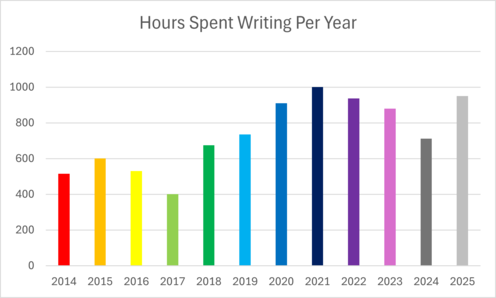
Here’s my time spent writing per year (since I started tabulating hours in 2014).
Click here to add your own text
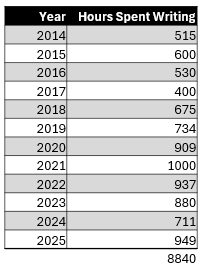
And for those of you who prefer hard numbers over visual approximates:
If you look at the colorful chart above, my hours spent writing per year definitely appears as a wave. And as I skim through my previous Year in Review posts, I can’t help but noting that I have had a lot of writing ups and downs. 2023 was definitely a low point, as was the first half of 2024. In 2017, the image I selected for the year was firefighters putting out a car fire. Contrast that with 2020, when I got a three-book deal, 2021, when my first novel was released, and 2022, when I was one of five nominees for the Mary Higgins Clark Award.
There’s something about being able to look back on over a decade of my career that puts it in perspective. And when I have those days or weeks or months where I wonder why I’m doing this, or if I should keep doing this, I can see the bigger picture.
Lows will be followed by highs.
2023 and 2024 were rather low (that’s an understatement, friends), but they were followed by this year’s high, my new nonfiction book:
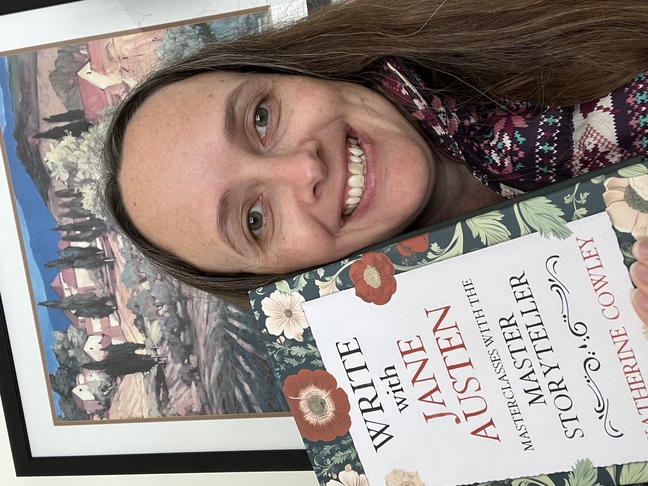
This book happened because I had a goal: to release a book about Jane Austen’s writing before Jane Austen’s 250th birthday. And I made it. But mostly because of the hyperfocus on the project.
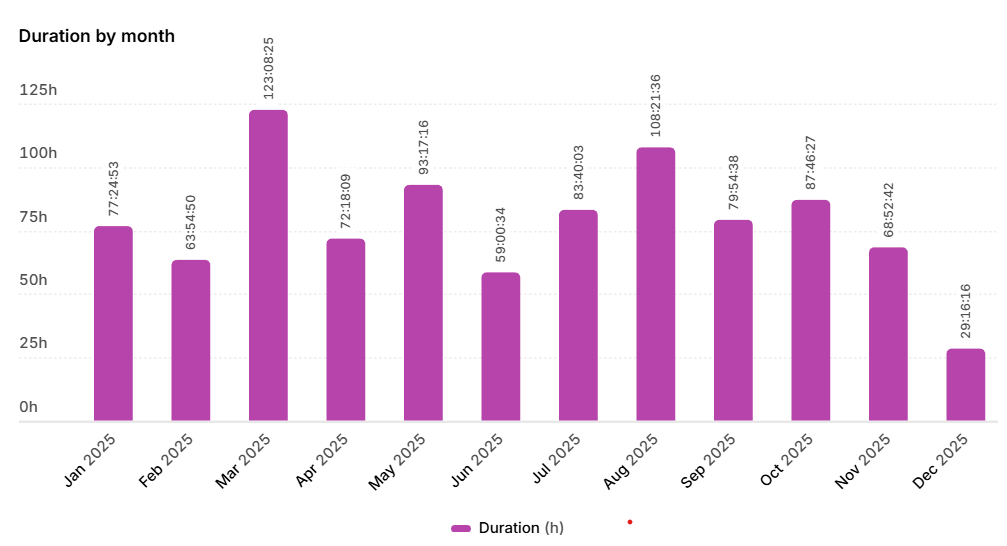
Here’s how many hours I spent on writing per month:
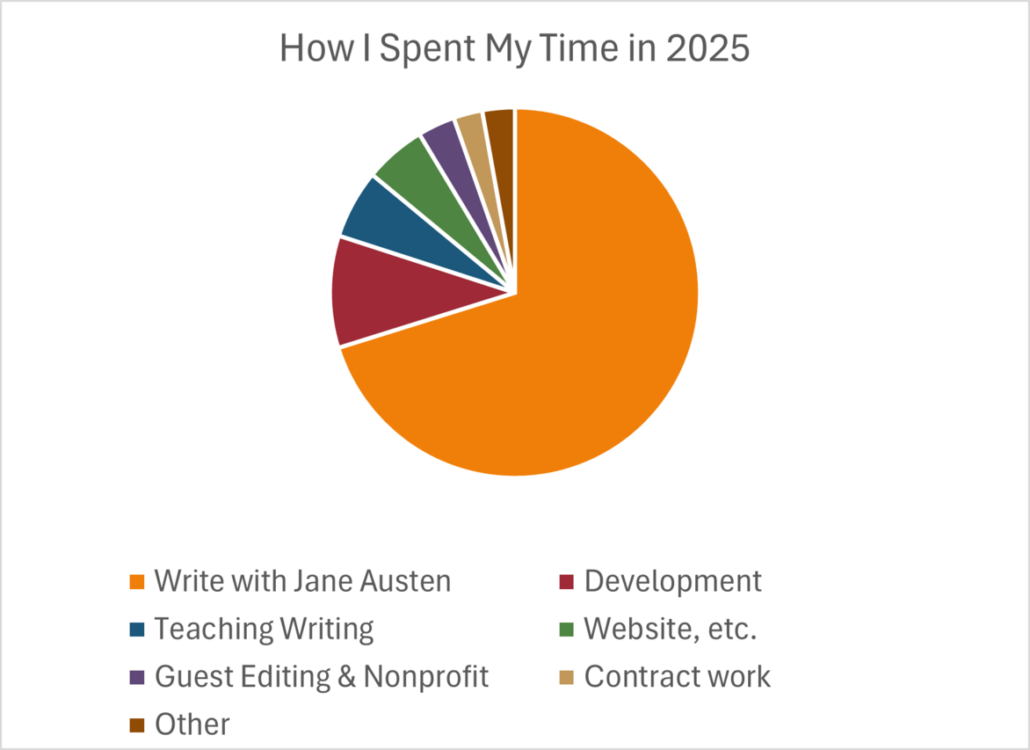
And you can see how much of that time was spent on Write with Jane Austen:
And a bar graph, which in some ways emphasizes it even more:
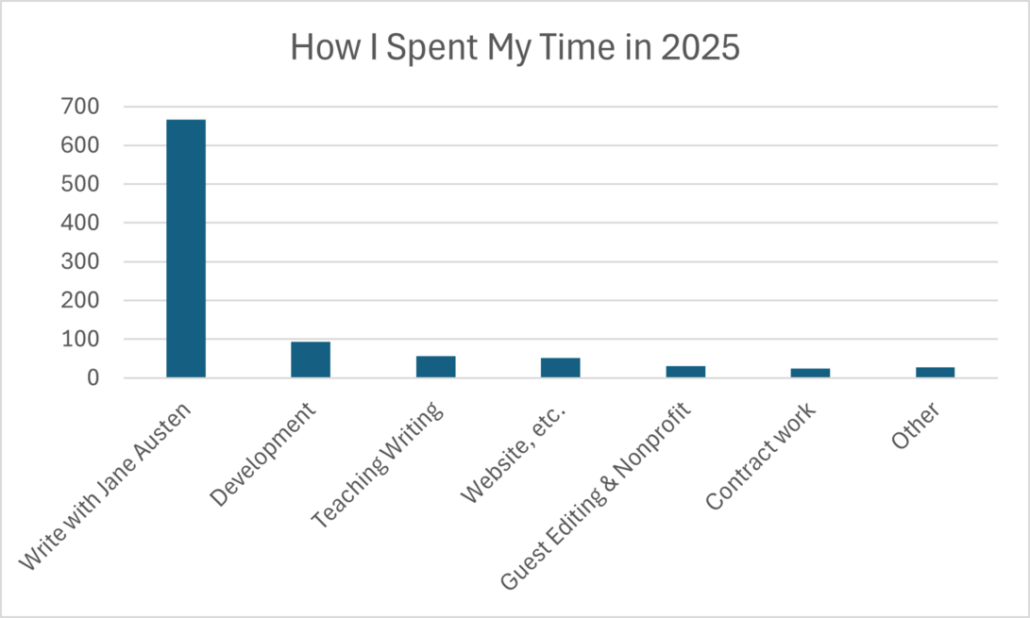
I spent 70% of my writing time on Write with Jane Austen. I have never, in the 12 years that I’ve been tracking, spent nearly that high a percentage on a single project.
665.83 hours.
Other things I did this year:
- “Development.” That’s my catch-all category that includes critiquing writing, writing group, reading books about writing craft, and networking.
- I taught writing classes. I taught several Lifelong Learning Classes at Kellogg Community college, and I taught at a writing conference.
- Contract work: this year it was doing a touch of work helping my friend Jeanna run a Kickstarter for her book Unsightly
- I guest edited a special mystery issue of the literary journal Irreantum. This was both challenging and delightful.
Because I my hyperfocus, I spent only a handful of hours working on short stories, most of which I did not complete. (An hour and a half on a short story is more of a brainstorm than a writing session…). I spent a handful of hours on novels—six, to be precise. In essence, I did no other projects.
But I met my goal.
Write with Jane Austen is my first (and perhaps my only?) nonfiction project, and it was my first project that I launched through Kickstarter, so the process looked rather different than for my Mary Bennet novels.
Here’s an infographic about the writing of Write with Jane Austen, which occurred over the course of six years, from 2020 to 2025:

The 831 hours spent on the writing itself is definitely longer than the time it took to write each individual Mary Bennet novel (The Secret Life of Miss Mary Bennet took 612.5). But I am immensely pleased with Write with Jane Austen and don’t regret working on it. (Though if I had realized it would take 1168 hours total, I probably would have shied away from the project.)
So that is 2025 in charts galore. I still haven’t fully decided what my 2026 will look like, but I do want to spread myself across more projects rather than focusing on a single one.
***
A few additional notes:
-People always ask, so a few years ago I wrote about how I track my writing time. Read all about it there!
-For those who would like to get their own copy of Write with Jane Austen, on Amazon US, you can get the paperback and hardcover, or the ebook. It’s also available through Barnes and Noble, Bookshop.org, Kobo, Smashwords, Waterstones (in the UK), various Amazon websites throughout the world, etc. Your indie bookstore or your library should be able to get ahold of a copy if you request it.

Leave a Reply
Want to join the discussion?Feel free to contribute!