Jane Austen’s 250th Birthday and How Austen Wrote Birthday and Holiday Greetings
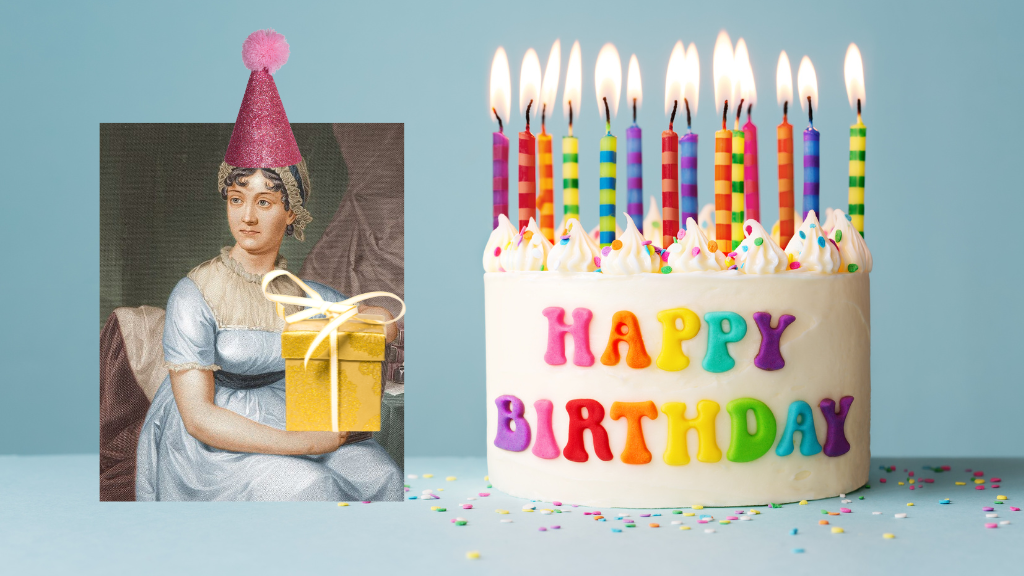
December 16, 2025 is Jane Austen’s 250th birthday, and so to celebrate, here’s a post with:
- How Austen wrote birthday and holiday greetings
- The letter I wrote to her for her birthday (and the book I wrote for her…probably shouldn’t forget that)
How Jane Austen Wrote Birthday and Holiday Greetings
Jane Austen spent much of her life with her sister and dear friend, Cassandra. However, the times that they were apart are a blessing to us, because from them we have many of Austen’s surviving letters.
In 1799, the day before Cassandra’s birthday, Jane wrote Cassandra a letter which she ended with the following:
I wish you joy of your birthday twenty times over. I shall be able to send this to the post to-day, which exalts me to the utmost pinnacle of human felicity, and makes me bask in the sunshine of prosperity or gives me any other sensation of pleasure in studied language which you may prefer. Do not be angry with me for not filling my sheet, and believe me yours affectionately,
Miss Austen
Not only does Jane wish her sister a twenty-times dose of birthday joy, but she rejoices–nay, feels exalted–because she can send such a letter, and send it immediately.
I don’t think Jane Austen would have liked many of today’s birthday cards, with pre-written sentimental phrases. Even in a letter with birthday greetings, in which there are certain conventions and well-wishes are expected, she must give them in a creative way.
Here, she uses hyperbole, exaggerating her emotions to the extreme. This does not mean she doesn’t feel positively towards her sister–she does feel happy for her sister’s birthday, and wants to express it–but she does so playfully, and probably wants to make her sister laugh. (Jane’s letters, and biographies about her, show that her family loved sharing humor with each other.)
I also like the admission: “or gives me any other sensation of pleasure in studied language which you may prefer.” If Cassandra would not express the joy of sending a birthday letter in the same manner, she is welcome to choose her own studied language. Whatever rhetorical devices or literary flourishes or elegant metaphors–Jane gives them all to Cassandra. I find Jane’s statement reminiscent of Mr. Collins, with the difference being that Austen uses irony and takes delight in recognizing the subtle absurdity of her own statement.
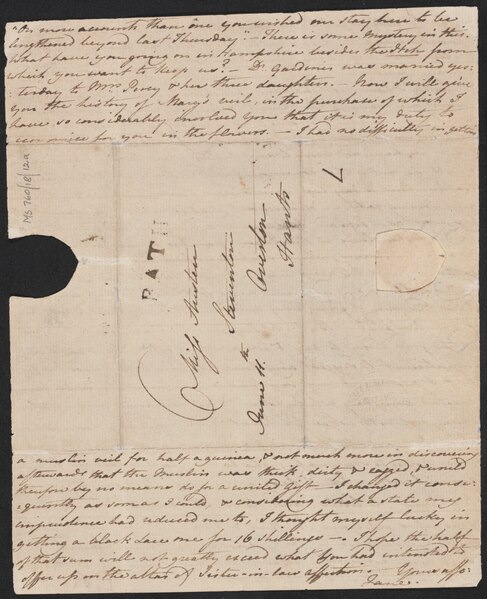
A letter from Jane Austen to Cassandra Austen. This is not any of the letters referenced in this blog post, however, it is a very visually appealing letter, so I have decided to include it. Image via National Library of Australia, Public domain, via Wikimedia Commons
And what about holiday greetings? How did Jane write this standard form?
In one letter to Cassandra, she writes:
I am glad you are to have Henry with you again; with him and the boys you cannot but have a cheerful, and at times even a merry, Christmas.
I love the honesty. “At times even…merry.” She doesn’t treat holidays like they need to be perfect.
In another letter written during the holiday season, Austen writes to Cassandra:
I am sorry my mother has been suffering, and am afraid this exquisite weather is too good to agree with her. I enjoy it all over me, from top to toe, from right to left, longitudinally, perpendicularly, diagonally; and I cannot but selfishly hope we are to have it last till Christmas,—nice, unwholesome, unseasonable, relaxing, close, muggy weather.
I could write an essay on this paragraph. (Fortunately, I’ve decided to spare you.) But I love the humor, I love how Jane finds joys in unexpected (and sometimes unwanted) occurrences of the season. And I love how she mixes her positive and negative adjectives (nice, unwholesome, unseasonable, relaxing, close, muggy) in a way that both offers insight and provides humor.
But how do we apply this?
I am so glad you asked.
If you want to write like Jane Austen, the next time you send a birthday or holiday greeting, don’t use a pre-written greeting card and definitely don’t use AI (Austen refused to use the average or standard way of saying something, after all). Instead, express your joy and love but be playful or humorous or absurd (or perhaps be all three–playful and humorous and absurd). Make light of adverse circumstances, be realistic, and don’t be afraid to play with expectations.
My Offering For Jane Austen’s Birthday (A Book, and a Birthday Letter!)
Those of you who backed the project on Kickstarter already know this, but I must declare it to the world! I officially met my goal for the year, which was to publish my new book before Jane Austen’s birthday.
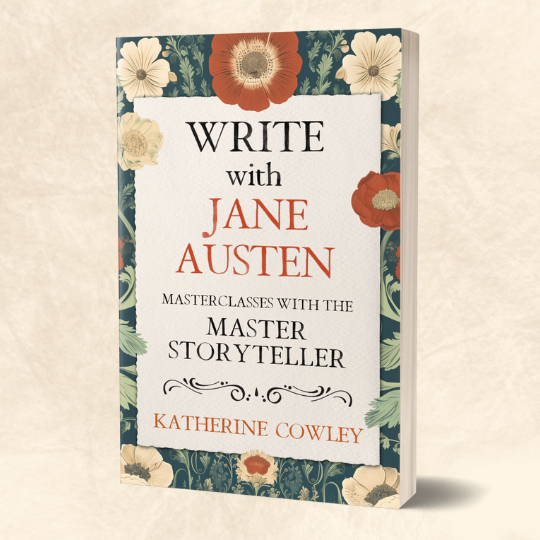
Write with Jane Austen: Masterclasses with the Master Storyteller is an in-depth look at all we can learn about writing from Jane Austen’s novels. Jane Austen is a master at all elements of storytelling, and I had years of delight writing about how we can apply her techniques to our writing, no matter what genre we write.
(Did you know that 200 years before Blake Snyder coined the term “save the cat,” Austen was already recommending that writers do just that? Did you know that Austen takes a cinematic approach to describing setting? Did you know that even within a point of view, Austen did not see it as fixed? There’s so much we can learn from writing from Austen.)
Write with Jane Austen is now available in print and ebook through all major retailers, and if you order now, you should be able to get a copy for yourself or a friend before the holidays. On Amazon US, you can get the paperback and hardcover, or the ebook. It’s also available through Barnes and Noble, Bookshop.org, Kobo, Smashwords, Waterstones (in the UK), various Amazon websites throughout the world, etc. Your indie bookstore or your library should be able to get ahold of a copy if you request it.
I can’t actually send this, but also I wrote a letter to Jane Austen for her birthday, in which I attempt to use some of her epistolary approaches to humor and irony, as well as apologize for my literary transgressions.
Dear Jane,
On this, your 250th birthday, I am not ungrateful to you.
For how could I be ungrateful, when you have ignored birthday conventions and instead of opening your own presents, you have gifted me a present–and a glorious one. Six incredible novels, that have spawned endless adaptations that hopefully you would find delightful and joyous, though it’s possible you would find some of them utterly horrifying. (You should probably catch up on 20th-century zombie stories before you indulge in Pride and Prejudice and Zombies. If you find it horrifying, it is in the horror genre, so it’s an appropriate response.)
Unfortunately, I have contributed to the madness by not only writing three novels about Mary Bennet but also writing a book about your writing. I know that in your time, you had to receive permission from someone in order to dedicate a work to them. While you dedicated your unpublished teenage works to family members in playful ways, you didn’t dedicate any of your published novels, except for Emma, and you probably did that a bit begrudgingly. (I would love to hear the full story someday on the time you were invited to the Prince Regent’s library, and then his librarian semi-forced you to dedicate a book to the prince. We’re pretty sure you wrote a letter about your library trip, and we’re also pretty sure Cassandra destroyed it. What evidence of your true thoughts was she trying to hide?)
Excuse the tangent. I lose focus, in part because I fear your disapproval. The news is this: I wrote a book about you for your birthday, and I dedicated it to you. I asked no permission, but I do ask forgiveness. May there be only rare pages in the book where you say, “That is not what I meant. That is not what I meant at all.”
You may take all the compliments to you in the book. Just know that more compliments are owed than I could manage to express in a few hundred pages.
Best regards, and any happiness that can be had on your 250th birthday.
Yours affectionally,
Katherine CowleyP.S. Please do not skewer me too harshly in your letters to Cassandra.
I would like to say that writing a book and even a letter is not too shabby of a celebration for my favorite author.
Wishing you all the best, as you celebrate Austen, birthdays, and/or holidays.