Posts

Jane Austen celebrating her birthday. Austen wears a birthday hat, holds a birthday present, and sits next to a birthday cake covered with candles.

Jane Austen’s 250th Birthday and How Austen Wrote Birthday and Holiday Greetings

Jane Austen celebrating her birthday. Austen wears a birthday hat, holds a birthday present, and sits next to a birthday cake covered with candles.

December 16, 2025 is Jane Austen’s 250th birthday, and so to celebrate, here’s a post with:

  • How Austen wrote birthday and holiday greetings
  • The letter I wrote to her for her birthday (and the book I wrote for her…probably shouldn’t forget that)

How Jane Austen Wrote Birthday and Holiday Greetings

Jane Austen spent much of her life with her sister and dear friend, Cassandra. However, the times that they were apart are a blessing to us, because from them we have many of Austen’s surviving letters.

In 1799, the day before Cassandra’s birthday, Jane wrote Cassandra a letter which she ended with the following:

I wish you joy of your birthday twenty times over. I shall be able to send this to the post to-day, which exalts me to the utmost pinnacle of human felicity, and makes me bask in the sunshine of prosperity or gives me any other sensation of pleasure in studied language which you may prefer. Do not be angry with me for not filling my sheet, and believe me yours affectionately,
Miss Austen

Not only does Jane wish her sister a twenty-times dose of birthday joy, but she rejoices–nay, feels exalted–because she can send such a letter, and send it immediately.

I don’t think Jane Austen would have liked many of today’s birthday cards, with pre-written sentimental phrases. Even in a letter with birthday greetings, in which there are certain conventions and well-wishes are expected, she must give them in a creative way.

Here, she uses hyperbole, exaggerating her emotions to the extreme. This does not mean she doesn’t feel positively towards her sister–she does feel happy for her sister’s birthday, and wants to express it–but she does so playfully, and probably wants to make her sister laugh. (Jane’s letters, and biographies  about her, show that her family loved sharing humor with each other.)

I also like the admission: “or gives me any other sensation of pleasure in studied language which you may prefer.” If Cassandra would not express the joy of sending a birthday letter in the same manner, she is welcome to choose her own studied language. Whatever rhetorical devices or literary flourishes or elegant metaphors–Jane gives them all to Cassandra. I find Jane’s statement reminiscent of Mr. Collins, with the difference being that Austen uses irony and takes delight in recognizing the subtle absurdity of her own statement.
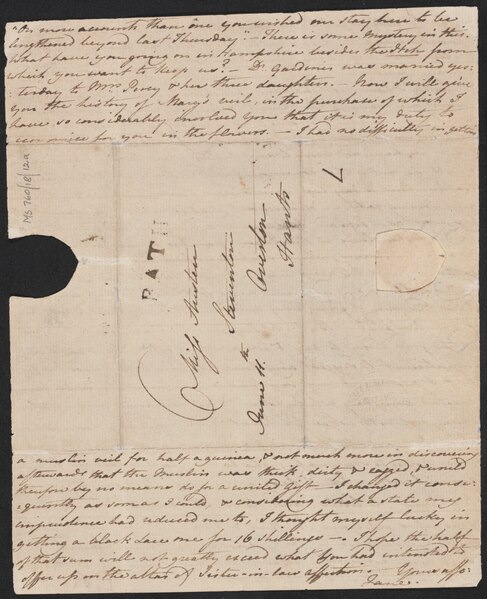
A letter from Jane Austen to Cassandra Austen

A letter from Jane Austen to Cassandra Austen. This is not any of the letters referenced in this blog post, however, it is a very visually appealing letter, so I have decided to include it. Image via National Library of Australia, Public domain, via Wikimedia Commons

And what about holiday greetings? How did Jane write this standard form?

In one letter to Cassandra, she writes:

I am glad you are to have Henry with you again; with him and the boys you cannot but have a cheerful, and at times even a merry, Christmas. 

I love the honesty. “At times even…merry.” She doesn’t treat holidays like they need to be perfect.

In another letter written during the holiday season, Austen writes to Cassandra:

I am sorry my mother has been suffering, and am afraid this exquisite weather is too good to agree with her. I enjoy it all over me, from top to toe, from right to left, longitudinally, perpendicularly, diagonally; and I cannot but selfishly hope we are to have it last till Christmas,—nice, unwholesome, unseasonable, relaxing, close, muggy weather.

I could write an essay on this paragraph. (Fortunately, I’ve decided to spare you.) But I love the humor, I love how Jane finds joys in unexpected (and sometimes unwanted) occurrences of the season. And I love how she mixes her positive and negative adjectives (nice, unwholesome, unseasonable, relaxing, close, muggy) in a way that both offers insight and provides humor.

But how do we apply this?

I am so glad you asked.

If you want to write like Jane Austen, the next time you send a birthday or holiday greeting, don’t use a pre-written greeting card and definitely don’t use AI (Austen refused to use the average or standard way of saying something, after all). Instead, express your joy and love but be playful or humorous or absurd (or perhaps be all three–playful and humorous and absurd). Make light of adverse circumstances, be realistic, and don’t be afraid to play with expectations.

My Offering For Jane Austen’s Birthday (A Book, and a Birthday Letter!)

Those of you who backed the project on Kickstarter already know this, but I must declare it to the world! I officially met my goal for the year, which was to publish my new book before Jane Austen’s birthday.
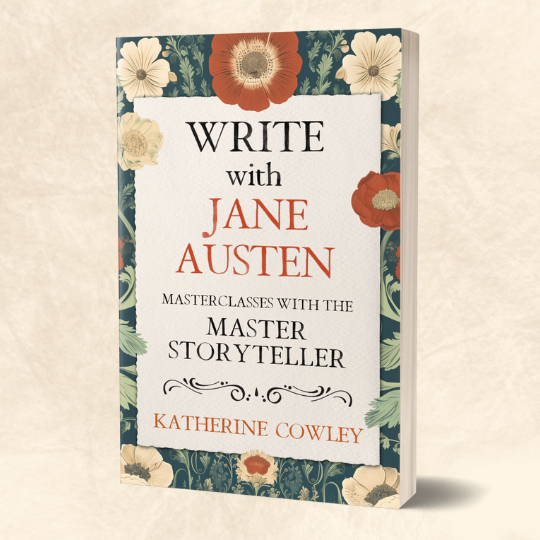
A 3D rendering of the book Write with Jane Austen: Masterclasses with the Master Storyteller

Write with Jane Austen: Masterclasses with the Master Storyteller is an in-depth look at all we can learn about writing from Jane Austen’s novels. Jane Austen is a master at all elements of storytelling, and I had years of delight writing about how we can apply her techniques to our writing, no matter what genre we write.

(Did you know that 200 years before Blake Snyder coined the term “save the cat,” Austen was already recommending that writers do just that? Did you know that Austen takes a cinematic approach to describing setting? Did you know that even within a point of view, Austen did not see it as fixed? There’s so much we can learn from writing from Austen.)

Write with Jane Austen is now available in print and ebook through all major retailers, and if you order now, you should be able to get a copy for yourself or a friend before the holidays. On Amazon US, you can get the paperback and hardcover, or the ebook. It’s also available through Barnes and NobleBookshop.orgKoboSmashwordsWaterstones (in the UK), various Amazon websites throughout the world, etc. Your indie bookstore or your library should be able to get ahold of a copy if you request it.

I can’t actually send this, but also I wrote a letter to Jane Austen for her birthday, in which I attempt to use some of her epistolary approaches to humor and irony, as well as apologize for my literary transgressions.

Dear Jane,

On this, your 250th birthday, I am not ungrateful to you.

For how could I be ungrateful, when you have ignored birthday conventions and instead of opening your own presents, you have gifted me a present–and a glorious one. Six incredible novels, that have spawned endless adaptations that hopefully you would find delightful and joyous, though it’s possible you would find some of them utterly horrifying. (You should probably catch up on 20th-century zombie stories before you indulge in Pride and Prejudice and Zombies. If you find it horrifying, it is in the horror genre, so it’s an appropriate response.)

Unfortunately, I have contributed to the madness by not only writing three novels about Mary Bennet but also writing a book about your writing. I know that in your time, you had to receive permission from someone in order to dedicate a work to them. While you dedicated your unpublished teenage works to family members in playful ways, you didn’t dedicate any of your published novels, except for Emma, and  you probably did that a bit begrudgingly. (I would love to hear the full story someday on the time you were invited to the Prince Regent’s library, and then his librarian semi-forced you to dedicate a book to the prince. We’re pretty sure you wrote a letter about your library trip, and we’re also pretty sure Cassandra destroyed it. What evidence of your true thoughts was she trying to hide?)

Excuse the tangent. I lose focus, in part because I fear your disapproval. The news is this: I wrote a book about you for your birthday, and I dedicated it to you. I asked no permission, but I do ask forgiveness. May there be only rare pages in the book where you say, “That is not what I meant. That is not what I meant at all.”

You may take all the compliments to you in the book. Just know that more compliments are owed than I could manage to express in a few hundred pages.

Best regards, and any happiness that can be had on your 250th birthday.

Yours affectionally,
Katherine Cowley

P.S. Please do not skewer me too harshly in your letters to Cassandra.

I would like to say that writing a book and even a letter is not too shabby of a celebration for my favorite author.

Wishing you all the best, as you celebrate Austen, birthdays, and/or holidays.
Subscribe for book news, events, writing tidbits, and other updates from Katherine Cowley!

* indicates required


Jane Austen Writing Lessons. #60: Getting in the Mood for Writing

#60: Getting in the Mood for Writing

Jane Austen Writing Lessons. #60: Getting in the Mood for Writing

There are days when writing comes easily for me: when I’m excited to get started, when I feel a spark, an unstoppable drive to write.

But then there are plenty of times when I have the time to write, when I’ve scheduled and planned out writing time, and I get to the computer and have a difficult time getting started.

Jane Austen had her difficult writing days as well. In a previous post, I discussed how distractions (like visitors and thoughts of mutton) made writing more difficult for her. There were also other days when she found difficulty writing because she was fatigued or because her pen was too hard.

On October 26, 1813, Jane Austen wrote a letter to her sister Cassandra and in her very first paragraph noted: “I am at all in a humour for writing.”

It’s comforting that Jane also had days where she was not in the mood to write. But what’s interesting is that her sentence doesn’t end there: she uses a semicolon. Here’s the full statement:

I am not at all in a humour for writing; I must write on till I am.

For Austen, the solution to not being in the mood for writing is simple: to write.

I’ve found that 95% of the time, this works for me too. If I can sit down and truly write (without getting distracted by twitter or anything else), then I start to feel like writing. A lot of times I set a timer for 30 minutes. I make a commitment to myself: I don’t feel like writing, but I have to do at least 30 minutes. And then I can walk away. But by the end of the 30 minutes, most of the time I am in the mood for writing and keep on going.

The 5% of the time when this doesn’t work for me, there’s something else going on. Mary Robinette Kowal has an excellent blog post titled “Sometimes Writers Block is Really Depression” where she talks about some of these other reasons we get stuck and don’t feel like writing, whether it’s plot problems or depression. Recognizing what the plot problem is can often help me get in the mood for writing. In the case of depression, taking steps like Mary Robinette did can help me improve my mental well being and make realistic goals for myself, which, in turn, can help me be in the mood for writing.

How do you get in the mood for writing? How do you get past the difficulty of starting? It doesn’t have to be Jane Austen’s method, but if you can figure out what works for you, it will help you make more of your writing sessions feel worthwhile. I know some writers who have a song they always listen to before writing, or who meditate for five minutes. I know some writers who think about their story while taking a shower, and then sit down at the page. I know some writers who turn off the internet or hide their phone. Regardless, whether it’s deciding to write until you feel like writing, or using another method, there truly are things you can do to put yourself more in the mood for writing.

If you have other methods that help get you in the mood for writing, please share in the comments!

Writing Exercises - Jane Austen Writing Lessons

Exercise 1: Plan out a few writing sessions for the next week. These don’t have to be long. And then when it is time for these sessions, write even if you don’t feel like writing.

Exercise 2: Spend fifteen minutes writing in a form that you don’t normally use to write. This might be in a notebook, in cursive, through dictation, on notecards, etc. Then reflect on the experience: how did this change your writing process and your thoughts about writing?

Don’t Miss a Lesson: Subscribe to Updates and Giveaways from katherinecowley.com

* indicates required


Which newsletter(s) would you like to receive?

Jane Austen Writing Lessons. #53: Creating Space for Writing

#53: Creating Space for Writing

Jane Austen Writing Lessons. #53: Creating Space for Writing

One of the most common questions I am asked about my writing is, “When do you write?” I’m also asked, “How do you get writing done with children?” or “How do you prioritize writing when there are other important responsibilities?”

Part of writing is understanding your process, and what it takes for you to be able to write. This is something that Jane Austen seems to have thought a lot about. On September 8, 1816, she wrote a letter to her sister Cassandra which included the following paragraph:

I enjoyed Edward’s company very much, as I said before, and yet I was not sorry when Friday came. It had been a busy week, and I wanted a few days’ quiet and exemption from the thought and contrivancy which any sort of company gives. I often wonder how you can find time for what you do, in addition to the care of the house; and how good Mrs. West could have written such books and collected so many hard words, with all her family cares, is still more a matter of astonishment. Composition seems to me impossible with a head full of joints of mutton and doses of rhubarb.

Company and a busy week made writing more difficult for Jane Austen. She needed time for herself, time for quiet, and time without too many obligations. Especially in her years living in Chawton, Jane’s family did much to lift some of her responsibilities in order to give her the time and the mental space for writing.

Jane also prioritized a physical space. She had her own little table, just for her. And when I attended a guided virtual tour of her Chawton house a few weeks ago, the guide explained that several of the windows by the road were boarded up, so she wouldn’t have all the passerbys on the road looking in on her and distracting her.

In the letter, Jane is astonished by Mrs. West, who balances books and family cares: “Composition seems to me impossible with a head full of joints of mutton and doses of rhubarb.”

Most of us have things we need to balance, whether it’s family obligations, a full or part time job, school, or endless other responsibilities. These things are part of our lives. They’re not going to go away. But are we letting our heads be full of joints of mutton and doses of rhubarb? Or are we finding some time that is just ours, where we can let everything else go and give space for creativity?

When my children were pre-school age, I used nap time and movie time just for writing. It didn’t matter if there was a pile of dishes in the sink or a mess on the floor, appointments to schedule, or seemingly-urgent needs. This was my time, no matter what, and I wouldn’t let it be filled with mutton or rhubarb or anything else.

At other times, I’ve done #5amwritersclub so I could write before my mind filled with any other obligations. I’ve worked in coffeeshops. I’ve prioritized attending writing group.

We all have times, like Jane Austen, where we have obligations that prevent us from writing. But it’s important to make space for writing, whether it’s an hour a day, one evening a month, or a weekend retreat twice a year.

I have a variation on the standard writing exercises today—these are more personal reflections, about your personal writing spaces. But first, a few personal writing notes. I wrote an essay on revising for tone for Women Writers, Women[’s] Books. And yesterday, my second novel was released, The True Confessions of a London SpyIt’s exciting to have a new book to share with readers and friends.

Writing Exercises - Jane Austen Writing Lessons

Exercise 1: Spend a few minutes reflecting on the spaces you have for writing in your life. What gives you mental, physical, and creative space for writing. Do you prioritize giving yourself this space? What is something you could change to help create better spaces for writing in your life?

Exercise 2: Speak to the people in your life about your writing. How do you support the people in your life in their goals? How do they support you in your creative endeavors? Would any adjustments help you better support each other.

Exercise 3: Make a list of the priorities in your life, the things that matter to you, the things that pay the bills, the things that are essential. The goal is not to feel guilty that you have other responsibilities that are not writing. The key is to consider what things truly matter to you most, to give yourself credit for those things and to find meaning in those things. Sometimes non-priority things can be eliminated or shifted to give more space for your key priorities.

Don’t Miss a Lesson: Subscribe to Updates and Giveaways from katherinecowley.com

* indicates required


Which newsletter(s) would you like to receive?

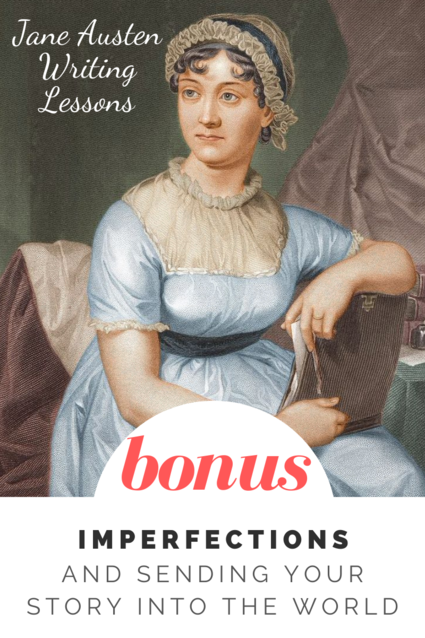
Jane Austen Writing Lessons. Bonus Lesson: Imperfections and Sending Your Story into the World

Jane Austen on Imperfections and Sending Your Stories into the World

Jane Austen Writing Lessons. Bonus Lesson: Imperfections and Sending Your Story into the World

I am traveling and have a number of other deadlines over the next few weeks, so instead of a regular Jane Austen Writing Lesson, I will instead offer several thoughts on writing, inspired by two of Jane Austen’s letters.

Pride and Prejudice was published on January 28, 1813, and on the 29th Jane wrote a letter to her sister Cassandra, telling her that she had received a copy of her book:

I want to tell you that I have got my own darling child from London.

This book was her “darling child,” and she immediately began reading it aloud to a friend, a Miss B. who had dined with them.

She really does seem to admire Elizabeth. I must confess that I think her as delightful a creature as ever appeared in print, and how I shall be able to tolerate those who do not like her at least, I do not know.

Like Austen, I am completely unable to tolerate people who dislike Elizabeth Bennet.

I really like what Austen writes next, about errors or shortfalls in her work:

There are a few typical errors; and a “said he,” or a “said she,” would sometimes make the dialogue more immediately clear; but “I do not write for such dull elves” as have not a great deal of ingenuity themselves. The second volume is shorter than I could wish, but the difference is not so much in reality as in look, there being a larger proportion of narrative in that part. I have lop’t and crop’t so successfully, however, that I imagine it must be rather shorter than “Sense and Sensibility” altogether.

I am currently working on proofreads of my second novel, and I have this overwhelming terror of having errors in the book (because there were a few errors that made it into the published version of my first novel). Yet even Jane Austen had to finish revising her novels and unleash them into the world, knowing that they were as good as she could make them at the time. Furthermore, if she had not left a few lines of dialogue unclear as to the speaker, modern scholars would lose out on all the fun they have debating about who to attribute those particular lines to.

In another letter penned the following week, Austen updated her sister after having read more of the novel aloud:

Upon the whole, however, I am quite vain enough and well satisfied enough.

May we all work to make our writing as good as we can possibly make it, and then may we be “well satisfied enough” to find joy in our work.

[Make sure to come back on August 4th—I’ll be back to my normal schedule of a new Jane Austen Writing Lesson every other Wednesday. Also, if you scroll down you can subscribe so you never miss a lesson!]

Don’t Miss a Lesson: Subscribe to Updates and Giveaways from katherinecowley.com

* indicates required


Which newsletter(s) would you like to receive?