Jane Austen Writing Lessons

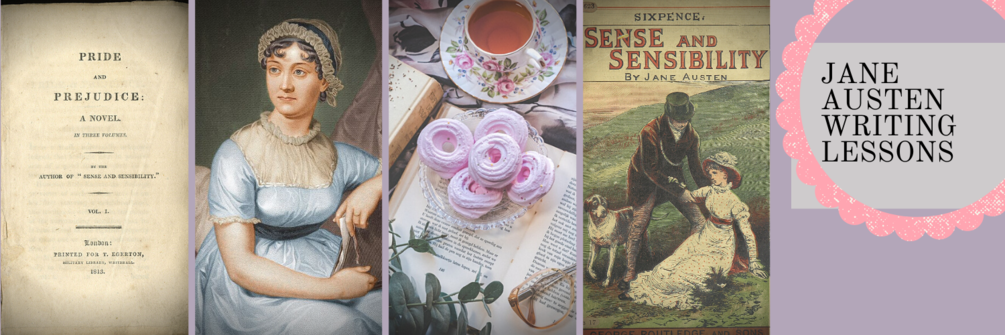
Jane Austen Writing Lessons. With an image of the original cover page of Pride and Prejudice; a color image of Jane Austen; an image of tea and pastries with an open book, and an early cover of Sense and Sensiblity.

One of the best ways to learn to write well is to learn from the examples of great writers. Jane Austen Writing Lessons is a series of blog posts about creative writing principles from plot structure to character development to dialogue. This blog was selected by “The Write Life” as one of the 100 Best Websites for Writers in 2021.

Jane Austen Writing Lessons is now a book!

Jane Austen Writing Lessons has been expanded into a book! The book includes over 70% brand-new material that never appeared on the blog. The book is now available in ebook, paperback, and hardcover from all major retailers.

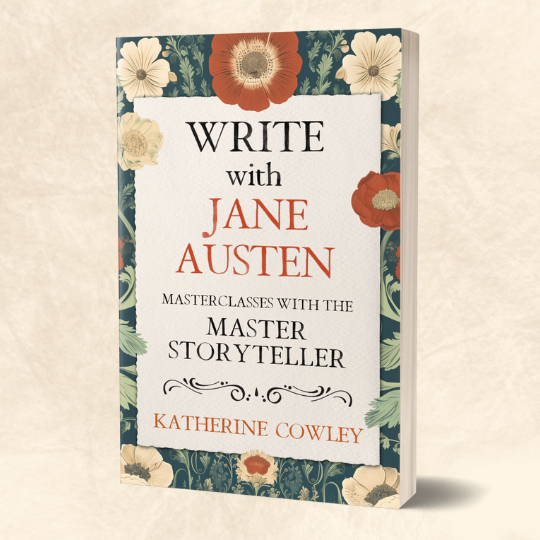
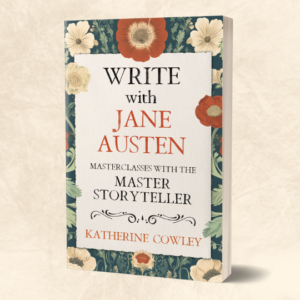
A 3D rendering of the book Write with Jane Austen: Masterclasses with the Master Storyteller

Read more about the book and find links to your favorite retailers.

Examples from Jane Austen

Each lesson looks to Jane Austen’s novels and her other works for examples of excellent writing. Quotes from her six published novels and an analysis of her craft–and how we can apply it to our own writing–is included in each lesson.

Writing Exercises

Writing Exercises - Jane Austen Writing Lessons

Each lesson includes 2-3 writing exercises that will help you practice the creative writing principle and apply it to your own writing.

Most Recent Jane Austen Writing Lessons

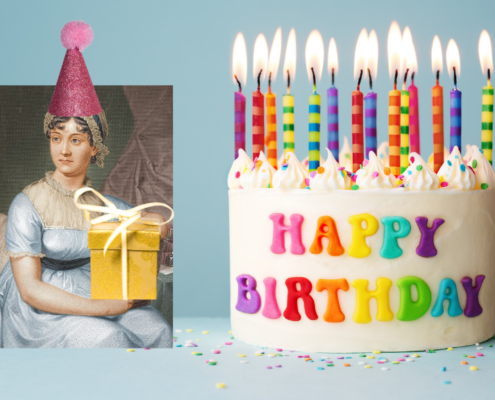
Jane Austen celebrating her birthday. Austen wears a birthday hat, holds a birthday present, and sits next to a birthday cake covered with candles.
Jane Austen Writing Lessons. #69: The Jane Austen Approach to Critiquing Writing
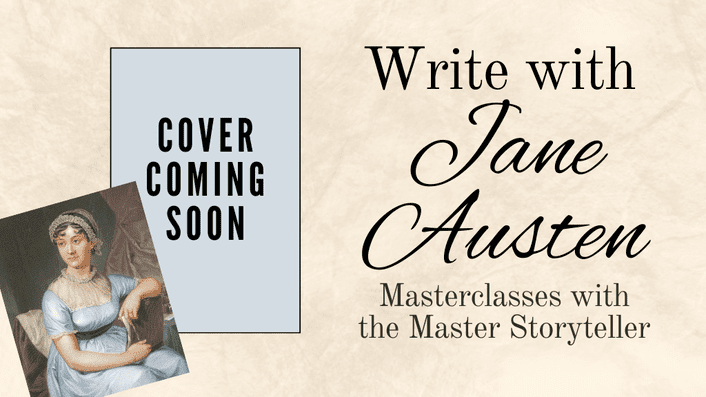
An intriguing snippet which has Jane Austen's portrait and a mysterious gray box with the words, "Cover Coming Soon"
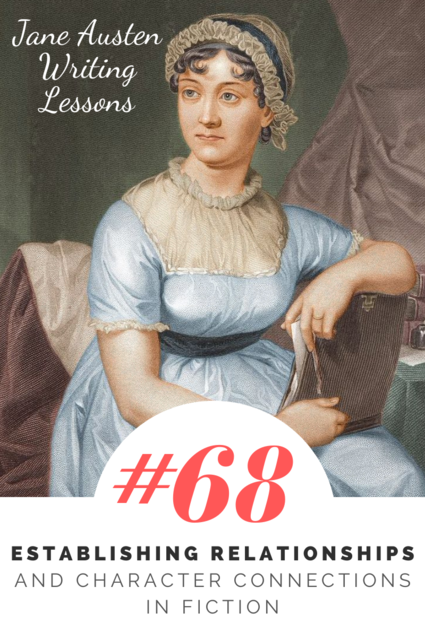
Jane Austen Writing Lessons #68: Establishing Relationships and Character Connections in Fiction
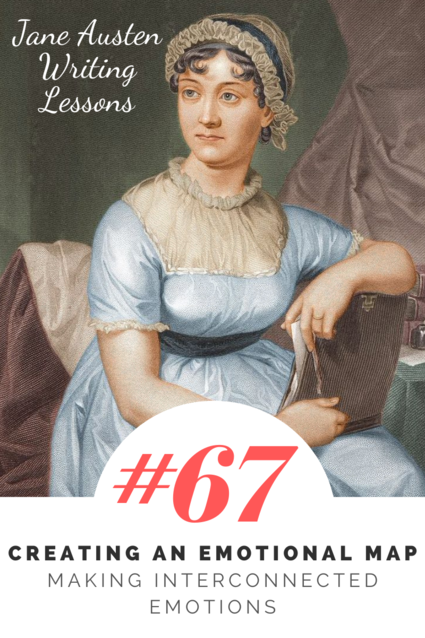
Jane Austen Writing Lessons 67. Creating an Emotional Map: Making Interconnected Emotions
Jane Austen Writing Lessons. #66: Evoking Emotions through Objective Correlative (External Objects)
Mary Bennet and Mr. Collins. Why didn't they marry? Would they have made a good match?
Jane Austen Writing Lessons. #65: Different Character Approaches to Dealing with and Expressing Emotions
Jane Austen Writing Lessons. #64: The Size or Degree of Character Emotions

Jane Austen Writing Lessons by Category

Recognition for Jane Austen Writing Lessons

Jane Austen Writing Lessons: one of the

Jane Austen Writing Lessons was selected by The Write Life as one of the “100 Best Websites for Writers in 2021.” They wrote:

“[Jane Austen Writing Lessons] is filled with blog posts about creative writing that use Jane Austen’s novels and other related stories to share what good writing looks and sounds like. Whether you’re interested in plot structure or character development to dialogue, each Jane Austen writing lesson focuses on one principle of writing at a time.”

About the Author

In addition to writing Jane Austen Writing Lessons, Katherine Cowley is the author of the novels The Secret Life of Miss Mary BennetThe True Confessions of a London Spy, and The Lady’s Guide to Death and Deception. She has taught writing classes at Western Michigan University and other universities and community colleges.

Her blog, Jane Austen Writing Lessons, has been expanded into a new book, Write with Jane Austen: Masterclasses with the Master Storyteller.

Jane Austen celebrating her birthday. Austen wears a birthday hat, holds a birthday present, and sits next to a birthday cake covered with candles.

Jane Austen’s 250th Birthday and How Austen Wrote Birthday and Holiday Greetings

Jane Austen celebrating her birthday. Austen wears a birthday hat, holds a birthday present, and sits next to a birthday cake covered with candles.

December 16, 2025 is Jane Austen’s 250th birthday, and so to celebrate, here’s a post with:

  • How Austen wrote birthday and holiday greetings
  • The letter I wrote to her for her birthday (and the book I wrote for her…probably shouldn’t forget that)

How Jane Austen Wrote Birthday and Holiday Greetings

Jane Austen spent much of her life with her sister and dear friend, Cassandra. However, the times that they were apart are a blessing to us, because from them we have many of Austen’s surviving letters.

In 1799, the day before Cassandra’s birthday, Jane wrote Cassandra a letter which she ended with the following:

I wish you joy of your birthday twenty times over. I shall be able to send this to the post to-day, which exalts me to the utmost pinnacle of human felicity, and makes me bask in the sunshine of prosperity or gives me any other sensation of pleasure in studied language which you may prefer. Do not be angry with me for not filling my sheet, and believe me yours affectionately,
Miss Austen

Not only does Jane wish her sister a twenty-times dose of birthday joy, but she rejoices–nay, feels exalted–because she can send such a letter, and send it immediately.

I don’t think Jane Austen would have liked many of today’s birthday cards, with pre-written sentimental phrases. Even in a letter with birthday greetings, in which there are certain conventions and well-wishes are expected, she must give them in a creative way.

Here, she uses hyperbole, exaggerating her emotions to the extreme. This does not mean she doesn’t feel positively towards her sister–she does feel happy for her sister’s birthday, and wants to express it–but she does so playfully, and probably wants to make her sister laugh. (Jane’s letters, and biographies  about her, show that her family loved sharing humor with each other.)

I also like the admission: “or gives me any other sensation of pleasure in studied language which you may prefer.” If Cassandra would not express the joy of sending a birthday letter in the same manner, she is welcome to choose her own studied language. Whatever rhetorical devices or literary flourishes or elegant metaphors–Jane gives them all to Cassandra. I find Jane’s statement reminiscent of Mr. Collins, with the difference being that Austen uses irony and takes delight in recognizing the subtle absurdity of her own statement.

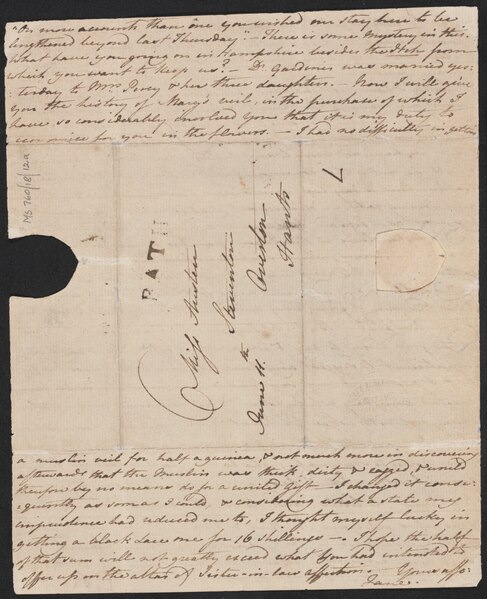
A letter from Jane Austen to Cassandra Austen

A letter from Jane Austen to Cassandra Austen. This is not any of the letters referenced in this blog post, however, it is a very visually appealing letter, so I have decided to include it. Image via National Library of Australia, Public domain, via Wikimedia Commons

And what about holiday greetings? How did Jane write this standard form?

In one letter to Cassandra, she writes:

I am glad you are to have Henry with you again; with him and the boys you cannot but have a cheerful, and at times even a merry, Christmas. 

I love the honesty. “At times even…merry.” She doesn’t treat holidays like they need to be perfect.

In another letter written during the holiday season, Austen writes to Cassandra:

I am sorry my mother has been suffering, and am afraid this exquisite weather is too good to agree with her. I enjoy it all over me, from top to toe, from right to left, longitudinally, perpendicularly, diagonally; and I cannot but selfishly hope we are to have it last till Christmas,—nice, unwholesome, unseasonable, relaxing, close, muggy weather.

I could write an essay on this paragraph. (Fortunately, I’ve decided to spare you.) But I love the humor, I love how Jane finds joys in unexpected (and sometimes unwanted) occurrences of the season. And I love how she mixes her positive and negative adjectives (nice, unwholesome, unseasonable, relaxing, close, muggy) in a way that both offers insight and provides humor.

But how do we apply this?

I am so glad you asked.

If you want to write like Jane Austen, the next time you send a birthday or holiday greeting, don’t use a pre-written greeting card and definitely don’t use AI (Austen refused to use the average or standard way of saying something, after all). Instead, express your joy and love but be playful or humorous or absurd (or perhaps be all three–playful and humorous and absurd). Make light of adverse circumstances, be realistic, and don’t be afraid to play with expectations.

My Offering For Jane Austen’s Birthday (A Book, and a Birthday Letter!)

Those of you who backed the project on Kickstarter already know this, but I must declare it to the world! I officially met my goal for the year, which was to publish my new book before Jane Austen’s birthday.

A 3D rendering of the book Write with Jane Austen: Masterclasses with the Master Storyteller

Write with Jane Austen: Masterclasses with the Master Storyteller is an in-depth look at all we can learn about writing from Jane Austen’s novels. Jane Austen is a master at all elements of storytelling, and I had years of delight writing about how we can apply her techniques to our writing, no matter what genre we write.

(Did you know that 200 years before Blake Snyder coined the term “save the cat,” Austen was already recommending that writers do just that? Did you know that Austen takes a cinematic approach to describing setting? Did you know that even within a point of view, Austen did not see it as fixed? There’s so much we can learn from writing from Austen.)

Write with Jane Austen is now available in print and ebook through all major retailers, and if you order now, you should be able to get a copy for yourself or a friend before the holidays. On Amazon US, you can get the paperback and hardcover, or the ebook. It’s also available through Barnes and NobleBookshop.orgKoboSmashwordsWaterstones (in the UK), various Amazon websites throughout the world, etc. Your indie bookstore or your library should be able to get ahold of a copy if you request it.

I can’t actually send this, but also I wrote a letter to Jane Austen for her birthday, in which I attempt to use some of her epistolary approaches to humor and irony, as well as apologize for my literary transgressions.

Dear Jane,

On this, your 250th birthday, I am not ungrateful to you.

For how could I be ungrateful, when you have ignored birthday conventions and instead of opening your own presents, you have gifted me a present–and a glorious one. Six incredible novels, that have spawned endless adaptations that hopefully you would find delightful and joyous, though it’s possible you would find some of them utterly horrifying. (You should probably catch up on 20th-century zombie stories before you indulge in Pride and Prejudice and Zombies. If you find it horrifying, it is in the horror genre, so it’s an appropriate response.)

Unfortunately, I have contributed to the madness by not only writing three novels about Mary Bennet but also writing a book about your writing. I know that in your time, you had to receive permission from someone in order to dedicate a work to them. While you dedicated your unpublished teenage works to family members in playful ways, you didn’t dedicate any of your published novels, except for Emma, and  you probably did that a bit begrudgingly. (I would love to hear the full story someday on the time you were invited to the Prince Regent’s library, and then his librarian semi-forced you to dedicate a book to the prince. We’re pretty sure you wrote a letter about your library trip, and we’re also pretty sure Cassandra destroyed it. What evidence of your true thoughts was she trying to hide?)

Excuse the tangent. I lose focus, in part because I fear your disapproval. The news is this: I wrote a book about you for your birthday, and I dedicated it to you. I asked no permission, but I do ask forgiveness. May there be only rare pages in the book where you say, “That is not what I meant. That is not what I meant at all.”

You may take all the compliments to you in the book. Just know that more compliments are owed than I could manage to express in a few hundred pages.

Best regards, and any happiness that can be had on your 250th birthday.

Yours affectionally,
Katherine Cowley

P.S. Please do not skewer me too harshly in your letters to Cassandra.

I would like to say that writing a book and even a letter is not too shabby of a celebration for my favorite author.

Wishing you all the best, as you celebrate Austen, birthdays, and/or holidays.

Subscribe for book news, events, writing tidbits, and other updates from Katherine Cowley!

* indicates required


Jane Austen Writing Lessons. #69: The Jane Austen Approach to Critiquing Writing

#69: The Jane Austen Approach to Critiquing Writing

Jane Austen’s Critique Group

I’ve been a member of critique groups for well over a decade, and sometimes I wonder what it would be like to be in a critique group with Jane Austen. We know that as a young writer, she frequently shared her drafts with family members and friends, entertaining them with her stories. We know she revised these pieces, and she surely made changes based off of their reactions and their questions.

As a published author, she, in turn, critiqued the writing of others. Her niece, Anna Austen Lefroy, loved to write and asked her aunt for feedback on her works. Between 1814 and 1816, Jane wrote a series of letters to Anna, giving entertaining, helpful, and at times difficult critiques.

One thing that stands out to me is that Jane Austen uses many of the same critiquing methods that I learned in graduate school, when I was studying best practices for teaching writing.

The Sandwich Critique Method: Good-Bad-Good

In Austen’s letters, she never just tells Anna what isn’t working: she also gives positive feedback.

In an undated letter, likely from the spring or early summer of 1814, Jane wrote to her niece:

MY DEAR ANNA,

I am very much obliged to you for sending your MS [manuscript]. It has entertained me extremely; all of us indeed. I read it aloud to your Grandmama and Aunt Cass., and we were all very much pleased. The spirit does not droop at all. Sir Thos., Lady Helen and St. Julian are very well done, and Cecilia continues to be interesting in spite of her being so amiable. It was very fit you should advance her age. I like the beginning of Devereux Forester very much, a great deal better than if he had been very good or very bad. A few verbal corrections are all that I felt tempted to make; the principal of them is a speech of St. Julian to Lady Helen, which you see I have presumed to alter. As Lady H. is Cecilia’s superior, it would not be correct to talk of her being introduced. It is Cecilia who must be introduced. And I do not like a lover speaking in the 3rd person; it is too much like the formal part of Lord Orville, and I think it not natural. If you think differently, however, you need not mind me. I am impatient for more, and only wait for a safe conveyance to return this book.

Yours affectionately, J. A.

This letter uses the classic sandwich technique for critiquing: start with the positive, then detail what could be improved, and then end with more positive. In other words, wrap what might be difficult to hear in between things that are working and positive encouragement.

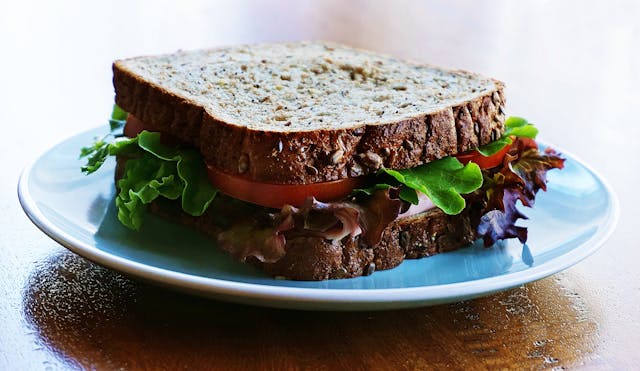
A classic delicious sandwich that metaphorically represents critiquing writing

Thus, Jane begins with “It has entertained me extremely” and ends with “I am impatient for more.”

At other times, Austen weaves the positive and the negative together. In a letter written on September 28th, 1814, Jane analyzes Anna’s characters, dissecting which ones are working and which ones need work:

We like the first chapter extremely, with only a little doubt whether Lady Helena is not almost too foolish. The matrimonial dialogue is very good certainly. I like Susan as well as ever, and begin now not to care at all about Cecilia; she may stay at Easton Court as long as she likes. Henry Mellish will be, I am afraid, too much in the common novel style,—a handsome, amiable, unexceptionable young man (such as do not much abound in real life), desperately in love and all in vain. But I have no business to judge him so early. Jane Egerton is a very natural, comprehensible girl, and the whole of her acquaintance with Susan and Susan’s letter to Cecilia are very pleasing and quite in character. But Miss Egerton does not entirely satisfy us. She is too formal and solemn, we think, in her advice to her brother not to fall in love; and it is hardly like a sensible woman,—it is putting it into his head. We should like a few hints from her better.

Jane paints a clear picture of strengths and weaknesses: some of the characters are “pleasing,” they feel natural and likeable, while other characters are cliché (“too much in the common novel style”) or “too formal and solemn.”

Writing exists with an audience in mind, and as a critiquer, you step in for the audience, sharing your reactions to the story, as well as your assumptions on how larger audiences will react. Thus, it’s useful for Jane to share both what is working and what is not working. Clearly we need to know what’s not working—it’s difficult to take a story from our heads and hearts and place it on a page, to convey that which want to convey. An audience reaction can let us know what needs to be improved. But we also need to know what is good about our writing—we need affirmation. In part, this is for self-esteem purposes, but more importantly we need to know what’s working well so we keep it in the story. Also, when we know that a technique is working well, we can emulate it in the rest of the story.

A modern scholar, William Hart-Davidson, recommends using a describe-evaluate-suggest model when giving a critique, and we see Austen using this very approach. She describes what she sees in a character, evaluates what she sees according to the goals of the story, and then, if needed, gives suggestions for improvement.

Thus, she describes the character of Henry Mellish as “a handsome, amiable, unexceptionable young man” and then evaluates the character according to her metric, feeling like a real person—she writes that he is a type that does “not much abound in real life.” The suggestion is implied—Anna should make him less “in the common novel style” and pull back on some of his characteristics.

Respecting the Storyteller

One of the other things I notice as I read Jane’s letters is the respect that she shows to Anna as a storyteller. Jane does not assume that she, the person giving feedback, knows better than the writer.

Thus, in the undated letter she writes:

I do not like a lover speaking in the 3rd person; it is too much like the formal part of Lord Orville, and I think it not natural. If you think differently, however, you need not mind me.

In a different letter, at the end of a rather critical paragraph, Austen writes:

Excuse the liberty I take in these suggestions.

Personally, if I were to receive a critique from Jane Austen, I’d probably apply every piece of feedback without question. But when Austen gives specific feedback, she is careful to frame it as a suggestion. Yes, she is a published author and her niece is not, but she knows that ultimately it’s Anna’s story. Anna can choose to apply the feedback if she wishes, but Jane does not want her to feel obligated to do so.

This is a healthy attitude to take when giving a critique: the goal is to help the writer revise and tell their own story in their own way, to the best of their abilities. It’s not to dominate or dictate, or to encourage that story that you would personally tell.

I’ve given a lot of feedback to authors, and I’m definitely gotten better at it over the years. I look back on a few early critiques I gave and cringe. I’ve also received a lot of invaluable feedback. I don’t use every suggestion, but I appreciate all those who have helped me improve my writing. I imagine that Jane Austen was also grateful for the support and feedback she received on her works.

In the next few weeks, I’ll share additional posts on what we can learn from Jane Austen about revision, including being aware of your audience as you revise. Meanwhile, I’m revising my upcoming Write with Jane Austen book, which will be launching in a few months on Kickstarter.
Don’t Miss Important Updates

Subscribe to the Write with Jane Austen newsletter receive new Jane Austen Writing Lessons in their email 1-2 weeks before they’re posted on my website. You can also get exclusive updates on the Write with Jane Austen book.

My regular newsletter contains more general information about my books, events, giveaways, and my reading recommendations.

Newsletters Signup

* indicates required

Which newsletter(s) would you like to receive?

Intuit Mailchimp

An intriguing snippet which has Jane Austen's portrait and a mysterious gray box with the words, "Cover Coming Soon"

New Book: Write with Jane Austen

Write with Jane Austen: Masterclasses with the Master Storyteller. The image also contains a mysterious gray box with the words "Cover Coming Soon," and a picture of Jane Austen

ETA: May 5th 2025: Write with Jane Austen is now live on Kickstarter!

If you’d like your own copy, you can pre-order the book there.

And here’s a sneak preview of the cover:

A 3D rendering of the book Write with Jane Austen: Masterclasses with the Master Storyteller

And now, back to the original post:

2025 is Jane Austen’s 250th birthday, and to celebrate, I am releasing a book titled Write with Jane Austen: Masterclasses with the Master Storyteller.

A Description of the Book

It is a truth universally acknowledged that if a writer wishes to write well, she should learn from the very best of writers. In other words, she should study with Jane Austen.

Write with Jane Austen is the definitive guide on how to improve your writing. Its lessons and examples draw from Austen’s six published novels and from her unpublished works. This book will help you craft a character’s internal and external journeys, create effective antagonists and obstacles, construct compelling relationships, capture a setting without disrupting the forward movement of the narrative, improve your style, and compose dialogue which brings the characters and the story to life. Each chapter contains writing exercises which will help you internalize and apply these principles.
Whether you write romance, women’s fiction, historical fiction, mystery, or any other genre, this book will enable you to emulate Jane Austen’s proven techniques and improve your storytelling. This guide will also increase any reader’s appreciation for Austen’s craft.

Background on the Book

From 2020 to 2022, I wrote a blog titled Jane Austen Writing Lessons. For each post, I took a writing topic (for instance, writing sympathetic characters) and explored principles and techniques that could be learned from Jane Austen’s six published novels.

Jane Austen Writing Lessons. With an image of the original cover page of Pride and Prejudice; a color image of Jane Austen; an image of tea and pastries with an open book, and an early cover of Sense and Sensiblity.

I had a fabulous time writing about sixty-five posts, and the blog was recognized by The Write Life as “one of the best websites for writers in 2021.” A number of readers and friends encouraged me to turn the blog into a book. I played with the idea, but I was working on other projects, so I never pursued it.

Fast forward to the summer of 2024. I realized that this coming year—2025—is Jane Austen’s 250th birthday. And I decided that this was the next project of my heart: to create a book on creative writing through the lens of Jane Austen’s works.

And so I went to work.

I didn’t want the book to read as a series of blog posts—I wanted beautiful chapter arcs. I ended up scrapping about 50,000 words from my blog. Delete. Delete. Delete.

There were also a number of new chapters and sections I wanted to write. And write I did. I added chapters on relationships, rising action, the climax, style, and more. The book is over 50% brand new material that never appeared on my blog, and the chapters taken from the blog have been heavily revised.

I still have a bit more editing to do, and then the book will be copy edited and proofread, but it won’t be long until I can send the book out into the world.

Crowdfunding Write with Jane Austen on Kickstarter

I am really excited to release Write with Jane Austen in an interactive way, through Kickstarter. Kickstarter is a crowdfunding website designed exclusively for creative projects. It has been used extensively by both new and established authors, including bestselling names like Brandon Sanderson.

The classic green Kickstarter logo.

I’m using Kickstarter because:

  1. It’s a great platform to run preorders for books.
  2. It’s interactive and exciting—I’ve personally backed 19 projects on Kickstarter, and as a reader, I love knowing that I can help bring a project to life. I also love the comments section (Kickstarter is the only place where it’s fun to read the comments!), the in-process updates from the creator, and the feeling of community.
  3. Running a Kickstarter will help cover the production costs for the book (i.e. cover, professional editing, etc.)
  4. Releasing a book on Kickstarter allows my loyal readers, friends, and fans to get a copy of the book months before it’s available to everyone else.
  5. Kickstarter allows me to offer other things in addition to the book—like writing workshops and a special edition workbook. (I will tell you more about these in the near future!)
The Kickstarter for the project will go live in March/April—to be the very first to know when it does, visit the book’s pre-launch page and click “Notify me on launch.”

Final Thoughts

I’m really excited to share this book with the world. Reading Jane Austen has changed my life for the better, and studying her craft in depth has transformed my writing. She truly is the master storyteller.

Don’t Miss Important Updates

To make sure you don’t miss important news and updates, sign up for one or both of my newsletters.

My regular newsletter contains information about my books, events, giveaways, and my reading recommendations. It will include some updates on the Write with Jane Austen book.

The Write with Jane Austen newslettter will include more updates on the book, exclusive tidbits, and mini-writing lessons to tide you over until the book is available.

Newsletters Signup

* indicates required

Which newsletter(s) would you like to receive?

Intuit Mailchimp

Jane Austen Writing Lessons #68: Establishing Relationships and Character Connections in Fiction

#68: Establishing Relationships and Character Connections in Fiction

Jane Austen Writing Lessons #68: Establishing Relationships and Character Connections in Fiction

This is the first post in a new series within Jane Austen Writing Lessons which will focus on relationships and character connections. A lot of times we think about relationships as romantic, and we will talk about that (after all, Austen has written some of my all-time favorite romantic relationships). But before we get to that point, we’re going to consider more general principles of establishing character relationships and connections.

In Jane Austen’s novel Emma, the very first spoken dialogue comes from Emma’s father, Mr. Woodhouse. He declares:

“Poor Miss Taylor!—I wish she were here again. What a pity it is that Mr. Weston ever thought of her!”

Miss Taylor is Emma’s former governess. She has recently married Mr. Weston, and as a result she no longer works for Mr. Woodhouse. Mr. Woodhouse is highly opposed to her loss. Emma attempts to convince her father that the marriage is a positive thing, beginning by saying, “I cannot agree with you, papa; you know I cannot.”

In these first few pages of Emma, the relationships and connections between characters begin to unfold:

  • Miss Taylor is in a romantic relationship with Mr. Weston.

    Emma believes she is responsible for their marriage. As a result of this marriage, Emma decides she wants to be a matchmaker, which sets off the novel’s chain of events.

  • Miss Taylor worked for Mr. Woodhouse.

    Clearly, he was highly reliant on her, and he considers his own needs and desires as more important than her own. He feels like his relationship with Miss Taylor can no longer have the same benefits or value. Even the possibility of visiting her seems nigh impossible, though they do not live far away.

  • Emma is friends with Miss Taylor.

    Emma is saddened by the fact that her friend/governess will no longer always be with her—Jane Austen writes, “Sorrow came—a gentle sorrow.” Yet because of their genuine friendship, Emma is pleased at the marriage. Emma is confident that she can retain her connection to her friend even though their circumstances have changed.

  • Emma and Mr. Weston.

    Their relationship is less clear in the opening pages, and their connection is not as strong as that between the other characters; however, Emma declares Mr. Weston to be “a good-humoured, pleasant, excellent man.”

  • Emma and her father, Mr. Woodhouse.

    In the opening paragraphs, the narrator declares that one of the evils of Emma’s upbringing is that she has “the power of having rather too much her own way.” This reflects on her relationship with her father. Emma also has an incredible loyalty to him: she is devoted to staying with him and taking care of him. From the first chapter, we see her trying to help her father by encouraging him to accept their new situation and changing relationships with others.

Even in these first few pages, Jane Austen masterfully establishes the relationships between different sets of characters. Many of these relationships become driving factors in the novel, influencing plot and character, and adding meaning and consequence to the characters’ actions. Some of the relationships shift and change over the course of the novel, while others remain relatively static.

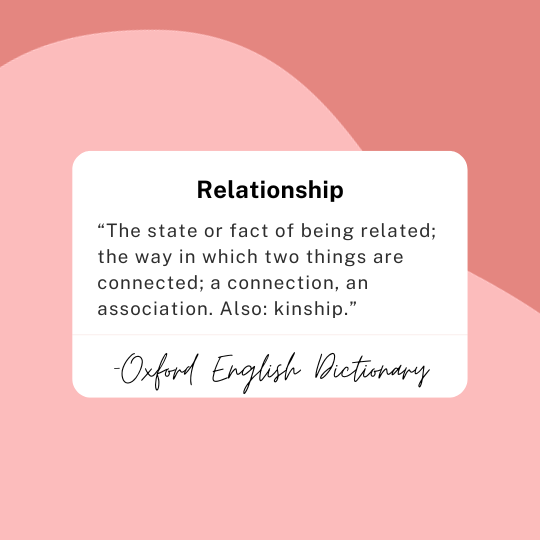
The first definition for the word relationship in the Oxford English Dictionary (OED) is as follows:

The state or fact of being related; the way in which two things are connected; a connection, an association. Also: kinship.

It’s only in definition 2b that the OED defines a relationship in an emotional or sexual way, so let’s linger on this first definition of relationship, in which two people are related or connected in some way.

The primary root for the word relationship is the word relation, which, according to the OED, began to be used in English in around 1398. A relation means there is a “connection, correspondence, or contrast between different things.” Examining the relation between two things means considering why they are associated or what connects them. A relation can also mean “the social interactions that occur and feelings that exist between two or more people or groups of people.”

As you write or revise your own fiction, it’s important to look at the relationships and connections between characters, both ones which involve your main character and relationships which only involve the supporting characters.

As I consider relationships in my own stories, I like to ask:

  • What connects people?
  • How do two characters know each other?
  • How do they feel about each other? Why?
  • How does one relationship affect other relationships in the story?
  • Is the main character aware of the connections between other characters?
  • How do the character relationships manifest on the page, in actions and behaviors?
  • What events in the novel will cause shifts or changes in these relationships?

In the coming months, we’ll look more closely at how Jane Austen uses relationship arcs, builds webs of relations, and also constructs romantic relationships. But first, here are some writing exercises.

Writing Exercises - Jane Austen Writing Lessons

Exercise 1: Consider the first five to ten pages of your book. Make a list of each relationship that is established and what your reader knows about each relationship so far.

Exercise 2: Find a place that has a number of people and spend a few minutes people watching. If you see any relationships or connections between people, write them down. What sort of relationships do you think these people have? What clues help you understand these relationships?

Exercise 3: Write a scene about two characters who would be unlikely to have any sort of prior connection but do have some sort of relationship (i.e. a friendship, a past, same employer, etc.).

Don’t Miss a Lesson: Subscribe to Updates and Giveaways from katherinecowley.com

* indicates required


Which newsletter(s) would you like to receive?

Jane Austen Writing Lessons 67. Creating an Emotional Map: Making Interconnected Emotions

#67: Creating an Emotional Map: Making Interconnected Emotions

Jane Austen Writing Lessons 67. Creating an Emotional Map: Making Interconnected Emotions

We’ve talked a lot about writing emotions over the past months, with posts on:

I wanted to do one final post on emotions, that ties everything together, so today I’ll be talking about creating an emotional map, or making a characters emotions in a single scene connected to their emotions in other scenes.

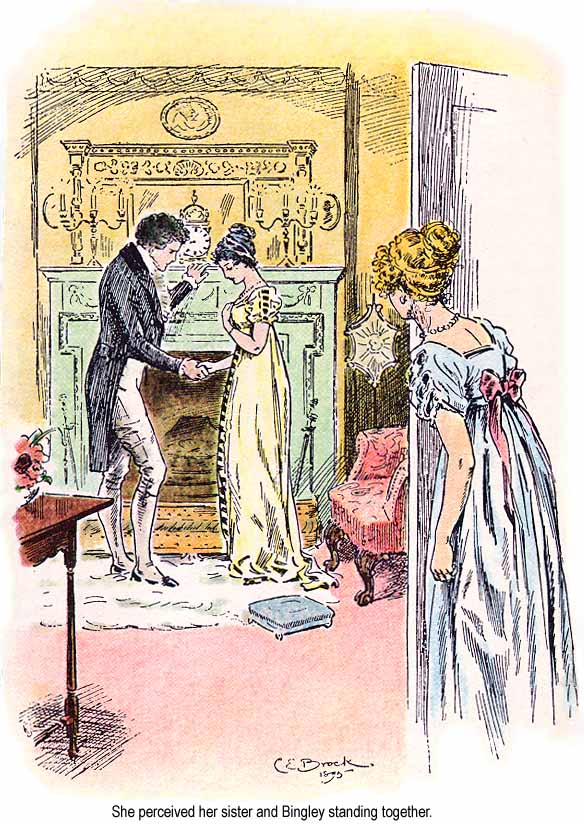
Near the end of Pride and Prejudice, Jane, the eldest of the Bennet sisters, becomes engaged to Mr. Bingley. Elizabeth opens a door and sees Jane and Mr. Bingley standing next to the fireplace, rather close to each other. Jane and Bingley quickly move apart, looking embarrassed.

Not a syllable was uttered by either; and Elizabeth was on the point of going away again, when Bingley, who as well as the other had sat down, suddenly rose, and, whispering a few words to her sister, ran out of the room.

Jane could have no reserves from Elizabeth, where confidence would give pleasure; and, instantly embracing her, acknowledged, with the liveliest emotion, that she was the happiest creature in the world.

“’Tis too much!” she added, “by far too much. I do not deserve it. Oh, why is not everybody as happy?”

Elizabeth’s congratulations were given with a sincerity, a warmth, a delight, which words could but poorly express. Every sentence of kindness was a fresh source of happiness to Jane. But she would not allow herself to stay with her sister, or say half that remained to be said, for the present.

“I must go instantly to my mother,” she cried. “I would not on any account trifle with her affectionate solicitude, or allow her to hear it from anyone but myself. He is gone to my father already. Oh, Lizzy, to know that what I have to relate will give such pleasure to all my dear family! how shall I bear so much happiness?”

Jane’s emotions are expressed primarily through her physical actions and through her dialogue (including the diction, word choice, and use of emphasis). It’s an effective scene at conveying emotions, but what makes it work is largely based on what Austen has established in the rest of the book.

An 1895 Illustration by CE Brock of Jane and Bingley standing close together next to the fireplace. Bingley holds Jane's hand, and Elizabeth peeks around the corner of the door.

An 1895 illustration by CE Brock of Jane and Bingley together, immediately after becoming engaged. Public domain image via Wikimedia Commons.

This post-proposal scene is in conversation with dozens of other scenes which have demonstrated Jane’s emotions. We’ve seen how reserved Jane is in outwardly expressing emotions, especially in groups of people (of Bingley she offers only “cautious praise” to everyone but Elizabeth). We’ve seen the pleasure Jane takes from little interactions with Mr. Bingley and his sister. We’ve seen her hope for an engagement. And then we’ve seen her despair—her utter, all-encompassing despair—when Mr. Bingley leaves without a word to her (though his sister Caroline almost gleefully writes to Jane of the news).

At various points Elizabeth and other characters analyze Jane’s emotions, sensing Jane’s devastation beneath all her attempts to insist that “He will be forgot, and we shall all be as we were before.”

At one point, Elizabeth reexamines all the letters that Jane has written to her:

They contained no actual complaint, nor was there any revival of past occurrences, or any communication of present suffering. But in all, and in almost every line of each, there was a want of that cheerfulness which had been used to characterize her style, and which, proceeding from the serenity of a mind at ease with itself, and kindly disposed towards everyone, had been scarcely ever clouded. Elizabeth noticed every sentence conveying the idea of uneasiness…

Jane’s utter joy at her engagement if effective because of all of these other scenes. Her happiness is the culmination of her earlier attachment to Mr. Bingley, and provides stark contrast to her despair.

An individual emotion does not occur in a vacuum. The emotion found in a single scene is simply a leaf or a branch on a character’s emotional tree. It’s a single block in a Lego tower, part of a larger structure which is more magnificent and complex than an individual Lego can be on its own.

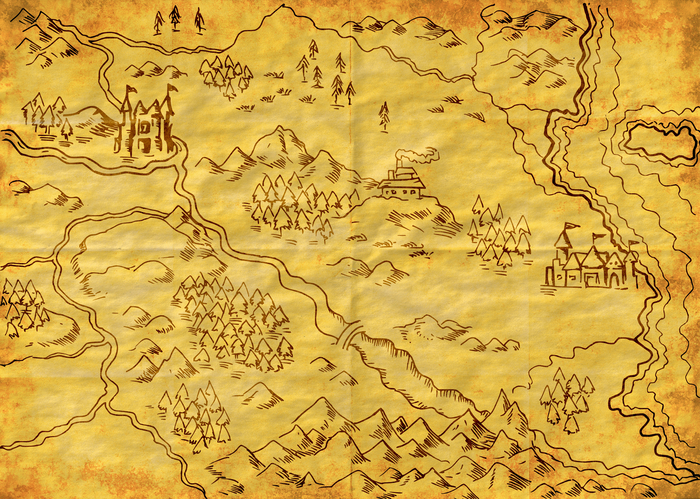
An old map, faded and yellowing, with mountains, castles, rivers, and bridges hand-drawn in ink

When I am revising a story, I like to consider a character’s individual emotions as part of a larger emotional map. After all, a character has emotional valleys and mountains, fast-moving rivers and muddy bogs. There are cities and villages: parts of the map where a series of emotions relate to a particular person, object, incident, or theme. Some characters experience their emotional map as a journey: they have an emotional arc as their emotions, or ways of dealing with their emotions, change. Other characters circle through the map in a regular fashion, or spend most of their time in a single area of the map. For some characters, we receive only a glimpse of their emotional map, while for others, we explore broad swaths of it with them.

Whenever I am stuck trying to figure out a character’s emotion, or I feel like I’m not effectively conveying that emotion on the page, I think about the characters emotional map and how this emotion connects to all the others in the story. Doing so always helps me to understand the character’s emotion in the moment and what will best convey that to the reader.

Writing Exercises - Jane Austen Writing Lessons

1. Write a page about how your current emotions connect to prior emotions you have had. You can focus on a specific emotion or on a specific incident. Reflect on what your own emotions can teach you about the emotions of your characters.

2. Use a visual form to analyze one of your character’s emotions and how they connect to each other. This might be a map (or even a treasure map), a tree, a building/structure, or anything else you think would be an effective medium. You could create this with paper or other objects, or you could print out a map/floorplan/picture, etc. and add things to it. Personally, I like doing this in a tactile way, with pen, paper, glue, etc., but you can do it virtually as well.

3. Find one of your favorite expressions of emotion in fiction, and then find two or three other passages/scenes in the same work that have a strong connection to this emotion (whether in building to it, contrasting with it, foreshadowing it, etc.).

Don’t Miss a Lesson: Subscribe to Updates and Giveaways from katherinecowley.com

* indicates required


Which newsletter(s) would you like to receive?