Jane Austen Writing Lessons

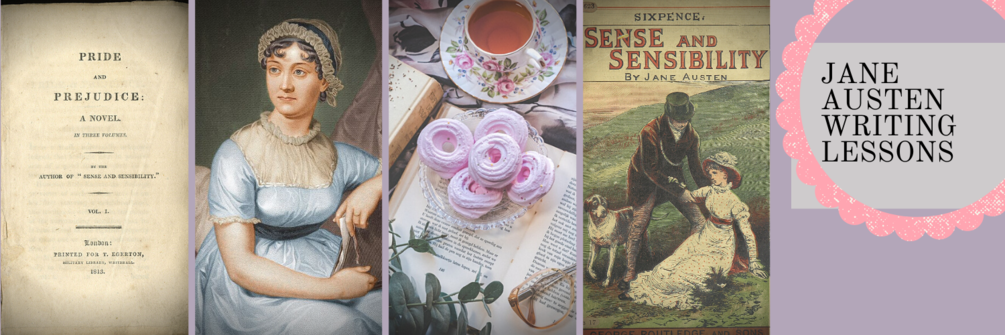
Jane Austen Writing Lessons. With an image of the original cover page of Pride and Prejudice; a color image of Jane Austen; an image of tea and pastries with an open book, and an early cover of Sense and Sensiblity.

One of the best ways to learn to write well is to learn from the examples of great writers. Jane Austen Writing Lessons is a series of blog posts about creative writing principles from plot structure to character development to dialogue. This blog was selected by “The Write Life” as one of the 100 Best Websites for Writers in 2021.

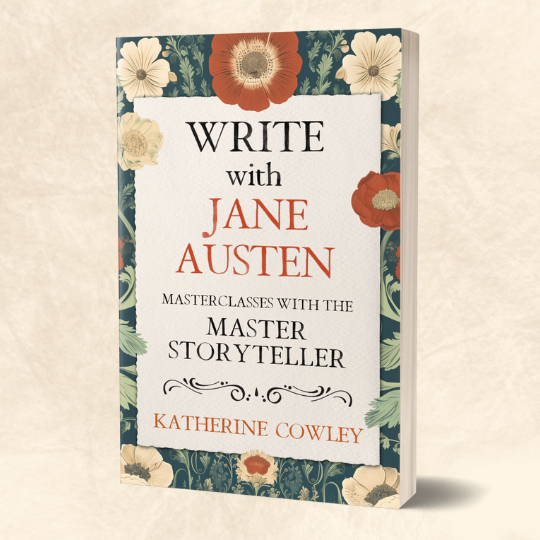
Jane Austen Writing Lessons is now a book!

Jane Austen Writing Lessons has been expanded into a book! The book includes over 70% brand-new material that never appeared on the blog. The book is now available in ebook, paperback, and hardcover from all major retailers.

A 3D rendering of the book Write with Jane Austen: Masterclasses with the Master Storyteller

Read more about the book and find links to your favorite retailers.

Examples from Jane Austen

Each lesson looks to Jane Austen’s novels and her other works for examples of excellent writing. Quotes from her six published novels and an analysis of her craft–and how we can apply it to our own writing–is included in each lesson.

Writing Exercises

Writing Exercises - Jane Austen Writing Lessons

Each lesson includes 2-3 writing exercises that will help you practice the creative writing principle and apply it to your own writing.

Most Recent Jane Austen Writing Lessons

Jane Austen celebrating her birthday. Austen wears a birthday hat, holds a birthday present, and sits next to a birthday cake covered with candles.
Jane Austen Writing Lessons. #69: The Jane Austen Approach to Critiquing Writing
An intriguing snippet which has Jane Austen's portrait and a mysterious gray box with the words, "Cover Coming Soon"
Jane Austen Writing Lessons #68: Establishing Relationships and Character Connections in Fiction
Jane Austen Writing Lessons 67. Creating an Emotional Map: Making Interconnected Emotions
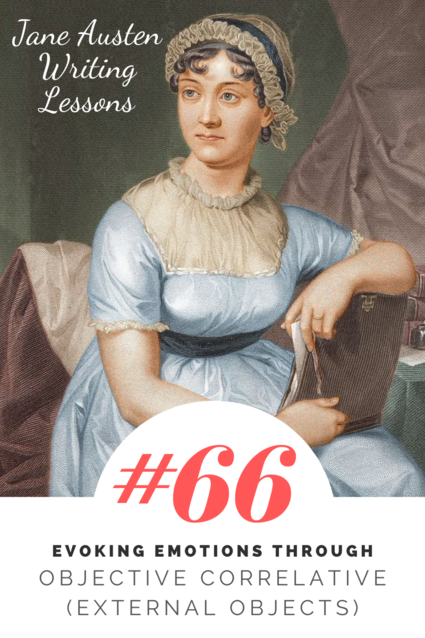
Jane Austen Writing Lessons. #66: Evoking Emotions through Objective Correlative (External Objects)
Mary Bennet and Mr. Collins. Why didn't they marry? Would they have made a good match?
Jane Austen Writing Lessons. #65: Different Character Approaches to Dealing with and Expressing Emotions
Jane Austen Writing Lessons. #64: The Size or Degree of Character Emotions

Jane Austen Writing Lessons by Category

Recognition for Jane Austen Writing Lessons

Jane Austen Writing Lessons: one of the

Jane Austen Writing Lessons was selected by The Write Life as one of the “100 Best Websites for Writers in 2021.” They wrote:

“[Jane Austen Writing Lessons] is filled with blog posts about creative writing that use Jane Austen’s novels and other related stories to share what good writing looks and sounds like. Whether you’re interested in plot structure or character development to dialogue, each Jane Austen writing lesson focuses on one principle of writing at a time.”

About the Author

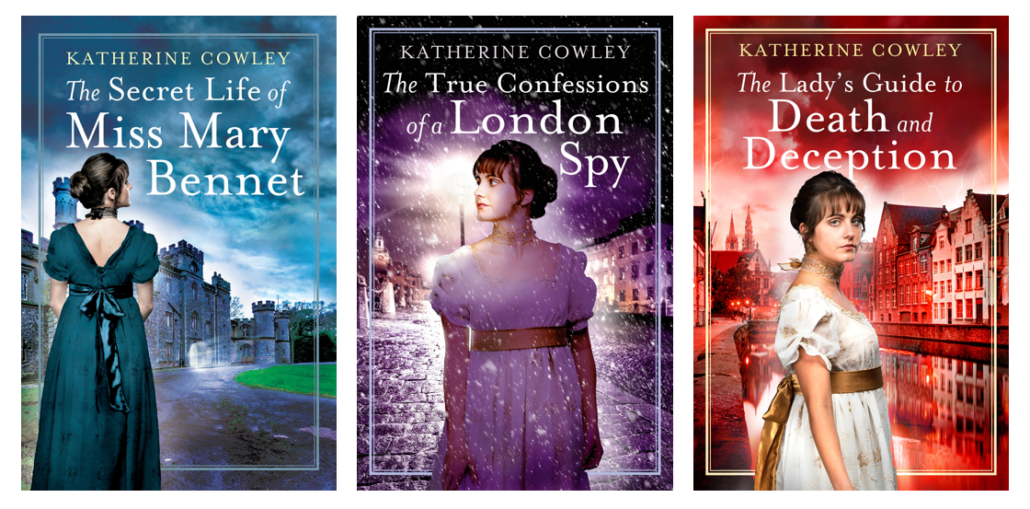
In addition to writing Jane Austen Writing Lessons, Katherine Cowley is the author of the novels The Secret Life of Miss Mary BennetThe True Confessions of a London Spy, and The Lady’s Guide to Death and Deception. She has taught writing classes at Western Michigan University and other universities and community colleges.

Her blog, Jane Austen Writing Lessons, has been expanded into a new book, Write with Jane Austen: Masterclasses with the Master Storyteller.

Jane Austen Writing Lessons. #66: Evoking Emotions through Objective Correlative (External Objects)

#66: Evoking Emotions Through Objective Correlative (External Objects)

Jane Austen Writing Lessons. #66: Evoking Emotions through Objective Correlative (External Objects)

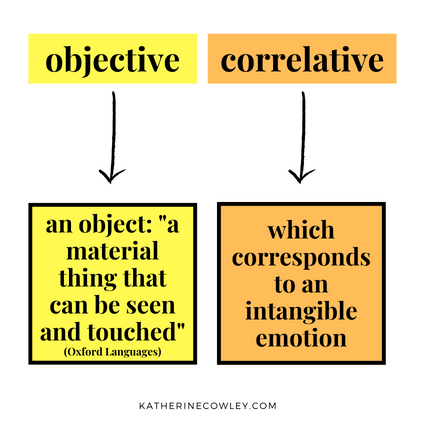
A powerful way to evoke emotions—to make them feel real, material, and defined—is through the use of objective correlative, or using external objects that the reader connects with an emotion. And of course, Jane Austen is a master at this.

In Austen’s novel Emma, the character of Harriet has difficulties with love (largely because of Emma’s interference). She becomes head-over-heels for Mr. Elton, and is devastated when she learns that he is not interested in her. Mr. Elton leaves town for a time period, and comes back with a bride, Augusta Hawkins. A few months later, a ball is held, and even though it is tradition for married men to dance with the unmarried ladies, Harriet is snubbed by Mr. Elton.

After the ball, Harriet comes to visit Emma, bringing with her a parcel on which she has written “Most precious treasures.” She wants to destroy these treasures, and she wants Emma as a witness.

Inside are two objects. First, is court plaister which Mr. Elton had once played with. Dictionary.com defines court plaister as “cotton or other fabric coated on one side with an adhesive preparation, as of isinglass and glycerin, used on the skin for medical and cosmetic purposes.” In essence, Harriet has kept an expensive Band-Aid.

The other object is a “superior treasure,” for Harriet finds it even “more valuable, because this is what did really once belong to him.”

She reveals the object to Emma:

It was the end of an old pencil,—the part without any lead.

Harriet has kept Mr. Elton’s pencil for months after his marriage to someone else. The tiny end of an old pencil stub, without any lead—it’s an evocative image, conjuring up a series of emotions for the reader. We feel pity for Harriet, we feel sympathy for her love and her heartbreak as we understand the depth of her feelings, and we feel negatively towards Emma. After all, it is Emma’s interference which has caused all this, has caused a discarded pencil stub to be another woman’s most prized possession.

This is a classic use of objective correlative.

Defining Objective Correlative and Its Powerful Emotional Impacts

According to scholar George P. Winston, the term objective correlative was coined by the American painter Washington Allston in 1843.

Allston’s definition of objective correlative is rather opaque. In his book Lectures on Art, he talks about how cabbages are different than cauliflowers—a cabbage can’t just change into a cauliflower, for it is a cabbage, and has its own physical properties and meaning.

Picture of a woman experiencing emotions while accompanied by cabbage and cauliflower (and broccoli). Washington Allston would approve. Photo by Ivan Samkov from Pexels

Picture of a woman experiencing emotions while accompanied by cabbage and cauliflower (and broccoli). Washington Allston would approve. Photo by Ivan Samkov from Pexels.

Then Allston writes:

So, too, is the external world to the mind; which needs, also, as the condition of its manifestation, its objective correlative. Hence the presence of some outward object, predetermined to correspond to the preëxisting idea in its living power, is essential to the evolution of its proper end,–the pleasurable emotion.

In other words, the things that happen inside our heads—and I would like to add, inside our hearts—are difficult to understand or to manifest. It’s so easy to go about our days and not understand why people are making the choices they’re making. It’s so easy to feel like others don’t truly understand our emotions—or that we don’t truly understand the emotions of those around us.

This becomes tricky for the writer. How do we take an emotion, something which is inherently abstract, intangible, and in many senses, undefinable, and make it feel real and substantial to the reader? There are numerous techniques that writers, including Jane Austen, use, including body language, facial expressions, dialogue, silence, free indirect speech, punctuation, syntax, repetition, and physical sensation, to name a few.

Allston doesn’t address these approaches, in part because he is a painter, interested in things which can take visual, material form on the canvas. But his advice can be useful for writers as well: he says that what we need do is manifest the mind—manifest the internal, unfathomable emotion—by finding a concrete, external object that can correlate to what is happening on the inside.

For Washington Allston, objects are “predetermined to correspond” to a “preexisting idea” or emotion, and I agree that there are some objects that have a standard emotion that are attached to them. For instance, in Western culture a coffin often evokes emotions related to sadness and mourning.

Yet we don’t automatically associate a pencil stub with the powerful emotions that Jane Austen conveys through it. So in order see the true power of objective correlative, we need a more expansive definition.

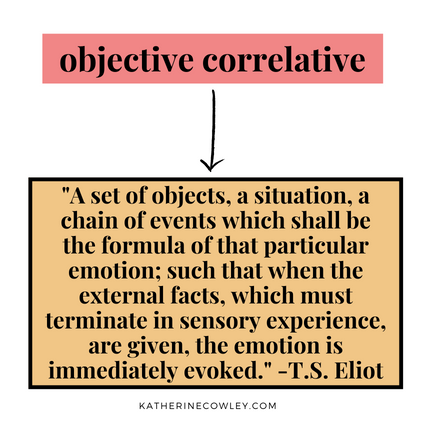
While others used Allston’s term, it was T.S. Eliot who popularized it in his 1919 essay, “Hamlet and His Problems.” He writes:

The only way of expressing emotion in the form of art is by finding an “objective correlative”; in other words, a set of objects, a situation, a chain of events which shall be the formula of that particular emotion; such that when the external facts, which must terminate in sensory experience, are given, the emotion is immediately evoked.

For T.S. Eliot, the emotional meaning of the object is contextual—it’s dependent on what happens around it in the poem or story. Objects are part of a situation and a chain of events, and it these groupings which create a formula for a particular emotion.

Let’s consider a few more examples of objective correlative in Austen’s work to see how we can apply this to our own writing.

In Sense and Sensibility, Marianne sees and reflects on the dead leaves with all the passion of romanticism. The leaves embody Marianne’s endless emotions and grief as she loses her home. The podcast The Thing About Austen has an excellent episode on Marianne’s dead leaves.

In Mansfield Park, the play Lovers’ Vows becomes an object which conveys emotions, both of Fanny and the other characters. This is truly a set of objects: there’s the script itself, the assignment of roles, all the preparations, and of course the physical set which is built and then torn down by Fanny’s uncle, leaving the play unperformed.

In the uncompleted novel Sanditon, the characters drive past Mr. and Mrs. Parker’s old house on the outskirts of Sanditon, which they have left in order to live in a new house, in the heart of the action, so they can pursue Mr. Parker’s dreams for Sanditon. Both Mr. and Mrs. Parker see different things in the old house and its gardens—they notice different attributes, and the things they notice and comment upon reveal that they feel very differently about the past, present, and future. While Mr. Parker praises it as “the house of my forefathers,” he remarks that it is “built in a hole” and that he is happy to have moved on. Mrs. Parker, on the other hand, says that it was a “very comfortable house,” and notices the beautiful garden, the places for the children to run and play, the desirable shade, and how it is always sheltered from the effects of winds and storms. It is clear that she misses the house and wishes they could return to it, and it is clear that turning Sanditon into a resort town is her husband’s dream, not hers.

It is important to note that Jane Austen uses objective correlative with moderation. None of her novels are packed with objective correlative, and not every object included in the novels is meant to create an emotion. Yet when she does use it, she does so to great effect.

How to Use Objective Correlative to Convey Emotions in Fiction

There are a number of principles we can take from how Jane Austen uses objective correlative:

  1. Objects can be used to correspond to emotions large and small.
  2. Some objects are important or evocative in their own right, but many are made important by the attention given to them. The context and history of the object can also help imbue meaning.
  3. In crafting fiction, it’s important to consider what people do with the objects or how they interact or talk about them.
  4. Highlighting the characteristics or attributes of an object can help open up our understanding of the corresponding emotion.
  5. The same object can engender different emotions for different characters. While sometimes an object reveals only the emotions of the main character, it can also reveal the emotions of other characters in the story.
  6. An object can be used in a single scene (like the pencil in Emma), or in sequence of scenes (like the play in Mansfield Park).
  7. In addition to revealing the emotions of characters, objects can create emotions in the reader.

I want to use one more example from Austen, to further explore the last two points: how an object can be used in a sequence of scenes, and how an object can create emotions in the reader.

Using Objective Correlative to Build to Moments of Emotional Weight for the Reader

In his definition, T.S. Eliot talked about a SET of objects and a CHAIN of events which immediately evoke a particular emotion in the audience.

One of the most effective ways to create a strong emotion in a reader is to build emotion with an object over time.

A great example of this is in Sense and Sensibility. (Warning: there will be major spoilers for the novel below!) As discussed in a previous post, Elinor keeps her emotions mostly inside. So how do we know that she is feeling strongly, and how do we as readers feel strongly with her? And how can we as readers draw parallels between Elinor’s heartbreak and her sister’s heartbreak, even though they are both such different characters? Austen achieves all of this through objective correlative.

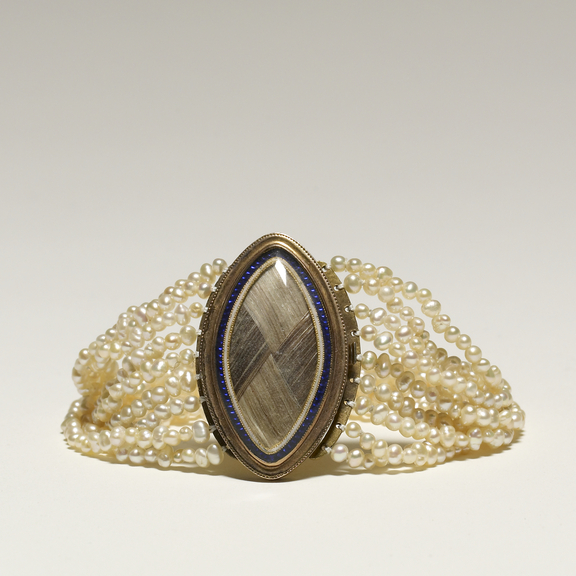
The objects used by Austen are locks of hair.

Locks of hair inlaid in a pearl bracelet. This piece was made in England between 1790 and 1810, and is owned by the Walters Art Museum. Image used through Creative Commons license.

Austen sets up these objects early on in the novel as meaningful tokens of affection when young Margaret tells Elinor that she saw Willoughby take a lock of Marianne’s hair:

Last night after tea, when you and mama went out of the room, they were whispering and talking together as fast as could be, and he seemed to be begging something of her, and presently he took up her scissors and cut off a long lock of her hair, for it was all tumbled down her back; and he kissed it, and folded it up in a piece of white paper; and put it into his pocket-book.

In a later chapter, the man Elinor loves, Edward, comes to visit. He is wearing a ring which contains a lock of hair. Marianne immediately assumes it belongs to Elinor, and teases Edward by pretending to wonder if the hair belongs to Edward’s sister, Fanny:

[Marianne] was sitting by Edward, and in taking his tea from Mrs. Dashwood, his hand passed so directly before her, as to make a ring, with a plait of hair in the centre, very conspicuous on one of his fingers.

“I never saw you wear a ring before, Edward,” she cried. “Is that Fanny’s hair? I remember her promising to give you some. But I should have thought her hair had been darker.”

Marianne spoke inconsiderately what she really felt—but when she saw how much she had pained Edward, her own vexation at her want of thought could not be surpassed by his. He coloured very deeply, and giving a momentary glance at Elinor, replied, “Yes; it is my sister’s hair. The setting always casts a different shade on it, you know.”

Elinor had met his eye, and looked conscious likewise. That the hair was her own, she instantaneously felt as well satisfied as Marianne; the only difference in their conclusions was, that what Marianne considered as a free gift from her sister, Elinor was conscious must have been procured by some theft or contrivance unknown to herself. She was not in a humour, however, to regard it as an affront, and affecting to take no notice of what passed, by instantly talking of something else, she internally resolved henceforward to catch every opportunity of eyeing the hair and of satisfying herself, beyond all doubt, that it was exactly the shade of her own.

Edward’s embarrassment lasted some time, and it ended in an absence of mind still more settled. He was particularly grave the whole morning. Marianne severely censured herself for what she had said; but her own forgiveness might have been more speedy, had she known how little offence it had given her sister.

Elinor is secretly pleased that Edward wears her hair in a ring. This is a promise of hope, a promise of affection, a promise that someday they might wed. And all of this emotion is embodied in a lock of hair.

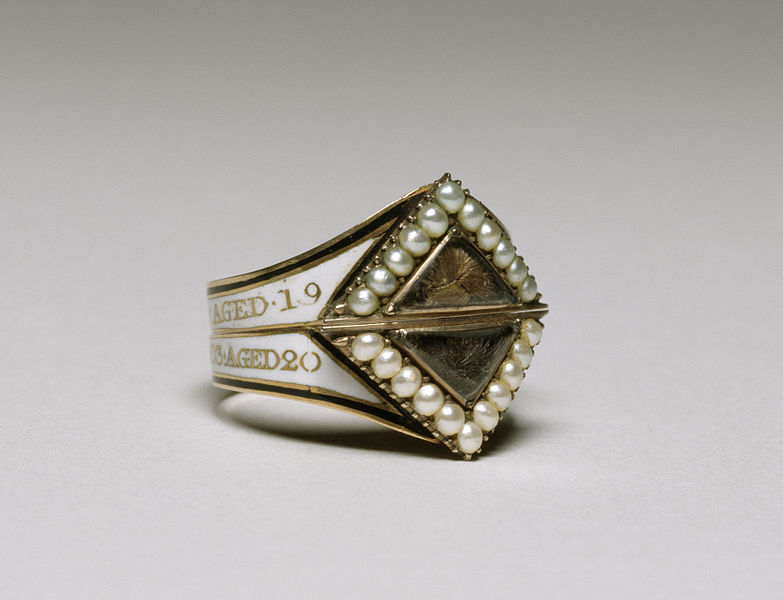
A memorial ring from 1804 or 1805 with locks of hair set between pearls. Mourning rings were given out to family and close friends at funerals, and often included locks of hair. In Sense and Sensibility it is clear that a ring with a lock of hair was not assumed to be a mourning ring, and that it was quite common for the ring to commemorate a living person. This ring is also owned by the Walters Art Museum. Image from Wikimedia Commons.

A few chapters later, as the chain of events progresses, Austen once again uses this same lock of hair. This is the prime example of what T.S. Eliot’s emotional formula, for she has set up the object to produce a very specific emotion from the reader.

What happens is that Elinor meets Lucy Steele. Lucy deduces that Elinor is in love with Edward, but Lucy is also in love with Edward, and she wants to mark her territory.

Lucy makes Elinor promise not to tell anyone what she is about to share, and then she confides in Elinor that she has been secretly engaged to Edward for four years.

Elinor cannot believe her, but Lucy provides more and more evidence, including dates and places that align with Elinor’s knowledge of Edward’s whereabouts, a miniature painting of Edward, and a letter written in Edward’s hand.

Then Lucy manages to completely decimate both Elinor and the reader’s emotions by bringing back a reference to the key object:

“Writing to each other,” said Lucy, returning the letter into her pocket, “is the only comfort we have in such long separations. Yes, I have one other comfort in his picture, but poor Edward has not even that. If he had but my picture, he says he should be easy. I gave him a lock of my hair set in a ring when he was at Longstaple last, and that was some comfort to him, he said, but not equal to a picture. Perhaps you might notice the ring when you saw him?”

“I did,” said Elinor, with a composure of voice, under which was concealed an emotion and distress beyond any thing she had ever felt before. She was mortified, shocked, confounded.

We too are mortified, shocked, and confounded, and we feel it deeply because these emotions are attached to a physical object. We thought the ring and the hair meant one thing, and to discover without a doubt that it means something else—this immediately evokes a reaction.

For me, this is the most powerful use of objective correlative in Sense and Sensibility, yet Austen continues to use locks of hair for emotional effect by bringing back the other lock of hair: Marianne’s.

When Marianne and Elinor spend the season in London, Marianne is snubbed by her love, Willoughby, and Elinor finds Marianne on her bed, completely and “violently” distraught. Next to Marianne, she discovers a letter from Willoughby, who has returned Marianne’s lock of hair.

It is with great regret that I obey your commands in returning the letters with which I have been honoured from you, and the lock of hair, which you so obligingly bestowed on me.

Marianne had asked for her letters and the lock of hair back, “if your sentiments are no longer what they were.” But she did not actually want him to return the hair. As she tells Elinor, she thought they were engaged:

“I felt myself,” she added, “to be as solemnly engaged to him, as if the strictest legal covenant had bound us to each other.”

“I can believe it,” said Elinor; “but unfortunately he did not feel the same.”

“He did feel the same, Elinor—for weeks and weeks he felt it. I know he did. Whatever may have changed him now, (and nothing but the blackest art employed against me can have done it), I was once as dear to him as my own soul could wish. This lock of hair, which now he can so readily give up, was begged of me with the most earnest supplication. Had you seen his look, his manner, had you heard his voice at that moment!”

Marianne rereads Willoughby’s letter, and the reference to the lock of hair only makes her more upset:

“It is too much! Oh, Willoughby, Willoughby, could this be yours! Cruel, cruel—nothing can acquit you….‘The lock of hair, (repeating it from the letter,) which you so obligingly bestowed on me’—That is unpardonable. Willoughby, where was your heart when you wrote those words? Oh, barbarously insolent!—Elinor, can he be justified?”

Once again, Austen employs objective correlative to show the depth of Marianne’s emotion by attaching it to a physical object. And, like Elinor, we feel deeply for Marianne.

Having built up this chain of events, with this set of objects (the locks of hair), Jane Austen continues to use them to great effect, bringing up each lock of hair one additional time.

When Marianne is severely ill and almost dies, Willoughby comes to visit, and tries to justify and redeem himself to Elinor. He blames his fiancé for forcing him to break Marianne’s heart and return Marianne’s lock of hair.

“[Marianne’s] three notes,—unluckily they were all in my pocketbook, or I should have denied their existence, and hoarded them for ever,—I was forced to put them up, and could not even kiss them. And the lock of hair—that too I had always carried about me in the same pocket-book, which was now searched by Madam with the most ingratiating virulence,—the dear lock,—all, every memento was torn from me.”

Elinor is tempted to absolve Willoughby—his speech is long and passionate, and the way he talks about Marianne’s lock of hair is definitely a point in his favor. Yet he returned it and broke his heart (and behaved like a rascal in other ways).
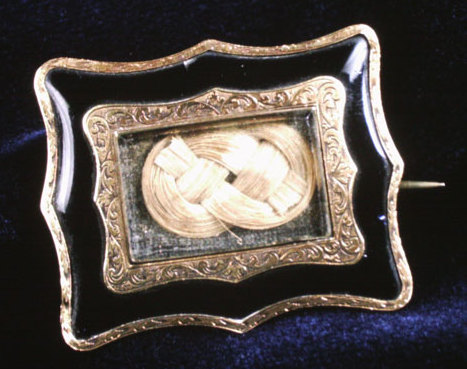
A brooch containing hair, so you can wear someone’s hair in your own hair. This was made in the 19th century, and is part of the permanent collection of The Children’s Museum of Indianapolis. Image courtesy of Wikimedia Commons.

Finally, Lucy’s lock of hair is once again brought back. After marrying Edward’s brother, she writes one last letter to Edward, saying that she feels no ill will to him, and that she decided that she could bestow her affections elsewhere since she thought she had lost his. The postscript of the letter reads:

“I have burnt all your letters, and will return your picture the first opportunity. Please to destroy my scrawls—but the ring with my hair you are very welcome to keep.”

Oh, dear Lucy. You are married to Edward’s brother, but you want him to keep your lock of hair. You want him to treasure and remember you still.

In this case, Austen is creating a very different emotion. We are meant to laugh at Lucy—and this becomes a laugh of relief, and we do feel relief, for Edward and Elinor have finally been able to come together. Edward and Elinor are able to read the letter and move past it. As Shakespeare would say, “All’s well that ends well.”

Jane Austen does not reveal what Edward actually does with the ring and the lock of hair, but based on his words to Elinor, and what that lock of hair meant to Lucy, we can safely assume that he does not keep it.

It amazes me what a simple lock of hair can do in the hands of an author like Jane Austen. This is my favorite example of objective correlative in literature.

There will be one more Jane Austen writing lesson to wrap up the series on emotion—I will be talking about other ways to build emotion across multiple scenes. And as always, there are three writing exercises below.

Writing Exercises - Jane Austen Writing Lessons

Exercise 1: Think of a scene you have written that has an important emotion (the emotion can be important, whether it is a large or a small one). Now imagine that you’re a painter. Instead of painting the character with their facial expression, you’ve decided to paint an object that corresponds to their emotion. If you have artistic inclinations (or want to try something new), paint or draw a picture of the object. If not, search for images online to find a representation of the object that best captures your character’s emotions.

Exercise 2: Reread one of your favorite stories or rewatch one of your favorite shows. Find an example of objective correlative. Is the object used once or as part of a sequence? What is the character’s relationship with the object? What emotions does the object reveal, and what emotions does the object create in the audience?

Exercise 3: For a story idea that is either new or in early stages of development/writing, choose an object or set of objects that could be used in a sequence of scenes to create emotions for the reader. Try to use the object at least three times. What does the object mean to the characters? What do you want the object to mean for the readers?

Don’t Miss a Lesson: Subscribe to Updates and Giveaways from katherinecowley.com

* indicates required


Which newsletter(s) would you like to receive?

Mary Bennet and Mr. Collins. Why didn't they marry? Would they have made a good match?

Mary Bennet and Mr. Collins

Mary Bennet and Mr. Collins. Why didn't they marry? Would they have made a good match?

In Jane Austen’s novel, Pride and Prejudice, several of the characters make good matches, not just financially, but emotionally and romantically. Elizabeth marries Mr. Darcy, and Jane marries Mr. Bingley. Other matches are more complicated, like Lydia’s marriage to Mr. Wickham, and Charlotte Lucas’ marriage to Mr. Collins. In fact, many readers have wondered if Mary Bennet and Mr. Collins might not have been more suited for each other. Why didn’t Mr. Collins marry Mary Bennet? And if they had married, would it have been a good match?

It’s Jane Austen’s fault that these questions are asked, for she planted seeds for these speculations in the text. At the same time, she clearly demonstrates what led Mr. Collins to choose Charlotte Lucas as his bride rather than turning to Mary Bennet. Let’s look at the sequence of events, as conveyed in the book:

  1. Mr. Collins proposes to Elizabeth.
  2. Elizabeth turns down Mr. Collins.
  3. Mrs. Bennet congratulates Mr. Collins on his engagement to her daughter. He explains that she turned him down, but that he also believes that despite her refusal, Elizabeth actually intends to marry him.
  4. Mrs. Bennet attempts to convince her husband to force Elizabeth to marry Mr. Collins. When Mr. Bennet refuses to do so, she tries—and fails—to convince Elizabeth on her own.
  5. Charlotte Lucas comes to visit the Bennets and finds the house in an uproar. Mr. Collins shows Charlotte civility, and she politely pretends not to notice the hubbub about the failed marriage proposal.
  6. Mr. Collins spends the rest of the day trying to ignore Elizabeth, and spends much of the time talking to Charlotte Lucas: “the assiduous attentions which he had been so sensible of himself were transferred for the rest of the day to Miss Lucas, whose civility in listening to him was a seasonable relief to them all, and especially to her friend.”
  7. The next day, the Bennets eat dinner with the Lucases, and Charlotte is so kind as to entertain Mr. Collins. (Austen lets us know that Charlotte’s actual “object was nothing less than to secure [Elizabeth] from any return of Mr. Collins’s addresses, by engaging them towards herself.”)
  8. The next morning—his very last day visiting Meryton—Mr. Collins walks towards Lucas Lodge. Upon seeing him from the window, Charlotte contrives to “accidentally” run into him in the lane. Mr. Collins proposes to Charlotte, and Charlotte accepts.
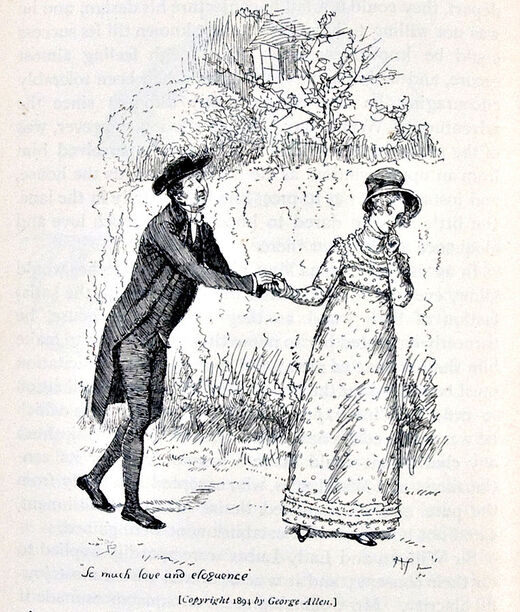
Mr. Collins proposes to Charlotte Lucas with "so much love and elegance." 1894 illustration by George Allen.

An 1894 illustration by George Allen of Mr. Collins proposing to Charlotte Lucas with “so much love and eloquence.” (Image in public domain; accessed through Wikimedia Commons)

  1. That evening, after becoming engaged to Charlotte Lucas, Mr. Collins must say farewell to the Bennets. He does not inform them of his engagement, but he does offer them his gratitude, affections, and wishes of health and happiness, even making a point not to exclude Elizabeth. Then he informs them that he plans to return soon to Longbourn, and the narrator finally tells us how Mary Bennet feels about the whole affair:

With proper civilities, the ladies then withdrew; all of them equally surprised to find that he meditated a quick return. Mrs. Bennet wished to understand by it that he thought of paying his addresses to one of her younger girls, and Mary might have been prevailed on to accept him. She rated his abilities much higher than any of the others: there was a solidity in his reflections which often struck her; and though by no means so clever as herself, she thought that, if encouraged to read and improve himself by such an example as hers, he might become a very agreeable companion. But on the following morning every hope of this kind was done away. Miss Lucas called soon after breakfast, and in a private conference with Elizabeth related the event of the day before.

Poor Mary Bennet.

Unlike her sisters, she actually values Mr. Collins’ abilities—or at least, “rated [them] much higher” than her sisters did. She is often—key word, often—struck by the “solidity in his reflections.” She does not think he is as intelligent or clever as she is, but she sees in him potential. He could read and improve himself. Even if he is not truly agreeable now, “he might become a very agreeable companion.”

Alas, Mary admits her feelings to herself to late to act on them. And even if she had admitted her feelings for Mr. Collins earlier, she would be unlikely to actively and swiftly pursue him, as Charlotte Lucas does. It is Charlotte’s willingness to converse with Mr. Collins, and then her direct pursuit of him, that leads to their marriage.
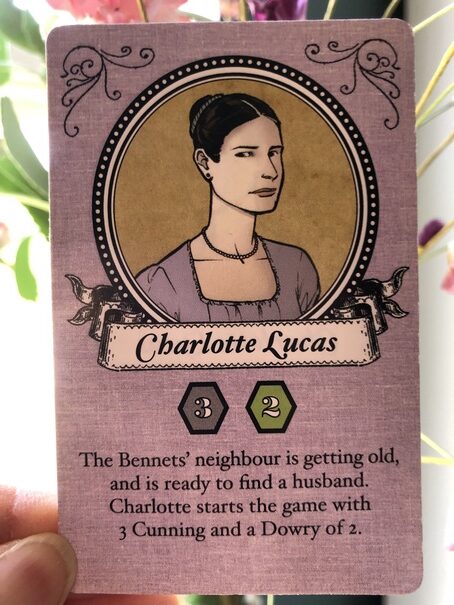
In one of my favorite card games, Marrying Mr. Darcy, Charlotte Lucas starts the game with a score of three cunning, which is rather fitting. (In the game, none of other characters start with any cunning, though they can acquire it throughout the game.)

The Charlotte Lucas card from the game Marrying Mr. Darcy. There is a portrait of Charlotte Lucas in a purple dress with an analytical look on her face. The card says, "The Bennets' neighbor is getting old, and is ready to find a husband. Charlotte starts the game with 3 Cunning and a Dowry of 2.

In Melissa Leilani Larsen’s fabulous stage version of Pride and Prejudice, Mary actually makes Mr. Collins a pudding, which she is about to give him when she is cast out of the room by her mother so that he can propose to Elizabeth. I saw a Zoom production of the play in early 2021, and the way Mary said “But he hasn’t tried my pudding” almost brought me to tears. In this adaptation, Mary’s realization of her feelings for Mr. Collins comes earlier, but still too late.
Now let’s dive into the text of Pride and Prejudice to consider seven arguments for why Mr. Collins should have married Mary Bennet, and seven arguments on why that would have been a bad idea.

Arguments for a happy union between Mr. Collins and Mary Bennet, aka, why he should have married her

  1. Mary is interested in Mr. Collins, sees his positive qualities, and believes he could become an agreeable companion—and is not interest a base upon which something more substantial can be built?
  2. Mr. Collins doesn’t really care which sister he marries. He transfers his interest easily from Jane to Elizabeth upon a gentle nudge from Mrs. Bennet. Mary is also a Bennet sister! Could he not shift his interest to her?
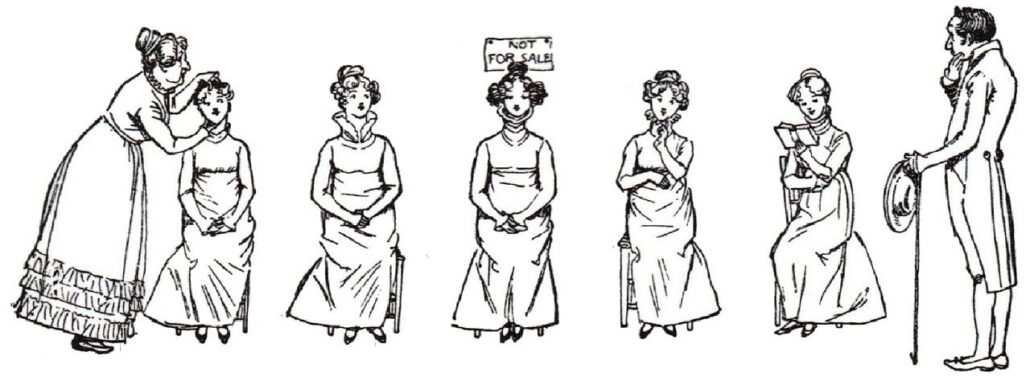
Hugh Thomson 1894 illustration from Pride and Prejudice. Five sisters sit on chairs, as if on display, and Mr. Collins inspects them. Mrs. Bennet adjusts the pose of one of her daughters. Jane has a sign over her head that says "Not for sale"

“Mr. Collins meant to choose one of the daughters.” A humorous 1894 illustration of the five sisters, one of whom Mrs. Bennet has marked as unavailable, by Hugh Thomson. (Source: Wikimedia Commons, Creative Commons license.)

  1. They have similar speaking habits: Mr. Collins like to wax eloquently about any subject, and Mary likes to make profound statements on life. Neither individual is as clever, intelligent, or witty as they think themselves.

During a dinner conversation, Mr. Collins mentions that he frequently compliments Lady Catherine de Bourgh and her daughter.

Mr. Bennet says:

“It is happy for you that you possess the talent of flattering with delicacy. May I ask whether these pleasing attentions proceed from the impulse of the moment, or are the result of previous study?”

Mr. Collins replies with one of the best lines from the novel:

“They arise chiefly from what is passing at the time; and though I sometimes amuse myself with suggesting and arranging such little elegant compliments as may be adapted to ordinary occasions, I always wish to give them as unstudied an air as possible.”

Both Mr. Bennet and Elizabeth find his reply pleasingly absurd.

Earlier in the novel, after the Meryton assembly, Elizabeth is complaining of Mr. Darcy’s behavior to her sisters and Charlotte Lucas. Elizabeth says,

“I could easily forgive his pride, if he had not mortified mine.”

Mary immediately gives a long speech on pride, which, while it contains some insights, does not truly add to the conversation:

“Pride,” observed Mary, who piqued herself upon the solidity of her reflections, “is a very common failing, I believe. By all that I have ever read, I am convinced that it is very common indeed; that human nature is particularly prone to it, and that there are very few of us who do not cherish a feeling of self-complacency on the score of some quality or other, real or imaginary. Vanity and pride are different things, though the words are often used synonymously. A person may be proud without being vain. Pride relates more to our opinion of ourselves; vanity to what we would have others think of us.”

No one acknowledges Mary’s statement, nor does it shift anyone’s views on the subject at hand.

  1. Neither Mr. Collins nor Mary completely fit into society. Both have trouble understanding and behaving appropriately in social situations, such as when Mr. Collins introduces himself to Mr. Darcy at the ball, and, at the very same ball, Mr. Bennet must stop Mary from performing on the pianoforte. Mary seems to have an innate social awkwardness and lack of awareness, and Mr. Collins’ deficits are caused, at least in part, by his upbringing and education.
  2. Mary is bookish, and Mr. Collins likes reading religious tracts and books.
  3. Mr. Collins is a clergyman, and Mary cares deeply about moral values.
  4. They are both judgmental. After Lydia runs away with Wickham, Mary declares,

“Loss of virtue in a female is irretrievable, that one false step involves her in endless ruin, that her reputation is no less brittle than it is beautiful, and that she cannot be too much guarded in her behaviour towards the undeserving of the other sex.”

And in a letter, Mr. Collins writes,

“The death of your daughter would have been a blessing in comparison of this.”

Ouch. That’s harsh.

As we consider these seven reasons, we find ourselves asking:

What better foundation for marriage is there than social ineptitude, bookishness, and a healthy dose of self-righteousness?

Mary and Mr. Collins do share some fundamental values, and both relate to people in a distinctive way. And this could be enough to argue that they would be well suited.

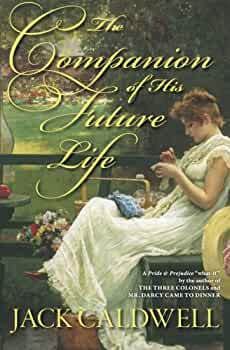
The Companion of His Future Life by Jack Caldwell

In Jack Caldwell’s novel The Companion of His Future Life, Mr. Collins does marry Mary Bennet. While the novel still focuses on the stories of Elizabeth and Jane, we see a fair bit of Mary, and both she and Mr. Collins seem quite satisfied with their choice. As a result of their marriage, Mary grows in new ways. She does not let Lady Catherine de Bourgh control her life, and goes behind her back to become close friends with Anne de Bourgh.

Arguments against a happy union between Mr. Collins and Mary Bennet, aka, why it’s a good thing he married Charlotte Lucas

  1. Being similar does not actually mean you are suited. Were they to marry, their similarities could cause them trouble in the future, particularly since they both struggle in social situations.
  2. Mr. Collins is actually a lot less bookish than Mary. He’s not as well read, and even Mary, with her inability to see how to apply her knowledge, can see that he is lacking in this area:

Though by no means so clever as herself, she thought that, if encouraged to read and improve himself by such an example as hers, he might become a very agreeable companion.

  1. Mr. Collins needs someone to manage him. He already follows Lady Catherine de Bourgh’s every suggestion. After his marriage to Charlotte, she helps him restrain some of his less-desirable tendencies in ways that make her life better:

To work in his garden was one of his most respectable pleasures; and Elizabeth admired the command of countenance with which Charlotte talked of the healthfulness of the exercise, and owned she encouraged it as much as possible.

Would Mary be able to do this in the same subtle yet effective manner? It is likely that she’d choose a different, more direct tact. Yet some of the reason Charlotte and Mr. Collins’ marriage works is because he does not feel any friction. At the end of Elizabeth’s six-week visit, Mr. Collins says:

“Only let me assure you, my dear Miss Elizabeth, that I can from my heart most cordially wish you equal felicity in marriage. My dear Charlotte and I have but one mind and one way of thinking. There is in everything a most remarkable resemblance of character and ideas between us. We seem to have been designed for each other.”

Unlike Charlotte, Mary is not strategic in being tactful, and Mary would likely directly tell Mr. Collins if she disagreed with him. This would create a very different marriage, one with the potential for conflict.

  1. Even after his marriage, Lady Catherine is the most important person in Mr. Collins’ life. Charlotte is willing to praise Lady Catherine, be quiet during large portions of meals with her, and ignore any difficulties she causes in her life.

While it’s possible Mary could do the same (and in Caldwell’s novel, she not only does that, but also manages to subtly influence Lady Catherine in ways that help her meet her own goals), it’s just as possible that Mary would follow the path of Elizabeth and state her mind to Lady Catherine. When Elizabeth speaks up to Lady Catherine, it causes great consternation on the part of Mr. Collins, and he would likely be even more upset if it were his wife disagreeing with her.

  1. Mary wants Mr. Collins to change (“to read and improve himself”). Could Mr. Collins change in a way that would suit Mary?

In her novels, Jane Austen is open to the idea of people changing, but this change generally happens before marriage. For instance, inspired by Elizabeth’s critique, Mr. Darcy lets go of his pride:

“I have been a selfish being all my life, in practice, though not in principle. As a child I was taught what was right, but I was not taught to correct my temper. I was given good principles, but left to follow them in pride and conceit….Such I was, from eight to eight-and-twenty; and such I might still have been but for you, dearest, loveliest Elizabeth! What do I not owe you!”

  1. A large part of Charlotte and Mr. Collins’ marital harmony is due to Charlotte’s ability to ignore that which she doesn’t like in her husband. When Elizabeth visits, she watches their interactions:

When Mr. Collins said anything of which his wife might reasonably be ashamed, which certainly was not seldom, she involuntarily turned her eye on Charlotte. Once or twice she could discern a faint blush; but in general Charlotte wisely did not hear.

Being able to largely ignore the little bothers in each other is of great service to other relationships as well (Mr. Bennet must do the same for Mrs. Bennet). This is something Mary would need to learn.

  1. Mary’s interests thus far have been to devote as much time to her studies and the piano as possible. She seems ill-prepared to manage a household, while Charlotte is ready and willing to do so. Mary would need to develop those skills and, by necessity of not having many servants, would need to take time from her books and devote herself to running a house. This is something she would need to learn if she ever marries anyone. But because it is something Charlotte already has mastered, and that she finds intrinsic value in, this is a source of joy for her.

When Elizabeth leaves after her six week visit, she reflects:

Poor Charlotte! it was melancholy to leave her to such society! But she had chosen it with her eyes open; and though evidently regretting that her visitors were to go, she did not seem to ask for compassion. Her home and her housekeeping, her parish and her poultry, and all their dependent concerns, had not yet lost their charms.

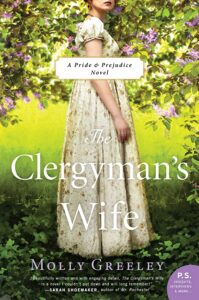
One of my favorite novels which explores Charlotte’s perspective, with its joys and struggles, is The Clergyman’s Wife. Even for Charlotte, even with her need for security, it is not an easy path.

The Clergyman's Wife by Molly Greeley

In looking at these seven reasons, Mary seems ill-suited for Mr. Collins. Charlotte already has the perspective and the skills to make matrimony to Mr. Collins be as smooth as possible, while if Mary were to marry Mr. Collins, their path would be bumpy, at least at the start.

How Does the Marriage Impact Elizabeth?

Reflections on Marriage: What we can learn from the marriages that did and did not occur

Any marriage requires give and take, and if the marriage of Mr. and Mrs. Bennet is a good indication, there are plenty of workable marriages in which the two individuals are not particularly suited for each other. Whether or not the pros outweigh the cons, or the cons outweigh the pros, ultimately Mary Bennet and Mr. Collins could have had a tolerable, successful, or perhaps even joyful marriage.

Regardless of whether they would have been suited for each other, Charlotte took the initiative and as a result, married Mr. Collins. From a story standpoint, this is powerful, because while Elizabeth doesn’t think highly of Mary’s life philosophies, Charlotte Lucas is her close friend. Charlotte and Mr. Collins’ engagement shakes Elizabeth.

When speaking to her sister Jane of Charlotte’s impending marriage, Elizabeth declares:

“It is unaccountable! in every view it is unaccountable!”

“My dear Lizzy, do not give way to such feelings as these. They will ruin your happiness. You do not make allowance enough for difference of situation and temper. Consider Mr. Collins’s respectability, and Charlotte’s prudent, steady character. Remember that she is one of a large family; that as to fortune it is a most eligible match; and be ready to believe, for everybody’s sake, that she may feel something like regard and esteem for our cousin.”

“To oblige you, I would try to believe almost anything, but no one else could be benefited by such a belief as this; for were I persuaded that Charlotte had any regard for him, I should only think worse of her understanding than I now do of her heart. My dear Jane, Mr. Collins is a conceited, pompous, narrow-minded, silly man: you know he is, as well as I do; and you must feel, as well as I do, that the woman who marries him cannot have a proper way of thinking. You shall not defend her, though it is Charlotte Lucas. You shall not, for the sake of one individual, change the meaning of principle and integrity, nor endeavour to persuade yourself or me, that selfishness is prudence, and insensibility of danger security for happiness.”

Later, when Elizabeth visits Charlotte and Mr. Collins, she comes to accept—perhaps even understand—Charlotte’s choice, despite knowing that she would never have been able to make such a choice herself. She thinks, “Poor Charlotte!,” but her anger for her friend’s choice has been replaced by melancholy.

Elizabeth does not adopt Charlotte’s outlook on life—if she had, she would have accepted Mr. Darcy’s first proposal, despite her dislike of him.

Mr. Collins and Charlotte’s marriage acts as a foil to Elizabeth’s ultimate decision to marry Mr. Darcy. Yet it also influences Elizabeth, and helps her have a more expansive perspective on life.

If Mary had married Mr. Collins, it would have been less likely to change Elizabeth in any significant way.

My Personal Stance

While I can understand the opposing perspective, personally, I don’t think that Mr. Collins and Mary would be particularly happy together. When I wrote my own continuation of Mary’s story, a trilogy which begins with The Secret Life of Miss Mary Bennet, I didn’t give Mary a romance in the first book, because I didn’t think she was ready for marriage. I felt like she needed to grow and develop, and figure out herself first, before she would be ready for a relationship. However, in the very first chapter, she does reflect on the fact that she did not have the opportunity to marry Mr. Collins: this is an event that has stuck with her and continues to influence her.

The complete series: The Secret Life of Miss Mary Bennet, The True Confessions of a London Spy, The Lady's Guide to Death and Deception

What do you think? Do you side with Jack Caldwell and others who see great potential in a Mary-Mr. Collins relationship? Or do you think that it would have been a bad choice for one or both of them? I’d love to hear your thoughts in the comments!

Subscribe for book news, events, giveaways, writing tidbits, and other updates from Katherine Cowley!

* indicates required


Note: sometimes I used affiliate links to Amazon and other websites. When that occurs, I may receive a small commission, but at no additional cost to you.

Jane Austen Writing Lessons. #65: Different Character Approaches to Dealing with and Expressing Emotions

#65: Different Character Approaches to Dealing With and Expressing Emotions

Jane Austen Writing Lessons. #65: Different Character Approaches to Dealing with and Expressing Emotions

Jane Austen’s Sense and Sensibility focuses on two sisters, Elinor and Marianne, who act as foils to each other. They see the world differently; they treat relationships differently; Elinor places more value on reason while Marianne places more value on feelings and sensibility. One of the most stark contrasts between the two sisters is how they deal with their emotions and how they express them to others.

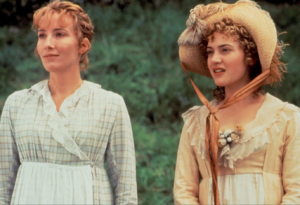
Elinor and Marianne in the 1995 version of Pride and Prejudice. Marianne is younger, and her gown has more color; she wears a fashionable hat while Elinor wears none.

Elinor and Marianne, as depicted in the 1995 film version of Sense and Sensibility

Both Elinor and Marianne experience similar loss: they are both separated from and hurt by the men they love.

When Willoughby leaves Marianne, she has a very dramatic response, and suffers “violent affliction.” Her emotions become less violent, but they continue to be marked by outward pining and despair. She becomes very inwardly focused, not noticing the needs or circumstances of those around her, and she makes a scene at a London ball when she sees Willoughby. After he marries someone else, goes out in bad weather and becomes deathly ill.

When Elinor discovers that Edward Ferrars is secretly engaged to Lucy Steele (through Lucy confiding in her), she suffers intense pain, but she refuses to outwardly show it to Lucy. And then she continues to mask her emotions with her family, even though doing so pains her. She knows that Marianne is suffering, and she doesn’t want to add any more burdens to her family by sharing her own suffering; furthermore, she is bound by a promise she has made to Lucy Steele, and because of that promise she does not know how to share her pain with those closest to her. Yet because she is a point of view character, as readers we see and understand her suffering and her internal angst.

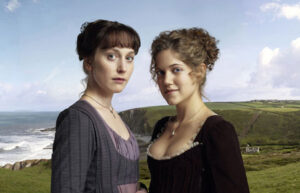
Elinor and Marianne, as depicted the 2008 version of Sense and Sensibility. Elinor appears more serious while Marianne appears more playful.

Elinor and Marianne, as depicted in the 2008 Sense and Sensibility miniseries

These two characters react to similar situations differently because of their contrasting personalities and because of different outside circumstances. In addition to considering how the same character will express small, medium, and large emotions differently, writers should consider how different characters deal with and express their emotions.

Later, when it becomes public knowledge that Edward is engaged to Lucy Steele, Marianne is in complete shock. But she notices that her sister is not surprised.

“How long has this been known to you, Elinor? has he written to you?”

“I have known it these four months. When Lucy first came to Barton Park last November, she told me in confidence of her engagement.”

At these words, Marianne’s eyes expressed the astonishment which her lips could not utter. After a pause of wonder, she exclaimed—

“Four months!—Have you known of this four months?”

Elinor confirmed it.

“What! while attending me in all my misery, has this been on your heart? And I have reproached you for being happy!”

“It was not fit that you should then know how much I was the reverse!”

“Four months!” cried Marianne again. “So calm! so cheerful! How have you been supported?”

Marianne struggles to understand how Elinor’s outward reality could be in such contrast to her inward reality, because for Marianne, her inward and outward realities are typically aligned.

To Marianne’s question, Elinor responds:

“By feeling that I was doing my duty.—My promise to Lucy, obliged me to be secret. I owed it to her, therefore, to avoid giving any hint of the truth; and I owed it to my family and friends, not to create in them a solicitude about me, which it could not be in my power to satisfy.”

Marianne seemed much struck.

“I have very often wished to undeceive yourself and my mother,” added Elinor; “and once or twice I have attempted it;—but without betraying my trust, I never could have convinced you.”

“Four months! and yet you loved him!”

“Yes. But I did not love only him; and while the comfort of others was dear to me, I was glad to spare them from knowing how much I felt. Now, I can think and speak of it with little emotion. I would not have you suffer on my account; for I assure you I no longer suffer materially myself. I have many things to support me. I am not conscious of having provoked the disappointment by any imprudence of my own, I have borne it as much as possible without spreading it farther.”

Elinor goes on to tell Marianne how she has forgiven Edward and does not blame him. Then she says:

“Edward will marry Lucy; he will marry a woman superior in person and understanding to half her sex; and time and habit will teach him to forget that he ever thought another superior to her.”

Marianne cannot accept that her sister could reach such a point if she truly and fully loved Edward:

“If such is your way of thinking,” said Marianne, “if the loss of what is most valued is so easily to be made up by something else, your resolution, your self-command, are, perhaps, a little less to be wondered at.—They are brought more within my comprehension.”

But Elinor will not accept Marianne’s judgment. She rebukes Marianne, in essence saying that she has loved and felt as deeply as Marianne:

“I understand you. You do not suppose that I have ever felt much. For four months, Marianne, I have had all this hanging on my mind, without being at liberty to speak of it to a single creature; knowing that it would make you and my mother most unhappy whenever it were explained to you, yet unable to prepare you for it in the least. It was told me,—it was in a manner forced on me by the very person herself, whose prior engagement ruined all my prospects; and told me, as I thought, with triumph. This person’s suspicions, therefore, I have had to oppose, by endeavouring to appear indifferent where I have been most deeply interested; and it has not been only once; I have had her hopes and exultation to listen to again and again. I have known myself to be divided from Edward for ever, without hearing one circumstance that could make me less desire the connection. Nothing has proved him unworthy; nor has anything declared him indifferent to me. I have had to contend against the unkindness of his sister, and the insolence of his mother; and have suffered the punishment of an attachment, without enjoying its advantages. And all this has been going on at a time, when, as you know too well, it has not been my only unhappiness. If you can think me capable of ever feeling, surely you may suppose that I have suffered now. The composure of mind with which I have brought myself at present to consider the matter, the consolation that I have been willing to admit, have been the effect of constant and painful exertion; they did not spring up of themselves; they did not occur to relieve my spirits at first. No, Marianne. Then, if I had not been bound to silence, perhaps nothing could have kept me entirely—not even what I owed to my dearest friends—from openly showing that I was very unhappy.”

Marianne was quite subdued.

“Oh! Elinor,” she cried, “you have made me hate myself for ever.—How barbarous have I been to you!—you, who have been my only comfort, who have borne with me in all my misery, who have seemed to be only suffering for me!—Is this my gratitude?—Is this the only return I can make you?—Because your merit cries out upon myself, I have been trying to do it away.”

This is a powerful scene between the two sisters, in part because their different approaches to dealing with and expressing emotions requires them to reconcile with each other.

When writing character emotions, it’s important to remember that there is a full range of ways a character can react to the same event: a more dramatic, outward expression or a quieter, more internal expression could both be used for either large or small emotions. A more “emotional” character, like Marianne, does not actually have more emotions—they simply express them in a different manner. It is important to note, however, that the way a character chooses to express their emotions does have consequences: Marianne pining for months does have negative effects on her well-being, and prevents her from dealing with her emotions and facing the truth about Willoughby.

There are a full range of possibilities responses in between these two opposite approaches: there are endless ways a character might deal with or express their emotions. There is no guide, no rule on whether your character should express emotions in a big or small manner, an internal or an external way: this is something you have to choose for each character, and this choice will reveal a lot about the individual and their circumstances.

Writing Exercises - Jane Austen Writing Lessons

Exercise 1: Write a scene with two characters. They can be siblings, friends, coworkers, or have something else that ties them together and creates similarities between them. In the scene, have something negative happen to both of the characters. The two characters should deal with and express their emotions in different ways (they do not need to be polarly opposite in their reactions, but they can be).

Exercise 2: Write a second scene with two characters with something in common—they can be the same characters from exercise 1, or new characters. In this scene, have something positive happen to both of the characters. Once again, have the characters deal with and express their emotions in different ways.

Exercise 3: Choose a handful of people in your life that you know well or interact with on a regular basis. For each person, write a several sentence sketch about how they deal with and express their emotions.

Then reflect on the differences between these people, and how their reactions are impacted by their personalities and circumstances.

Don’t Miss a Lesson: Subscribe to Updates and Giveaways from katherinecowley.com

* indicates required


Which newsletter(s) would you like to receive?

Jane Austen Writing Lessons. #64: The Size or Degree of Character Emotions

#64: The Size or Degree of Character Emotions

Jane Austen Writing Lessons. #64: The Size or Degree of Character Emotions

When we talk about emotions in writing, we often think of big emotions, when characters are very emotional and emotive.

Yet characters experience not only a broad range of types of emotions, but a broad range of sizes of emotions. Characters have emotions that are strong or overwhelming, but they also have emotions that are fleeting and less consequential.

When considering the size of the emotion, it’s useful to ask:

  • To what degree does your character experience this emotion?
  • How important is this emotion to the story?
  • How many emotional clues need to be planted to convey this emotion?

In Pride and Prejudice, Elizabeth experiences emotions in every scene—and in most scenes, she experiences more than one emotion. Let’s look at how Jane Austen conveys small emotions, mid-size emotions, and large emotions for this character.

Small Emotions

Small emotions are ones that the character experiences either for a short time, or only to a small degree. This might a small annoyance, a temporary flush of joy, a reaction to another character or something that happened.

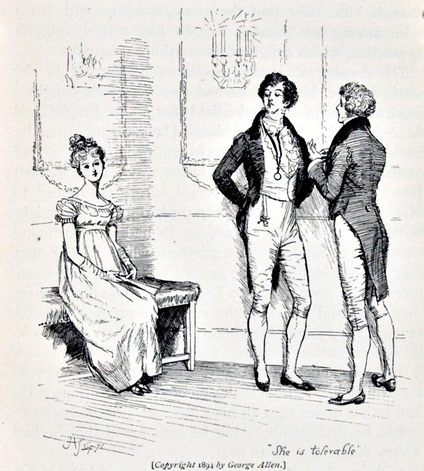
While attending the Meryton Assembly, Elizabeth overhears Mr. Bingley trying to convince Mr. Darcy to dance, and Bingley points out that Elizabeth could be a good partner. Mr. Darcy replies:

“She is tolerable; but not handsome enough to tempt me.”

Illustration from 1894 by Hugh Thomson, featuring Jane overhearing Mr. Darcy tell Mr. Bingley "She is tolerable"

1894 illustration from Pride and Prejudice by Hugh Thomson, via Lilly Library, Indiana University, Wikipedia Commons

While this is a rather weighty insult, Elizabeth has only a small emotional response:

Mr. Darcy walked off; and Elizabeth remained with no very cordial feelings towards him. She told the story however with great spirit among her friends; for she had a lively, playful disposition, which delighted in any thing ridiculous.

Clearly she’s not happy with Darcy, but rather than wallowing in the emotion, she sees it as ridiculous and tells it as a funny story.

Throughout Pride and Prejudice, Elizabeth often uses humor as a lens to deal with small emotions. For some character, this event could create a much larger emotional response, but for Elizabeth it remains small, and she moves on.

It is a key emotional moment for the reader–one of the most memorable moments in the novel, that sets up their antagonism–but it doesn’t require very much space on the page.

At other times emotions are implied or are barely brushed upon. It’s important for the reader to understand what the character’s emotion is, but it’s a small emotion that needs only a small amount of space.

For example, after Mr. Collins’ arrival, he starts showering compliments on the family:

He had not been long seated before he complimented Mrs. Bennet on having so fine a family of daughters, said he had heard much of their beauty, but that, in this instance, fame had fallen short of the truth; and added, that the did not doubt her seeing them all in due time well disposed of in marriage.

And then, Austen gives us the emotional response of Elizabeth and her sisters, in contrast to Mrs. Bennet’s response:

This gallantry was not much to the taste of some of his hearers, but Mrs. Bennet, who quarrelled with no compliments, answered most readily.

It’s a simple phrase—“not much to the taste of some of his hearers”—but it does all that is needed to do to establish Elizabeth’s sentiments towards her cousin.

Hugh Thomson 1894 illustration from Pride and Prejudice. Five sisters sit on chairs, as if on display, and Mr. Collins inspects them. Mrs. Bennet adjusts the pose of one of her daughters. Jane has a sign over her head that says "Not for sale"

1894 illustration by Hugh Thomson from Pride and Prejudice. Jane, of course, is “Not for Sale,” but Mr. Collins is welcome (according to Mrs. Bennet) to choose any of the other daughters. Image via Wikimedia Commons.

Mid-Size Emotions

Mid-size emotions are ones that are larger for the character. They occupy more of the character’s heart and mind—they linger, have consequence, or are not as quickly resolved. They have a weightier impact on the character, and they often require more sentences on the page—more emotional clues.

In Pride and Prejudice, after Elizabeth and her sisters meet Mr. Wickham, Mr. Bingley and Mr. Darcy see them—and Mr. Darcy sees Mr. Wickham. Elizabeth witnesses their emotions, and has her own emotions (particularly her curiosity) piqued.

[Mr. Darcy’s eyes] were suddenly arrested by the sight of the stranger, and Elizabeth happening to see the countenance of both as they looked at each other, was all astonishment at the effect of the meeting. Both changed colour, one looked white, the other red. Mr. Wickham, after a few moments, touched his hat—a salutation which Mr. Darcy just deigned to return. What could be the meaning of it? It was impossible to imagine; it was impossible not to long to know.

Here, Elizabeth notes the interaction, and her questions and her longing to know show her curiosity.

Later on in the scene, we read:

As they walked home, Elizabeth related to Jane what she had seen pass between the two gentlemen; but though Jane would have defended either or both, had they appeared to be in the wrong, she could no more explain such behaviour than her sister.

Elizabeth comes back to her emotion, she comes back to her puzzlement and her curiosity by raising it with Jane.

Mid-size emotions often need either more emotional clues, or recur again at some point in the scene.

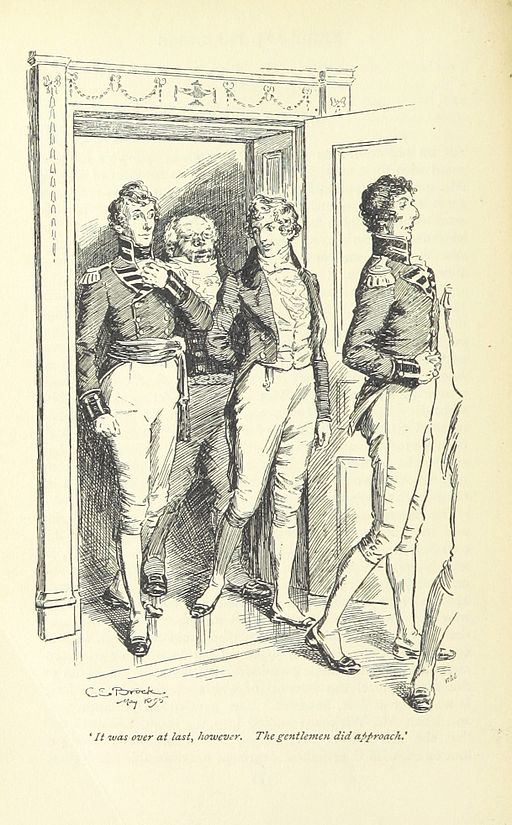
1895 illustration by C.E. Brock of the arrival of Mr. Wickham and other officers at a gathering held by the Phillips family. Via Wikimedia Commons.

It’s not long after this point when Mr. Wickham’s confides in Elizabeth, telling his story of how he has been wronged by Mr. Darcy. This revelation produces emotions in Elizabeth that are larger than the emotions she felt upon seeing their initial antagonism, but still mid-sized in comparison to some of her emotions in other scenes.

Elizabeth is shocked, and we see this shock and surprise in her speech:

“This is quite shocking!—He deserves to be publicly disgraced.”

In the scene that follows she then asks follow-up questions. She pauses when speaking. She reflects. She remembers things Mr. Darcy has said in the past that would seem to corroborate Wickham’s claims. These emotional clues are layered on each other, giving a sense of how she feels.

She also uses many more exclamation marks than in her normal dialogue, and uses strong word choice:

“How strange!” cried Elizabeth. “How abominable! I wonder that the very pride of this Mr. Darcy has not made him just to you! If from no better motive, that he should not have been too proud to be dishonest—for dishonesty I must call it.”

Even once her conversation with Mr. Wickham is over, she keeps returning to it in her mind. Her emotions on the matter, and on Mr. Wickham more generally, become her entire focus:

There could be no conversation in the noise of Mrs. Phillips’s supper party, but his manners recommended him to everybody. Whatever he said, was said well; and whatever he did, done gracefully. Elizabeth went away with her head full of him. She could think of nothing but of Mr. Wickham, and of what he had told her, all the way home; but there was not time for her even to mention his name as they went, for neither Lydia nor Mr. Collins were once silent.

And her emotions don’t end in this scene. The next chapter begins:

Elizabeth related to Jane the next day, what had passed between Mr. Wickham and herself.

Note how much more page time is given to this emotion than to when Mr. Darcy insulted her at the ball. Note how much more it consumes her—how it engages her in different ways and uses a larger variety of emotional clues.

Large Emotions

Large emotions are bigger for the characters. They are often more personal and have larger consequences. They can accompany events or knowledge which is life changing or life shattering. Often these emotions are large because the circumstances require the character to develop a new understanding of the world and their place in it.

Like with mid-size emotions, large emotions require more page time, a layering of emotional clues, and a return, multiple times, to the emotion. Large emotions also provoke stronger reactions, stronger or more extreme physical sensations, and lead the character to engage in behavior that is outside of their norm.

1894 illustration by Hugh Thomson of Colonel Fitzwilliam and Elizabeth. Via Wikimedia Commons.

Elizabeth is extremely upset when she finds out from Colonel Fitzwilliam that it was Mr. Darcy who broke up Mr. Bingley and her sister Jane. He says simply,

“There were some strong objections against the lady.”

Paragraphs follow in which Elizabeth deals with her emotions, thinking about what happened. She considers how in  some ways Mr. Darcy is right to have objections, but then she counters her own thoughts by thinking about how much Jane has been wronged.

The agitation and tears which the subject occasioned, brought on a headache; and it grew so much worse towards the evening that, added to her unwillingness to see Mr. Darcy, it determined her not to attend her cousins to Rosings, where they were engaged to drink tea.

For most of her smaller negative emotions, Elizabeth has used humor. For mid-sized ones, she grapples with the problem, considering it from many sides—which she also does here. But this is emotion to a new degree. This has caused tears and a headache. And while Elizabeth is normally very correct in her behaviors and social expectations, she does not go to Rosings as she normally would.

In the next chapter we see the continuation of this emotion as she goes through all of Jane’s letters, trying to read Jane’s emotions and see how Mr. Bingley’s absence has impacted her sister.

It’s only a few pages later that Mr. Darcy proposes to her. She angrily turns him down, expressing her emotions to him in multiple ways. Even after he has gone, we continue to experience her emotions with her, and we have a longer shift into free indirect speech than we’ve experienced at other points in the novel.

The tumult of her mind, was now painfully great. She knew not how to support herself, and from actual weakness sat down and cried for half-an-hour. Her astonishment, as she reflected on what had passed, was increased by every review of it. That she should receive an offer of marriage from Mr. Darcy! That he should have been in love with her for so many months! So much in love as to wish to marry her in spite of all the objections which had made him prevent his friend’s marrying her sister, and which must appear at least with equal force in his own case—was almost incredible! It was gratifying to have inspired unconsciously so strong an affection. But his pride, his abominable pride—his shameless avowal of what he had done with respect to Jane—his unpardonable assurance in acknowledging, though he could not justify it, and the unfeeling manner in which he had mentioned Mr. Wickham, his cruelty towards whom he had not attempted to deny, soon overcame the pity which the consideration of his attachment had for a moment excited.

She continued in very agitated reflections till the sound of Lady Catherine’s carriage made her feel how unequal she was to encounter Charlotte’s observation, and hurried her away to her room.

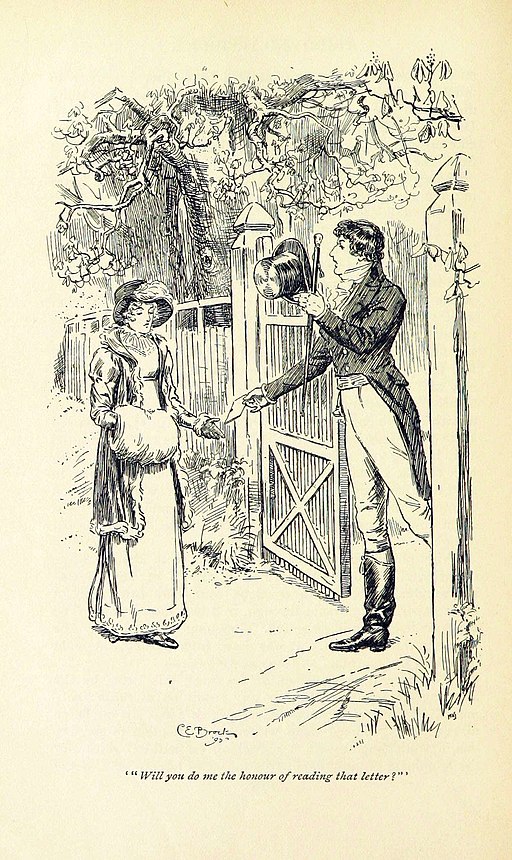
Illustration by C E Brock -- Mr. Darcy greets Elizabeth at the gate. He holds out a letter. Text reads, "Will you do me the honour of reading that letter?"

1895 illustration by C.E. Brock of Mr. Darcy giving Elizabeth a letter. Image via Wikimedia Commons.

Later, she receives his letter full of explanations. During the letter, we just read it with Elizabeth–the whole letter is included with no interruptions, no character actions or thoughts. We experience our own emotions as readers, and can guess at Elizabeth’s. Then after the letter, we have lengthy passages in which she walks, she re-reads, she analyzes specific phrases, she reflects. Her emotions undergo multiple shifts—and we go with her through these shifts.

Large emotions are often more complicated. They are not as clear cut—anger, joy, frustration, forgiveness can all be complicated and filled with nuance. Large emotions are bottles filled to bursting, and often require the character’s exploration and the narrator’s. They shift, they grow, they lessen, they increase again, and as we ride this roller coaster with the character, we empathize and at times even have a cathartic experience.

Conclusion

If you attend a symphony, you will not hear all the instruments playing at full volume the entire time. That would not be good music. Instead, some movements may be performed at quietly, while others will swell to fortissimo, some sections may highlight the violins, while others may feature brass instruments, and other still use a solo. We may only hear the cymbal a handful of times, but when we do, it will be at key moments.

We should do the same when we write character emotions: include a range of emotions, some of which are focused on at different times. Sometimes we touch on an emotion for only a moment; other times we explore the emotion for an extended period, or bring back an emotional theme later in the story. Including varying degrees of emotions—small, mid-sized, and large—creates contrast and emphasis, directs the readers’ attention, and serves to better illustrate character, as we see how they react and change in moments big and small.

Writing Exercises - Jane Austen Writing Lessons

Exercise 1: Emotion chart

Reread a book or rewatch a film you enjoy. As you do so, create a chart of character emotions. You can focus on the main character’s emotions or chart the emotions of multiple characters. Track the types of emotions experienced by the character(s), the size of the emotions, and what emotional clues are used.

Does a character experience or express large or small emotions differently? How do the biggest emotions line up with the biggest plot moments?

Exercise 2: Emotion reversal

Write about a small emotion you had in a large way—with several paragraphs and a layering of emotional clues. For example, spend a significant amount of time writing about mild irritation at no ripe avocados, a small amount of joy from getting the day’s Wordle, etc.

Now, write about a large emotion you had in a small way. This might be a phrase or a few sentences. You might dismiss the large emotion, compare it to something else and move on, etc.

Now, reflect. While often it’s useful to write about bigger emotions in a big way, and smaller emotions in a small way, in what circumstances would it be useful to do the reverse?

Exercise 3: Planning (or revising) a story

Plan out a novel that you intend to write. Which three scenes do you want to have the biggest, most explored emotions? How will the placement of these emotional scenes help the story? (You can also do this with a short story—however, choose one scene or moment to have the biggest, most explored emotions.)

If you are revising a story, find which scenes already have the biggest, most expressed emotions. Are these the scenes that should have the most emotional weight? Are they expressing or layering in the most effective way? As necessary, revise.

Don’t Miss a Lesson: Subscribe to Updates and Giveaways from katherinecowley.com

* indicates required


Which newsletter(s) would you like to receive?

Jane Austen Writing Lessons. #63: Four More Internal Emotion Techniques

#63: Four More Internal Emotion Techniques

Jane Austen Writing Lessons. #63: Four More Internal Emotion Techniques

In Jane Austen’s novel, Northanger Abbey, the character of Catherine Morland is filled with emotions, so much so that she is sometimes carried away in flights of fancy. Austen uses many of the techniques we’ve already talked about to plant clues to her emotional state, including sharing character thoughts, free indirect speech, relationship to setting as a window into emotion, concrete actions and behavior, awareness/lack of awareness, body language, verbs and adjectives, and dialogue.

There are four more key techniques that Jane Austen uses to convey emotion. These techniques work best for viewpoint characters, because they often require being in the character’s head. They are tools that can be applied for both very emotive characters, like Catherine Morland, and for characters that keep their emotions more concealed, subdued, and in check, like Elinor Dashwood in Sense and Sensibility.

Additional Internal Emotion Techniques (which are especially useful for viewpoint characters

  1. Punctuation, Syntax, and Rhythm
  2. Pointing to the past and/or to the future
  3. Repetition
  4. Physical sensation and internal physical sensation

We’ll consider two scenes from Northanger Abbey that demonstrate these four internal emotion techniques.

Internal Emotion Technique 1: Punctuation, Syntax, and Rhythm

Punctuation, syntax, and rhythm can be a powerful tool for conveying emotion, especially when the punctuation, syntax, and rhythm are markedly different from other sentences, passages, or scenes.

In Northanger Abbey, Catherine has met many new acquaintances. In particular, she has fallen for a certain Henry Tilney, and she has also become friends with Henry’s sister, Eleanor.

Eleanor wants a companion, so she and her father, General Tilney, invite Catherine to come stay with them at their home, Northanger Abbey. The narrator then gives us a sense of Catherine’s reaction. Take note of the punctuation, the syntax, and the rhythm that is employed:

Northanger Abbey! These were thrilling words, and wound up Catherine’s feelings to the highest point of ecstasy. Her grateful and gratified heart could hardly restrain its expressions within the language of tolerable calmness. To receive so flattering an invitation! To have her company so warmly solicited! Everything honourable and soothing, every present enjoyment, and every future hope was contained in it; and her acceptance, with only the saving clause of Papa and Mamma’s approbation, was eagerly given. “I will write home directly,” said she, “and if they do not object, as I dare say they will not—”

Note the heavy use of exclamation marks, the short sentences and other phrases that build with rapid commas, and the way that the rhythm builds to match her excitement.

Exclamation marks and commas aren’t the only punctuation marks Jane Austen employs to convey emotion—at other points in her novel she uses em dashes, question marks, and periods in revelatory ways. Long and short sentences, sentences with broken rhythm and smooth, sentences which feel like poetry—all of these are tools Austen uses to impact the reader’s experience of the character’s lived experience.

In a prior post, I analyzed Emma’s large discoveries near the end of the novel Emma. These discoveries show her that she has been wrong in so many ways, and this realization impacts her emotions. If you reread those passages, you see that punctuation, syntax, and rhythm are constantly in play to help us understand Emma’s experience.

While punctuation, syntax, and rhythm are especially useful at conveying the emotion of the viewpoint character, they can also be used to for non-viewpoint characters, but typically only in their dialogue. (We have no way of knowing their internal thoughts, but the way the punctuation, syntax, and rhythm of how they speak can definitely be effected by their emotions.)

Internal Emotion Technique 2: Pointing to the Past and/or the Future

In a previous lesson, we talked about how we can access a viewpoint character’s thoughts on a subject, and this can be used to reveal emotion. This technique is an extension of that. An extremely effective way to reveal emotion is to have a character think of something that happened in the past or in the future.

Past events can be ones which we experienced earlier in the novel. Pointing again to them creates emotional resonance between those events and the new passage. It can show the character creating meaning or connection, for good or for bad. It can recall prior emotions, or reinterpret past emotions into something new.

You can also point to past events that did not occur in the novel—that happened before the pages. This provides backstory, it paints a fuller picture of the character’s lives, and it can also illuminate why something might impact a character in a certain way.

The next passage is a little later in the same scene, after the Tilneys have invited Catherine to visit Northanger Abbey. In this passage, Catherine looks back on all her experiences in Bath, even the ones that were not always positive (some of the scenes with her friend Isabella were rather fraught) in a rosy light, as leading to this moment. How she is analyzing and calling upon the past gives a strong sense for her present emotional state.

The circumstances of the morning had led Catherine’s feelings through the varieties of suspense, security, and disappointment; but they were now safely lodged in perfect bliss; and with spirits elated to rapture, with Henry at her heart, and Northanger Abbey on her lips, she hurried home to write her letter….By the kindness of her first friends, the Allens, she had been introduced into scenes where pleasures of every kind had met her. Her feelings, her preferences, had each known the happiness of a return. Wherever she felt attachment, she had been able to create it. The affection of Isabella was to be secured to her in a sister. The Tilneys, they, by whom, above all, she desired to be favourably thought of, outstripped even her wishes in the flattering measures by which their intimacy was to be continued.

The paragraph continues by pointing to the future. Catherine immediately begins imagining and envisioning what her experience at Northanger Abbey might look like.

She was to be their chosen visitor, she was to be for weeks under the same roof with the person whose society she mostly prized—and, in addition to all the rest, this roof was to be the roof of an abbey! Her passion for ancient edifices was next in degree to her passion for Henry Tilney—and castles and abbeys made usually the charm of those reveries which his image did not fill. To see and explore either the ramparts and keep of the one, or the cloisters of the other, had been for many weeks a darling wish, though to be more than the visitor of an hour had seemed too nearly impossible for desire. And yet, this was to happen. With all the chances against her of house, hall, place, park, court, and cottage, Northanger turned up an abbey, and she was to be its inhabitant. Its long, damp passages, its narrow cells and ruined chapel, were to be within her daily reach, and she could not entirely subdue the hope of some traditional legends, some awful memorials of an injured and ill-fated nun.

Pointing to the future is a powerful tool to convey emotion, because it can reveal what a character expects, what they hope for or fear, whether they are high strung or analytical or relaxed. A character has no way of knowing what the future will actually hold, but how they think about the future reveals their current state.

Once again, this is a tool that is largely used for viewpoint characters.

Internal Emotion Technique 3: Repetition

Repetition is a powerful tool. Jane Austen uses repetition of action, of thought, of imagery, of attention, of words, and of certain sounds. You can repeat anything, as long as it creates a building sensation.

Repetition can connect things together. It shows what the character is focusing on, what their thoughts can’t avoid, what they keep coming back to. It can create rhythm, it can call back to something from earlier, or it can further develop an emotion or thought.

In the previous scene, we already saw the repetition of the word every (emphasis added):

Everything honourable and soothing, every present enjoyment, and every future hope was contained in it.

Later, when Catherine is at Northanger Abbey, she has a frightening night in her bedroom, partly because she has convinced herself that frightening things have happened in this space.

She wonders what is in an old-fashioned cabinet, and throughout the scene, she tries to open it again and again—a repetition of action. There is also a repetition of her experiencing the wind. Some characters might notice that it’s stormy, and it’s mentioned once, but in this scene, wind is mentioned again and again, and each time it shows the building of her emotions.

The window curtains seemed in motion. It could be nothing but the violence of the wind penetrating through the divisions of the shutters; and she stepped boldly forward, carelessly humming a tune, to assure herself of its being so, peeped courageously behind each curtain, saw nothing on either low window seat to scare her, and on placing a hand against the shutter, felt the strongest conviction of the wind’s force. 

A little later in the scene we read:

The wind roared down the chimney, the rain beat in torrents against the windows, and everything seemed to speak the awfulness of her situation. 

And again:

A violent gust of wind, rising with sudden fury, added fresh horror to the moment.

Later still:

She had not been used to feel alarm from wind, but now every blast seemed fraught with awful intelligence.

And one final reference to the wind:

The storm still raged, and various were the noises, more terrific even than the wind, which struck at intervals on her startled ear.

In early drafts, I sometimes include unneeded repetition. I’ll accidentally repeat a word or a phrase, I’ll start too many sentences in the same way, or I’ll have a character do the same thing twice for no reason. I always try to cut the accidental repetitions. The intentional repetitions can be powerful, though I always test them on readers to make sure my use of repetition is building something rather feeling like sloppy writing.

There is a myriad of ways you can use repetition for viewpoint characters. For non-viewpoint characters, repetition is most likely to be seen either in their dialogue or the in repeated actions.

Internal Emotion Technique 4: Physical sensation and internal physical sensation

For viewpoint characters and non-viewpoint characters alike, a character’s actions, behavior, and body language are a strong indicator of their emotions. Does a character drop a letter, walk slowly, run up the stairs, or fidget restlessly? Each of these can be an outward expression of their internal state.

For viewpoint characters, we can also use their physical sensations—things happening to their body—and their internal physical sensations—things happening inside the body that other characters cannot possibly know.

The following paragraph is from the scene with the wind, while Catherine is trying to open the cabinet. I’ve bolded a sentence that reveals Catherine’s physical sensations.

It was some time however before she could unfasten the door, the same difficulty occurring in the management of this inner lock as of the outer; but at length it did open; and not vain, as hitherto, was her search; her quick eyes directly fell on a roll of paper pushed back into the further part of the cavity, apparently for concealment, and her feelings at that moment were indescribable. Her heart fluttered, her knees trembled, and her cheeks grew pale. She seized, with an unsteady hand, the precious manuscript, for half a glance sufficed to ascertain written characters

Catherine is feeling her heart flutter. Her knees are trembling. And her cheeks are growing pale. Each of these physical sensations are her body’s manifestations of her emotion.

Her heart fluttering is a truly internal physical sensation. It is inside her body, and it effects and reflects her experience when she finally manages to open the cabinet.

Her cheeks growing pale is also a physical sensation, though it has an external component that other characters could notice, were they in the room. Her knees trembling is a physical sensation that would be rather unlikely for other characters to notice, but possible in certain situations.

Regardless, these are all physical sensations belonging to our viewpoint character that are part of her experience and are fair game for the narrator to mention.

If you want a resource on how to write about internal and external physical sensations, as well as body language and actions that might reflect certain emotions, I highly recommend the book The Emotion Thesaurus.

While some authors rely heavily on physical sensation and internal physical sensation to convey emotions, Jane Austen uses it sparingly. However, when she uses it, she does so to great effect.

Conclusion

There are so many tools that can be used to convey a character’s emotions. For viewpoint characters, we have the additional opportunity to submerse ourselves into their emotions, by using tools that aren’t as readily available to use on non-viewpoint characters, such as internal physical sensations, repetition, pointing to the past or future, and syntax.

In the next lesson we’ll look at the size or degree of emotions—the differences between conveying small, medium, and large emotions. I hope that you’ll join me!

Writing Exercises - Jane Austen Writing Lessons

Exercise 1: Chart your own physical sensations

Over the course of a day or a morning, record your own physical sensations and internal physical sensations. Did you touch something scratchy? Did something taste sour? Did the chair feel hard? Did your knee itch? Did your eyes feel unfocused? Did your back hurt? Did you lose your balance?

If relevant, jot down a word or two that captures your emotional state at the time. Was your physical sensation reflecting your emotions at the time? Did your physical sensations contrast your emotions? Did your physical sensations and internal physical sensations change your emotions?

Consider what you learned about physical sensations and emotions, and how you can incorporate that into your own writing.

Exercise 2: Finding a Place to Live

Write a brief scene in which a character is touring apartments or other places to live. In this scene, try to incorporate each of the techniques talked about in this lesson:

  1. Punctuation, Syntax, and Rhythm
  2. Pointing to the past and/or to the future
  3. Repetition
  4. Physical sensation and internal physical sensation

Exercise 3: Emotion Revision

Take a scene in a story you are writing and see if you are incorporating any of these techniques. If so, are there ways you could strengthen your use of the technique? If not, at what points would one or more of these techniques be useful? Now revise the scene.

Don’t Miss a Lesson: Subscribe to Updates and Giveaways from katherinecowley.com

* indicates required


Which newsletter(s) would you like to receive?