Jane Austen Writing Lessons

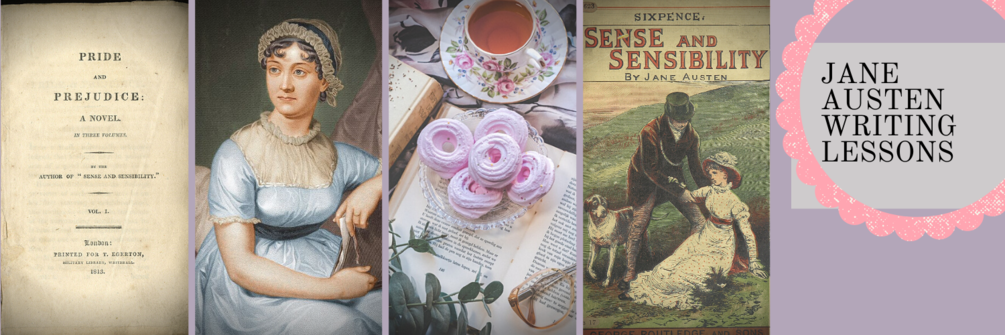
Jane Austen Writing Lessons. With an image of the original cover page of Pride and Prejudice; a color image of Jane Austen; an image of tea and pastries with an open book, and an early cover of Sense and Sensiblity.

One of the best ways to learn to write well is to learn from the examples of great writers. Jane Austen Writing Lessons is a series of blog posts about creative writing principles from plot structure to character development to dialogue. This blog was selected by “The Write Life” as one of the 100 Best Websites for Writers in 2021.

Jane Austen Writing Lessons is now a book!

Jane Austen Writing Lessons has been expanded into a book! The book includes over 70% brand-new material that never appeared on the blog. The book is now available in ebook, paperback, and hardcover from all major retailers.

A 3D rendering of the book Write with Jane Austen: Masterclasses with the Master Storyteller

Read more about the book and find links to your favorite retailers.

Examples from Jane Austen

Each lesson looks to Jane Austen’s novels and her other works for examples of excellent writing. Quotes from her six published novels and an analysis of her craft–and how we can apply it to our own writing–is included in each lesson.

Writing Exercises

Writing Exercises - Jane Austen Writing Lessons

Each lesson includes 2-3 writing exercises that will help you practice the creative writing principle and apply it to your own writing.

Most Recent Jane Austen Writing Lessons

Jane Austen celebrating her birthday. Austen wears a birthday hat, holds a birthday present, and sits next to a birthday cake covered with candles.
Jane Austen Writing Lessons. #69: The Jane Austen Approach to Critiquing Writing
An intriguing snippet which has Jane Austen's portrait and a mysterious gray box with the words, "Cover Coming Soon"
Jane Austen Writing Lessons #68: Establishing Relationships and Character Connections in Fiction
Jane Austen Writing Lessons 67. Creating an Emotional Map: Making Interconnected Emotions
Jane Austen Writing Lessons. #66: Evoking Emotions through Objective Correlative (External Objects)
Mary Bennet and Mr. Collins. Why didn't they marry? Would they have made a good match?
Jane Austen Writing Lessons. #65: Different Character Approaches to Dealing with and Expressing Emotions
Jane Austen Writing Lessons. #64: The Size or Degree of Character Emotions

Jane Austen Writing Lessons by Category

Recognition for Jane Austen Writing Lessons

Jane Austen Writing Lessons: one of the

Jane Austen Writing Lessons was selected by The Write Life as one of the “100 Best Websites for Writers in 2021.” They wrote:

“[Jane Austen Writing Lessons] is filled with blog posts about creative writing that use Jane Austen’s novels and other related stories to share what good writing looks and sounds like. Whether you’re interested in plot structure or character development to dialogue, each Jane Austen writing lesson focuses on one principle of writing at a time.”

About the Author

In addition to writing Jane Austen Writing Lessons, Katherine Cowley is the author of the novels The Secret Life of Miss Mary BennetThe True Confessions of a London Spy, and The Lady’s Guide to Death and Deception. She has taught writing classes at Western Michigan University and other universities and community colleges.

Her blog, Jane Austen Writing Lessons, has been expanded into a new book, Write with Jane Austen: Masterclasses with the Master Storyteller.

Jane Austen Writing Lessons. #52: Different Responses to Dialogue

#52: Different Responses to Dialogue

Jane Austen Writing Lessons. #52: Different Responses to Dialogue

One of the most useful practices when writing dialogue is to consider how different characters will respond to the same line of dialogue in different ways. Whenever, we have certain expectations for how we will be interpreted, for how we would like others to respond. Sometimes, they respond in the way we would expect; other times they respond differently. In a group dialogue, with three or more people, there can be—and often should be—a diverse range of responses to key lines of dialogue.

In Jane Austen’s novel Persuasion, Louisa Musgrove falls on a stone staircase and injures her head. Her illness and her recovery become a talking point in many social gatherings. Not long after the injury, Lady Russell and Anne Elliot call upon the Crofts. Jane Austen describes the conversation between Lady Russell, Anne, and Mrs. Croft, as Admiral Croft observes and then adds his perspective on the matter:

As to the sad catastrophe itself, it could be canvassed only in one style by a couple of steady, sensible women, whose judgments had to work on ascertained events; and it was perfectly decided that it had been the consequence of much thoughtfulness and much imprudence; that its effects were most alarming, and that it was frightful to think, how long Miss Musgrove’s recovery might yet be doubtful, and how liable she would still remain to suffer from the concussion hereafter!—The Admiral wound it all up summarily by exclaiming,

“Ay, a very bad business indeed.—A new sort of way this, for a young fellow to be making love, by breaking his mistress’s head!—is not it, Miss Elliot?—This is breaking a head and giving a plaister truly!”

Admiral Croft’s manners were not quite of the tone to suit Lady Russell, but they delighted Anne. His goodness of heart and simplicity of character were irresistible.

Lady Russell does not approve of Admiral Croft’s statement or the manner in which he has said it—to her, Louisa’s injury is not a laughing manner. This is not a formal, sophisticated way to speak of it. Yet we read that this response “delighted Anne.” It is not that Anne disregards propriety, but rather that she sees a place for levity, and that she understands his goodness and his character and how that informs his statement.

In a previous Jane Austen Writing Lesson, I discussed how groups of characters are not monoliths: even among very similar characters, there should be a range of perspectives and attributes.

The same is true with how characters respond to dialogue.

Factors that influence how a character responds to dialogue:

  • Their personality

  • Their expectations

  • Their knowledge of, and relationship with, the speaker

  • Their understanding of the situation and topic

  • Their wants, needs, and goals

  • Their inherent biases

In Mansfield Park, a group of individuals, which includes most of the main characters, is given a tour of the Rushworth home by Mrs. Rushworth. Mrs. Rushworth show them the chapel—which disappoints Fanny for its lack of grandeur—and explains:

“It is a handsome chapel, and was formerly in constant use both morning and evening. Prayers were always read in it by the domestic chaplain, within the memory of many. But the late Mr. Rushworth left it off.”

Miss Crawford interprets this dialogue very differently than Fanny:

“Every generation has its improvements,” said Miss Crawford, with a smile, to Edmund….

“It is a pity,” cried Fanny, “that the custom should have been discontinued. It was a valuable part of former times. There is something in a chapel and chaplain so much in character with a great house, with one’s ideas of what such a household should be! A whole family assembling regularly for the purpose of prayer is fine!”

The differences in their reactions to Mrs. Rushworth’s dialogue reveal much about Miss Crawford and Fanny. Fanny is pious and has grand visions of morality, while Miss Crawford is more cynical.

Yet the dialogue does not stop there—each of the characters continue to bring themselves to the discussion. Fanny’s statement is immediately interpreted in two different ways:

“Very fine indeed!” said Miss Crawford, laughing. “It must do the heads of the family a great deal of good to force all the poor housemaids and footmen to leave business and pleasure, and say their prayers here twice a day, while they are inventing excuses themselves for staying away.”

That is hardly Fanny’s idea of a family assembling,” said Edmund. “If the master and mistress do not attend themselves, there must be more harm than good in the custom.”

Miss Crawford’s interpretation shows an awareness of class disparity and the way in which upper class people often force their morality on those in their employ while disregarding the same principles of morality for themselves. It’s both a clever and an insightful comment. And it also treats Fanny’s perspective as inadequate and uninformed.

Edmund’s response defends Fanny, in part because of the long-established relationship that he has with Fanny, and his understanding of her meaning. But his response also stems from the fact that he intends to become a clergyman and also sees value in religious practices.

Later on in the scene, Edmund’s sister Julia tells a joke about Maria and Mr. Rushworth being ready for marriage, and tells Edmund:

“My dear Edmund, if you were but in orders now, you might perform the ceremony directly.”

Miss Crawford is shocked by this new information:

“Ordained!” said Miss Crawford; “what, are you to be a clergyman?”

“Yes; I shall take orders soon after my father’s return—probably at Christmas.”

Miss Crawford, rallying her spirits, and recovering her complexion, replied only, “If I had known this before, I would have spoken of the cloth with more respect,” and turned the subject.

This new knowledge makes Miss Crawford wish that she had responded differently to the previous lines of dialogue. She was trying to impress Edmund with her insights and clever way of speaking, but was missing information that would have shifted her response.

In writing group dialogue, it is useful to consider that different characters will often respond to the same passage of dialogue in different ways. Incorporating these differences can richer dialogue with more tension and movement.

Writing Exercises - Jane Austen Writing Lessons
The Response Game

Exercise 1: The Response Game

Choose 5 characters. These could be characters you’ve already written, characters from one of your favorite books or films (for example, Mr. Darcy, Mr. Bingley, Miss Caroline Bingley, Elizabeth Bennet, and Jane Bennet), or characters that are inspired by people in your life.

Now watch a trailer for a new or upcoming movie. How would each of the five characters respond differently to this trailer?

Craft a 2-3 sentence response for each of the characters to this movie trailer.

Exercise 2: A Practice Scene

Write a brief scene with three characters. Have one of the characters say a line of dialogue which is interpreted differently by the characters. something, and then the other two characters respond in different manners. The responses can be largely internal or largely external; they can be in the form of dialogue, action, or introspection. The characters may also have the same external reaction or action, but for different reasons.

Exercise 3: Dialogue Analysis and Revision

Part 1: Analyze a passage of dialogue in a published short story or novel. The passage of dialogue should include at least three characters. Consider when characters respond differently to the same line of dialogue, and what motivates this response.

Part 2: Revise a scene you have written which includes dialogue between at least three characters. Are there places where you could strengthen the passage by having the characters respond differently to the dialogue?

Don’t Miss a Lesson: Subscribe to Updates and Giveaways from katherinecowley.com

* indicates required


Which newsletter(s) would you like to receive?

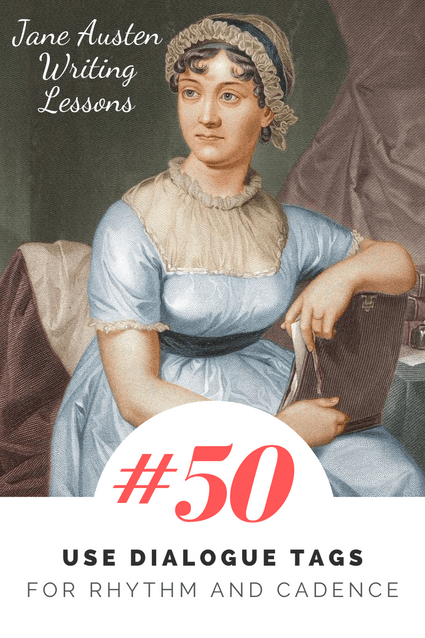
Jane Austen Writing Lessons #50: Use Dialogue Tags for Rhythm and Cadence

#50: Use Dialogue Tags for Rhythm and Cadence

Jane Austen Writing Lessons #50: Use Dialogue Tags for Rhythm and Cadence

In Northanger Abbey, Catherine Morland and her friend Isabella Thorpe are conversing in the Pump-Room, a building in the town of Bath that was a popular gathering place. For quite some time, they are watched by several men, but then the men leave. Isabella pretends that she is grateful for their departure; however, she is actually disappointed that they have left and secretly wants to follow them.

Isabella says:

“Well, I am amazingly glad I have got rid of them! And now, what say you to going to Edgar’s Buildings with me, and looking at my new hat? You said you should like to see it.”

Catherine readily agreed. “Only,” she added, “perhaps we may overtake the two young men.”

The key dialogue tag in this passage is she added. As we discussed in the previous lesson on dialogue tags, she added could be considered a functional dialogue tag, a dialogue tag which shows how what the character is saying is functioning within the larger conversation. First Catherine agrees with her friend, and then what she says adds to—and modifies—her previous statement.

Yet she added is doing more than just telling us the role that her statement plays in the conversation. Its placement controls the rhythm of the paragraph and indicates the cadence of Catherine’s speech.

Jane Austen regularly uses dialogue tags for rhythm and cadence, and doing so is a powerful tool that can be used in any fictional genre.

Let’s define rhythm and cadence as we’ll use them in this lesson.

Definitions: Rhythm and Cadence in Dialogue

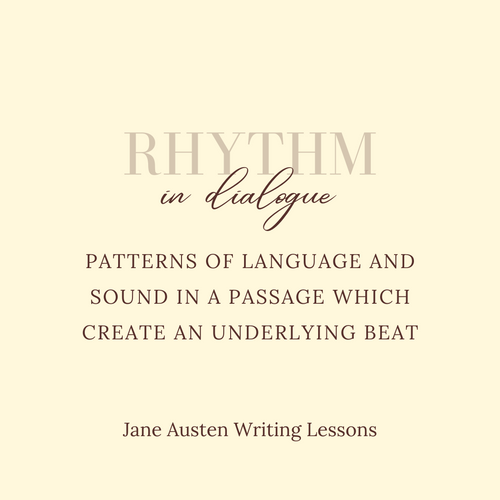
Rhythm in dialogue: patterns of language and sound in a passage which create an underlying beat. Jane Austen Writing Lessons

Rhythm is patterns of language and sound in a passage which create an underlying beat. Poetry sometimes uses strict meters, or rhythm patterns, but there is rhythm in prose as well, and the beat and speed and emphasis created by the rhythm in prose effects both the feel and the speed at which we read. Rhythm is particularly important as we consider dialogue, for dialogue is meant to be spoken aloud. Rhythm can have a powerful effect on the reader both when a beat is created or when it is broken—interrupted.

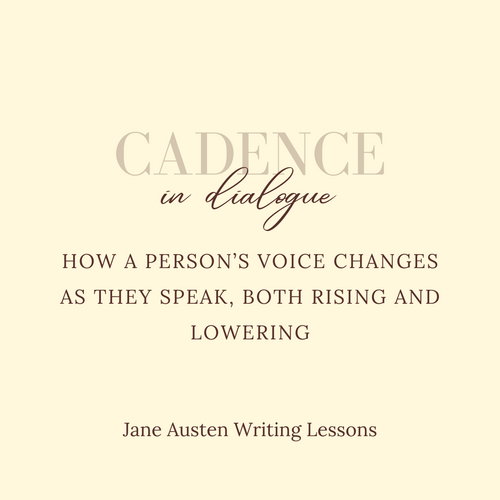
Cadence is how a person’s voice changes as they speak, both rising and lowering. In most cases, a speaker’s voice is not level or flat across a passage of dialogue: tone and pitch and emphasis change with the content of what someone is saying, and how they feel about it.

Much of the rhythm and cadence of a passage of dialogue is determined by the words and phrasing of the dialogue itself, however, rhythm and cadence can also be impacted by the dialogue tags.

Let’s consider again the line from Northanger Abbey:

Catherine readily agreed. “Only,” she added, “perhaps we may overtake the two young men.”

We can almost hear Catherine’s cadence as we read. She agrees with her friend, probably saying something like, “Of course, I would love to join you.” And then we have an “Only,” she added. It reads almost as an interruption—she’s likely raised her voice slightly, and she’s pausing after it, as if she has just realized the problem with Isabella’s proposal.

During Isabella’s statement—the proposal of activities—and Catherine readily agreed we have a steady rhythm, almost a beat. It’s smooth, nothing accentuated. But then “Only,” she added breaks the smooth rhythm—the forced pause is like an orchestra suddenly stopping all sound for a beat, which adds emphasis to what comes after.

Dialogue Tag Placement

One of the most common techniques that Jane Austen uses to control rhythm and cadence is to choose where to use a dialogue tag, whether it’s a he said, said Catherine, or an action that substitutes for a dialogue tag.

Consider the following passage of dialogue, from the first time that Catherine Morland and Mr. Tilney meet at a ball:

Mr. Tilney was polite enough to seem interested in what she said; and she kept him on the subject of muslins till the dancing recommenced. Catherine feared, as she listened to their discourse, that he indulged himself a little too much with the foibles of others. – “What are you thinking of so earnestly?” said he, as they walked back to the ball-room;—“not of your partner, I hope, for by that shake of the head, your meditations are not satisfactory.”

Catherine coloured, and said, “I was not thinking of any thing.”

“That is artful and deep, to be sure; but I had rather be told at once that you will not tell me.”

If a dialogue tag is used, there are three primary places where it can be placed: before the dialogue, partway through the dialogue (often after a word, sentence, or phrase), and after the dialogue.

One approach that Austen particularly seems to favor is providing the tag partway through the dialogue. This allows a build-up before the dialogue tag—we’re interested in what is being said. Then we are given a physical pause or beat that also serves to provide who is speaking and sometimes how they are speaking or what they are doing. This is followed by more dialogue, which completes the character’s self-expression.

Instead of placing the dialogue tag in the middle of the paragraph, Austen could have written:

As they walked back to the ballroom, Mr. Tilney said, “What are you thinking of so earnestly? Not of your partner, I hope, for by that shake of the head, your meditations are not satisfactory.”

This eliminates the pause after his question—he immediately says the next statement. It also eliminates some of the implied cadence—modulation of his tone—in his question.

The dialogue tag could also have been placed at the end:

“What are you thinking of so earnestly? Not of your partner, I hope, for by that shake of the head, your meditations are not satisfactory,” said Mr. Tilney as they walked back to the ballroom.

Often, a dialogue tag at the end works best for shorter pieces of dialogue—we don’t want to read five or six sentences of dialogue, and then find out who is speaking. This dialogue is of a length that works well with the tag at the end, but it has a different rhythm than what Austen has chosen:

“What are you thinking of so earnestly?” said he, as they walked back to the ball-room;—“not of your partner, I hope, for by that shake of the head, your meditations are not satisfactory.”

Now consider the placement of the dialogue tag in Catherine’s response:

Catherine coloured, and said, “I was not thinking of any thing.”

In part, placing it at the start is necessary, because Catherine blushes as an immediate response to his statement, and then she speaks. However, placing it at the start also impacts how we understand her tone and her volume—we assume she is embarrassed, and likely speaking more quietly, and more quickly, than earlier.

Unnecessary (Yet Rhythmically Appropriate) Dialogue Tags

Another technique that Austen uses is to incorporate dialogue tags that, strictly speaking, are unnecessary—we already know who is speaking, and the dialogue tag doesn’t provide information about the function of the dialogue, how the dialogue is spoken, what emotion is used, etc. Yet these “unnecessary” dialogue tags are used to impact either the rhythm, the cadence, or both.

Later in Northanger Abbey, John Thorpe decides to take Catherine Morland’s future into his own hands. He knows that Catherine has plans to do something with the Tilneys, but he wants Catherine to do something with him, so he goes to the Tilney’s and cancels Catherine’s engagement. He then informs Catherine that she is now available to do something with him:

“Now, my sweet Catherine, all our distresses are over; you are honourably acquitted, and we shall have a most delightful party.”

“This will not do,” said Catherine; “I cannot submit to this. I must run after Miss Tilney directly and set her right.”

The phrase said Catherine is unnecessary—it is clear that Catherine is speaking, and she just been directly addressed by Mr. Thorpe, so readers will assume that the next dialogue is Catherine’s. And, as discussed in the previous lesson on dialogue tags, Austen often omits dialogue tags in cases like this when it is clear who is speaking.

Yet including the dialogue effects the rhythm—we feel Catherine’s pause after her statement, which punctuates both “This will not do” and “I cannot submit to this.” It also affects her cadence. When I read this passage aloud, I naturally read “This will do not do” at a standard tone, and then I read “I cannot submit to this” a little higher and faster.

In Conclusion: The Power of Dialogue Tags

Dialogue tags are powerful. They can:
  • Attribute dialogue to a speaker

  • Indicate the function of a line of dialogue within a passage

  • Show how someone is speaking

  • Convey the emotion of a speaker or listener

  • Describe the actions that are taken in conjunction with the dialogue

And, as discussed in this lesson, dialogue tags can also

  • Impact the rhythm of the passage

  • Shift the cadence of the speakers

In the following passage, the dialogue tags do all of these things.

While walking on the street, Catherine has just run into her brother, James Morland, and his friend, John Thorpe. The men are theoretically speaking to Catherine, but they are truly speaking to each other:

[John Thorpe] took out his watch: “How long do you think we have been running it from Tetbury, Miss Morland?”

“I do not know the distance.” Her brother told her that it was twenty-three miles.

“Three-and-twenty!” cried Thorpe; “five-and-twenty if it is an inch.” Morland remonstrated, pleaded the authority of roadbooks, innkeepers, and milestones; but his friend disregarded them all; he had a surer test of distance. “I know it must be five-and-twenty,” said he, “by the time we have been doing it. It is now half after one; we drove out of the inn-yard at Tetbury as the town-clock struck eleven; and I defy any man in England to make my horse go less than ten miles an hour in harness; that makes it exactly twenty-five.”

“You have lost an hour,” said Morland; “it was only ten o’clock when we came from Tetbury.”

“Ten o’clock! it was eleven, upon my soul! I counted every stroke. This brother of yours would persuade me out of my senses, Miss Morland; do but look at my horse; did you ever see an animal so made for speed in your life?” (The servant had just mounted the carriage and was driving off.) “Such true blood! Three hours and a half indeed coming only three-and-twenty miles! look at that creature, and suppose it possible if you can.”

Writing Exercises - Jane Austen Writing Lessons

Exercise 1: Playing with another author’s dialogue tags

Another author… what types of dialogue tags do they use. Choose a passage with multiple dialogue tags and read it aloud. Now rewrite the passage with moved to different places and read it aloud.

Exercise 2: Every possible variation

Write a snatch of dialogue—one to three sentences of a single character speaking. Now try to create as many variations of it as possible without changing the words of the dialogue itself.

Things you can vary:

  • Placement of dialogue tag (beginning, middle, end)
  • Type of dialogue tag (said, a functional dialogue tag like replied or added, a descriptive dialogue like whispered)
  • Conveying emotion or how the character is speaking through the dialogue tag
  • Using adverbs or character actions
  • Using no dialogue tag at all

How many variations were you able to create? Read them aloud and consider how it affects the interpretation of the dialogue, as well as the rhythm and the cadence. Now choose your favorite. (Note: it’s normally important to consider the context—the passage or scene as a whole—when choosing how to use dialogue tags for a single unit of dialogue.)

Exercise 3: Adjusting your own rhythm and cadence

Choose a scene that you have written in a short story or novel which includes between two and four paragraphs or lines of sequential dialogue. Rewrite the passage to create a different rhythm and cadence. Now read aloud the original version followed by the new version. Which do you prefer and why?

Don’t Miss a Lesson: Subscribe to Updates and Giveaways from katherinecowley.com

* indicates required


Which newsletter(s) would you like to receive?

Jane Austen Writing Lessons. #49: When to Use Dialogue Tags (and How)

#49: When to Use Dialogue Tags (and How)

Jane Austen Writing Lessons. #49: When to Use Dialogue Tags (and How)

Jane Austen is a master of dialogue, and the next series of lessons will focus on what we can learn from Jane Austen on writing dialogue in fiction. This post will specifically address when to use dialogue tags—and how.

While dialogue tags are often taught as an introductory writing technique, Austen uses them in advanced ways, to control rhythm and cadence, and to convey emotion and conflict. Many times, she chooses to forgo dialogue tags entirely. We’ll start with a basic definition of dialogue tags, analyze her sophisticated use of tags in a passage from Pride and Prejudice, and consider the question of when to use dialogue tags, and when to omit them entirely.

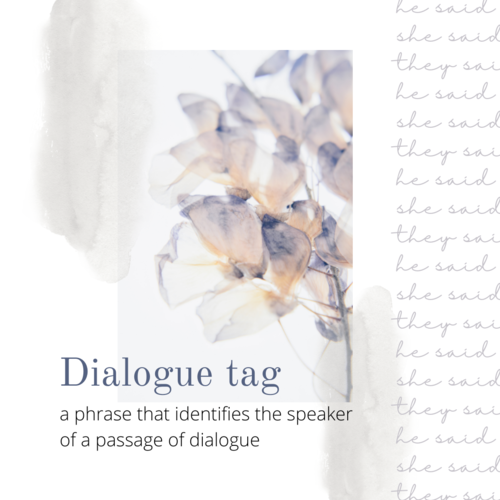
Dialogue Tag Definition. Dialogue: a phrase that identifies the speaker of a passage of dialogue

A dialogue tag is a phrase that identifies the speaker of a passage of dialogue.

In English, the most commonly used dialogue tag is the word “said” accompanied by the name of a character or a pronoun.

Often dialogue tags are used for clarity and to prevent confusion. Dialogue tags can also be used to add a pause, or to describe how or why a character is speaking.

Instead of using a dialogue tag, an action beat can be used—if a character is acting or doing something, then we assume that the dialogue within the passage also belongs to them.

Dialogue Tag Example: The Meryton Assembly

The Meryton assembly is the first time that we meet the single and ever-so-desirable characters, Mr. Bingley and Mr. Darcy.

Consider the use of dialogue tags and action beats in this passage in which Mr. Bingley attempts to convince Mr. Darcy to dance:

“Come, Darcy,” said he, “I must have you dance. I hate to see you standing about by yourself in this stupid manner. You had much better dance.”

“I certainly shall not. You know how I detest it, unless I am particularly acquainted with my partner. At such an assembly as this, it would be insupportable. Your sisters are engaged, and there is not another woman in the room whom it would not be a punishment to me to stand up with.”

“I would not be so fastidious as you are,” cried Bingley, “for a kingdom! Upon my honour, I never met with so many pleasant girls in my life as I have this evening; and there are several of them you see uncommonly pretty.”

“You are dancing with the only handsome girl in the room,” said Mr. Darcy, looking at the eldest Miss Bennet.

“Oh! she is the most beautiful creature I ever beheld! But there is one of her sisters sitting down just behind you, who is very pretty, and I dare say very agreeable. Do let me ask my partner to introduce you.”

“Which do you mean?” and turning round, he looked for a moment at Elizabeth, till catching her eye, he withdrew his own and coldly said, “She is tolerable; but not handsome enough to tempt me; and I am in no humour at present to give consequence to young ladies who are slighted by other men. You had better return to your partner and enjoy her smiles, for you are wasting your time with me.”

In this passage, there are three dialogue tags which use said: said he, said Mr. Darcy, and coldly said. There is one dialogue tag which uses a different verb: cried Bingley. This shows both Mr. Bingley’s emotion and the manner in which he is speaking. There is one spot where an action beat is used instead of a dialogue tag: “Which do you mean?” and turning round, he looked for a moment at Elizabeth… (This phrasing works well in Pride and Prejudice, but as a note, modern dialogue conventions often—but not always—split the action beat into a separate sentence. If this convention was used, this paragraph could be written something like: “Which do you mean?” He turned round and looked for a moment at Elizabeth.)

Using Said vs. Other Dialogue Tags

Using Said vs. Other Dialogue Tags

The author Elliott Slaughter performed a study of dialogue tags, and one of the texts that he analyzed was Pride and Prejudice. He found that 50% of Austen’s dialogue tags used the word “said.”

In English, “said” is seen as an invisible dialogue tag. It does its job, assigning dialogue to the speaker, but we aren’t meant to really notice or pay attention to it. Often, we don’t want the reader to be focusing on the dialogue tag—we want them to focus on the dialogue itself, and strong dialogue often gives a feel of how the speaker is speaking on its own, without extra description. In the brilliant book Craft in the Real World, Matthew Salesses explains that said being seen as invisible is just a cultural convention, and is not inherently better or right. Non-native English speakers sometimes find the constant use of the word said to be jarring, while those who have read hundreds of books in English become used to it.

Endless authors and books on writing recommend that writers primarily use the word said in dialogue tags, and to use other verbs minimally or not at all. Largely, I agree—a lot of the time, you do want the dialogue tag to be invisible, and if you’re constantly using other verbs, it can distract or become annoying. Yet when we read Pride and Prejudice we can see how effectively Austen uses other dialogue tags.

According to Elliott Slaughter, while 50% of Austen’s dialogue tags use the word said, 32% of the time she uses “functional dialogue tags”—tags which “indicate the function or role of a piece of dialogue.” The functional dialogue tags Austen uses include replied, added, continued, thought, repeated, and answered. Another common functional dialogue tag in fiction is asked. 18% of the time Austen uses “descriptive dialogue tags”—“verbs that describe the manner, mood or inflection of the speech and not simply its function or form.” The descriptive dialogue tags used by Austen include cried, observed, exclaimed, called, and whispered.

In a previous Jane Austen Writing Lesson, I talked in more depth about how characters say lines of dialogue; one method of doing so is to incorporate actions or adverbs. The only thing I’ll add here is an extra detail from Slaughter’s study—at 14 points in Pride and Prejudice, Austen uses an adverb to describe how someone says something. The adverbs she uses include impatiently, warmly, drily, stoutly, and resentfully.

In the passage between Mr. Darcy and Mr. Bingley, there were two paragraphs of dialogue that did not include any dialogue tags or action beats. The paragraph that begins “I certainly shall not” is Mr. Darcy’s dialogue, while the paragraph that begins “Oh! she is the most beautiful creature I ever beheld!” is Mr. Bingley’s.

Omitting a dialogue tag focuses the reader on what the characters are saying, and it increases the pace by which we read the dialogue. In Austen’s novels, dialogue tags are used only if they are necessary for comprehension, if they will positively impact the rhythm or cadence, or if they truly add something to the reader’s understanding of the characters and their conversation. The rest of the time, she does not include dialogue tags.

In Elliott Slaughter’s study on dialogue tags in Pride and Prejudice, he found that for 51% of the dialogue, Austen does not use a dialogue tag or any sort of attribution. This is especially common during conversations between two characters. In some passages, the identity of the speakers will be made clear once, either at the start of the conversation or in the actions before the conversation, and then Austen will give five, six, or ten lines of dialogue without any tags or attributions. While it’s easiest to omit dialogue tags if there are only two characters, Austen often omits tags in conversations with larger groups of characters.

In a later scene in Pride and Prejudice, Mr. Darcy’s makes a declaration on Mr. Bingley’s tractability, and then we read:

“You have only proved by this,” cried Elizabeth, “that Mr. Bingley did not do justice to his own disposition. You have shown him off now much more than he did himself.”

“I am exceedingly gratified,” said Bingley, “by your converting what my friend says into a compliment on the sweetness of my temper. But I am afraid you are giving it a turn which that gentleman did by no means intend; for he would certainly think the better of me, if under such a circumstance I were to give a flat denial, and ride off as fast as I could.”

“Would Mr. Darcy then consider the rashness of your original intention as atoned for by your obstinacy in adhering to it?”

“Upon my word, I cannot exactly explain the matter, Darcy must speak for himself.”

“You expect me to account for opinions which you choose to call mine, but which I have never acknowledged. Allowing the case, however, to stand according to your representation, you must remember, Miss Bennet, that the friend who is supposed to desire his return to the house, and the delay of his plan, has merely desired it, asked it without offering one argument in favour of its propriety.”

“To yield readily—easily—to the persuasion of a friend is no merit with you.”

“To yield without conviction is no compliment to the understanding of either.”

The first two paragraphs include dialogue tags, for Elizabeth and Mr. Bingley, but then the rest of this dialogue we can assume by context that the lines belong to Elizabeth, Mr. Bingley, Mr. Darcy, Elizabeth, and then Mr. Darcy. Descriptions of how these characters are speaking is not necessary—we know them and can make assumptions on their tone and mannerisms based solely on what they say.

There are a few places in Pride and Prejudice where the speaker is unclear, which has led to rather exciting scholarly debates. In a letter about Pride and Prejudice which Jane Austen wrote to her sister Cassandra, she said,

There are a few typical errors; and a “said he,” or a “said she,” would sometimes make the dialogue more immediately clear; but “I do not write for such dull elves” as have not a great deal of ingenuity themselves.

While Austen wished she had added a few more uses of “said he” and “said she,” the fact is that there are 633 lines of dialogue in Pride and Prejudice which do not include dialogue tags, and, with a few possible exceptions, they are not necessary in these passages. As you consider what sorts of dialogue tags you want to use in your own writing, consider also when to use dialogue tags, and when to omit them.

Writing Exercises - Jane Austen Writing Lessons

Exercise 1: Dialogue Analysis

Choose a book that you admire written by an author who is not Jane Austen. Take a scene or a chapter and analyze the author’s use of dialogue tags. How often do they use the verb said? Do they also use other verbs as dialogue tags? Are action beats used instead of, or in addition to, dialogue tags. Are adverbs or other descriptions of how the character speak used? How often are dialogue tags omitted?

Exercise 2: Omitting Dialogue Tags

Take a scene of dialogue you have written and see how dialogue tags and action beats you can remove without making it unclear who is speaking.

Exercise 3: Dialogue as Style

How you use dialogue tags is an extension of your style as a writer—the choices you consistently make contribute to the overall style of the text. Write a brief scene of dialogue between two to four characters. Now, revise the scene using two different dialogue tag styles. Here are a few options:

  • Style 1: Use only invisible dialogue tags (i.e. said) and omit other dialogue tags.
  • Style 2: Lean heavy on action beats, though other dialogue tags are allowed.
  • Style 3: Jane Austen style. Omit about half the dialogue tags; when you do use dialogue tags, have about half of them be the verb said and half be other verbs.
  • Style 4: Wide range of tags. Use at least one said, one functional dialogue tag (i.e. asked, replied, etc.), one descriptive dialogue tag (i.e. cried, whispered, exclaimed, or said + adverb), and one action beat.
  • Style 5: Another approach to dialogue tags of your choosing.

Don’t Miss a Lesson: Subscribe to Updates and Giveaways from katherinecowley.com

* indicates required


Which newsletter(s) would you like to receive?

Jane Austen Writing Lessons. #48: Techniques for Writing About Holidays in Fiction

#48: Techniques for Writing About Holidays in Fiction

Jane Austen Writing Lessons. #48: Techniques for Writing About Holidays in Fiction

Jane Austen has a thing for Christmas.

In some of her novels, Christmas is mentioned only in brief, while in others it is a focal component, but each of her six published novels incorporates Christmas in some way. In this post, we’re going to look at how Jane Austen uses Christmas as a storyteller, and what writing techniques we can learn from her. Whether your characters celebrate Christmas or Eid or Rosh Hashanah, you can apply these techniques for writing about holidays in fiction to your own stories.

Writing Holidays in Fiction. Technique #1: Use holidays as time markers. Jane Austen Writing Lessons.

Technique 1: Use Holidays as Time Markers

Major holidays act as time markers in the year—they are days that are out of the ordinary, and we associate them with certain months and seasons. Austen often references Christmas a time marker, to show either a sense of when something occurred or will occur, or to show the passage of time.

She does this a number of times in her novels, but here’s a few brief examples.

Mansfield Park

In Mansfield Park, there is a conversation between Miss Crawford and Edmund Bertram. They share a romantic interest in each other, but Miss Crawford looks down on the clergy as a profession, while Edmund looks forward to becoming a clergyman:

“Ordained!” said Miss Crawford; “what, are you to be a clergyman?”

“Yes; I shall take orders soon after my father’s return—probably at Christmas.”

Pride and Prejudice

After the regiment leaves Meryton, initially a number of members of the Bennet family are devastated. Eventually, their intense feelings on the matter begin to subside:

Mrs. Bennet was restored to her usual querulous serenity; and, by the middle of June, Kitty was so much recovered as to be able to enter Meryton without tears; an event of such happy promise as to make Elizabeth hope that by the following Christmas she might be so tolerably reasonable as not to mention an officer above once a day…

Technique 2: Use Holidays to Convey Emotions

Holidays are not joyful for everyone: there is not a unified experience or emotional reaction for any holiday. Jane Austen uses holidays to demonstrate a range of emotional states. Sometimes, the emotions shown will be about the holiday itself, or people’s expectations and experience of the holiday. At other times, she will use a holiday to reflect a character’s overall emotional state at this point in the story.

This passage in Persuasion does both: we see characters’ emotions about the present holiday (which in part is related to their expectations for it). Lady Russell expects a quieter holiday than Mrs. Musgrove. We also see characters’ emotional states about the present events—Anne is still troubled by Louisa Musgrove’s accident and the resulting health consequences, and so she expects something different from Christmas, while Mrs. Musgrove finds the Christmas chaos to be a balm for her worries about her daughter Louisa.

Immediately surrounding Mrs Musgrove were the little Harvilles, whom she was sedulously guarding from the tyranny of the two children from the Cottage, expressly arrived to amuse them. On one side was a table occupied by some chattering girls, cutting up silk and gold paper; and on the other were tressels and trays, bending under the weight of brawn and cold pies, where riotous boys were holding high revel; the whole completed by a roaring Christmas fire, which seemed determined to be heard, in spite of all the noise of the others. Charles and Mary also came in, of course, during their visit, and Mr Musgrove made a point of paying his respects to Lady Russell, and sat down close to her for ten minutes, talking with a very raised voice, but from the clamour of the children on his knees, generally in vain. It was a fine family-piece.

Anne, judging from her own temperament, would have deemed such a domestic hurricane a bad restorative of the nerves, which Louisa’s illness must have so greatly shaken. But Mrs Musgrove, who got Anne near her on purpose to thank her most cordially, again and again, for all her attentions to them, concluded a short recapitulation of what she had suffered herself by observing, with a happy glance round the room, that after all she had gone through, nothing was so likely to do her good as a little quiet cheerfulness at home.

Louisa was now recovering apace. Her mother could even think of her being able to join their party at home, before her brothers and sisters went to school again. The Harvilles had promised to come with her and stay at Uppercross, whenever she returned. Captain Wentworth was gone, for the present, to see his brother in Shropshire.

“I hope I shall remember, in future,” said Lady Russell, as soon as they were reseated in the carriage, “not to call at Uppercross in the Christmas holidays.”

Technique 3: Use Distinctive Holiday Details

At times, Austen gives distinctive details surrounding Christmas. This gives flavor to the holiday and paints the setting for the reader. As a modern reader, these details are fascinating, but they would also be interesting for a contemporary reader because they show how a particular character or group interacts with the holiday.

In the above passage from Persuasion, here are some of the distinctive details included about Christmas:

  • Girls cutting up silk and gold paper
  • A table covered by “tressels and trays, bending under the weight of brawn and cold pies”
  • A “roaring Christmas fire”—a loud, large fire, louder and larger because it is for Christmas

The novel Sense and Sensibility includes only two brief references to Christmas, and yet the details included do give flavor to both the holiday and the character’s experience.

After Marianne Dashwood falls down a hill and is rescued by John Willoughby, the incident is mentioned by the Dashwoods to their friend Sir John, and Sir John gives several details praising Willoughby’s character, including the following with a reference to Christmas:

“He is as good a sort of fellow, I believe, as ever lived,” repeated Sir John. “I remember last Christmas at a little hop at the park, he danced from eight o’clock till four, without once sitting down.”

Here, we have details about Christmas—an outdoor party at the park, with dancing for eight hours!

Writing Holidays in Fiction. Technique #4: Use holidays for their associations. Jane Austen Writing Lessons.

Technique 4: Use Holidays for their Associations

Every holiday has a set of associations for both characters and readers. Some of these associations are universal—Christmas, for example, is associated with celebration and community and gathering as family and friends—while some may be more distinct.

In Emma, when the characters are at Box Hill, the characters begin sharing conundrums—a sort of riddle—and other plays on words. When it comes to Mrs. Elton, she says:

“Oh! for myself, I protest I must be excused,” said Mrs. Elton; “I really cannot attempt—I am not at all fond of the sort of thing. I had an acrostic once sent to me upon my own name, which I was not at all pleased with. I knew who it came from. An abominable puppy!—You know who I mean (nodding to her husband). These kind of things are very well at Christmas, when one is sitting round the fire; but quite out of place, in my opinion, when one is exploring about the country in summer.”

Mrs. Elton’s excuse for not participating is that it is not Christmas.

At other times these associations create emotional touchstones for the reader.

One of my favorite podcasts, The Thing About Austen, recently aired an episode about Elizabeth’s invitation for the Gardiners to join her for Christmas at Pemberley—first, Christmas is set up as a family event in the novel, for which the Gardiners always come to visit; then, Elizabeth supposes that it is good that she did not marry Mr. Darcy, for he would not allow the Gardiners to visit; and then, Elizabeth invites the Gardiners for Christmas. It’s an 18-minute episode, and well worth listening to for the way they analyze these passages and the details they include about Christmas in the Regency.

Writing Holidays in Fiction. Technique #5: Use holidays for key scenes.

Technique 5: Use Holidays for Key Scenes

In a previous post, I discussed how distinctive settings are often used for key scenes and turning points.
A holiday can provide a perfect opportunity for these key scenes or turning points—there is lots of emotions, and characters are often gathered together.

The most famous holiday scene in Austen’s works is the Christmas Eve dinner at the Westons in Emma. Its untimely end due to the snow leads to Mr. Elton’s unwanted proposal to Emma in a carriage. I discuss this scene in more depth in my post on using distinctive settings for major plot turns.
The other key scene which occurs at Christmas is the ball thrown for Fanny and her brother in Mansfield Park. This is the first time Fanny’s uncle has truly given her any attention—it is, perhaps, the first time she has felt valued by him. It provokes an internal crisis, as Fanny must decide whether to wear the necklace given her by the Crawfords or the one given by her cousin Edmund. And it is also an event where Henry Crawford gives Fanny his attentions as he attempts to make her fall in love with him. It’s an important scene with many key plot and character moments that change the course of the story.
Conclusion

While Austen often references Christmas, these techniques can be used for incorporating other holidays in fiction as well. Holidays are not an essential or required part of storytelling, yet every single culture and people celebrates holidays. Including holidays can give a fullness to the characters’ lives and show how they behave in circumstances which are out of the ordinary.

Writing Exercises - Jane Austen Writing Lessons

Exercise 1: Other Holidays

Choose a holiday that is not Christmas that your characters would celebrate. Write either a reference to the holiday or a full scene which uses at least one of the techniques in this lesson. Make sure to consider what associations the characters would have for the holiday and how they would celebrate it.

Exercise 2: A Holiday Story

Some of the most famous works of fiction, like A Christmas Carol, use a holiday as a core focus and setting for the entire story.

Holiday stories are often associated with certain genres, such as romance, however, holiday stories can be used in any genre—horror, science fiction, mystery, etc.

Outline a short story or novel, of any genre, which uses a holiday as a core component and setting.

Exercise 3: Read or Watch

Read or watch a story which incorporates a holiday, either in a small or large way. Does the story use the same techniques as Austen, or different ones?

Don’t Miss a Lesson: Subscribe to Updates and Giveaways from katherinecowley.com

* indicates required


Which newsletter(s) would you like to receive?