Jane Austen Writing Lessons

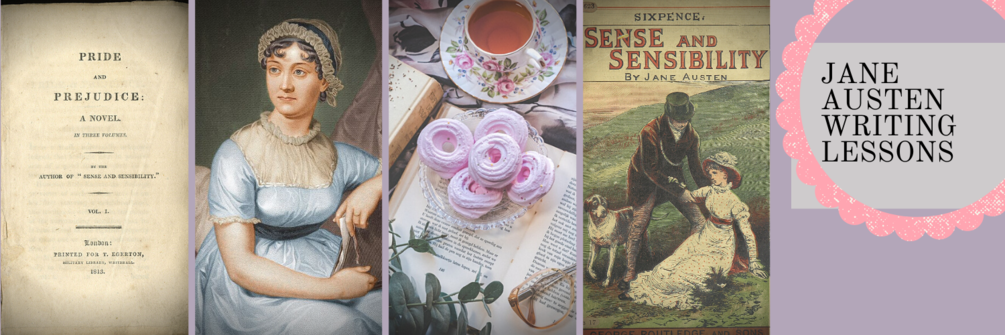
Jane Austen Writing Lessons. With an image of the original cover page of Pride and Prejudice; a color image of Jane Austen; an image of tea and pastries with an open book, and an early cover of Sense and Sensiblity.

One of the best ways to learn to write well is to learn from the examples of great writers. Jane Austen Writing Lessons is a series of blog posts about creative writing principles from plot structure to character development to dialogue. This blog was selected by “The Write Life” as one of the 100 Best Websites for Writers in 2021.

Jane Austen Writing Lessons is now a book!

Jane Austen Writing Lessons has been expanded into a book! The book includes over 70% brand-new material that never appeared on the blog. The book is now available in ebook, paperback, and hardcover from all major retailers.

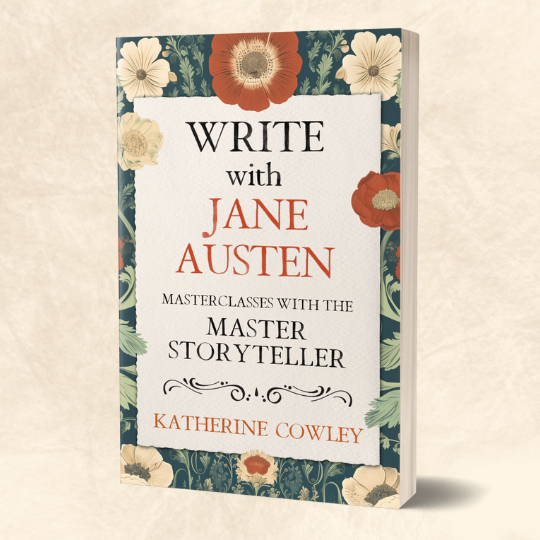
A 3D rendering of the book Write with Jane Austen: Masterclasses with the Master Storyteller

Read more about the book and find links to your favorite retailers.

Examples from Jane Austen

Each lesson looks to Jane Austen’s novels and her other works for examples of excellent writing. Quotes from her six published novels and an analysis of her craft–and how we can apply it to our own writing–is included in each lesson.

Writing Exercises

Writing Exercises - Jane Austen Writing Lessons

Each lesson includes 2-3 writing exercises that will help you practice the creative writing principle and apply it to your own writing.

Most Recent Jane Austen Writing Lessons

Jane Austen celebrating her birthday. Austen wears a birthday hat, holds a birthday present, and sits next to a birthday cake covered with candles.
Jane Austen Writing Lessons. #69: The Jane Austen Approach to Critiquing Writing
An intriguing snippet which has Jane Austen's portrait and a mysterious gray box with the words, "Cover Coming Soon"
Jane Austen Writing Lessons #68: Establishing Relationships and Character Connections in Fiction
Jane Austen Writing Lessons 67. Creating an Emotional Map: Making Interconnected Emotions
Jane Austen Writing Lessons. #66: Evoking Emotions through Objective Correlative (External Objects)
Mary Bennet and Mr. Collins. Why didn't they marry? Would they have made a good match?
Jane Austen Writing Lessons. #65: Different Character Approaches to Dealing with and Expressing Emotions
Jane Austen Writing Lessons. #64: The Size or Degree of Character Emotions

Jane Austen Writing Lessons by Category

Recognition for Jane Austen Writing Lessons

Jane Austen Writing Lessons: one of the

Jane Austen Writing Lessons was selected by The Write Life as one of the “100 Best Websites for Writers in 2021.” They wrote:

“[Jane Austen Writing Lessons] is filled with blog posts about creative writing that use Jane Austen’s novels and other related stories to share what good writing looks and sounds like. Whether you’re interested in plot structure or character development to dialogue, each Jane Austen writing lesson focuses on one principle of writing at a time.”

About the Author

In addition to writing Jane Austen Writing Lessons, Katherine Cowley is the author of the novels The Secret Life of Miss Mary BennetThe True Confessions of a London Spy, and The Lady’s Guide to Death and Deception. She has taught writing classes at Western Michigan University and other universities and community colleges.

Her blog, Jane Austen Writing Lessons, has been expanded into a new book, Write with Jane Austen: Masterclasses with the Master Storyteller.

Jane Austen Writing Lessons. #33: Use Familiar and Invisible Settings

#33: Use Familiar and Invisible Settings

Jane Austen Writing Lessons. #33: Use Familiar and Invisible Settings

Jane Austen is not afraid to describe settings: a few posts back, I discussed the pages of setting description she uses when Elizabeth arrives at Pemberley. She also tends to focus more on setting when it’s relevant to a major plot turn or serves to reveal a character’s emotions.

Yet other times, Austen hardly describes the setting at all. Take, for instance, the Meryton Assembly, the ball where Jane meets Mr. Bingley for the first time and Elizabeth meets Mr. Darcy. It’s a crucial scene in Pride and Prejudice, yet the assembly room is not described:

When the party entered the assembly room, it consisted of only five altogether.

Never, at any point, does Austen describe the assembly room, its size or arrangement, its features. She does give a few other clues to the setting:

The report which was in general circulation within five minutes of his entrance, of his having ten thousand a year.

This gives the sense that people are talking to each other and spreading information. Also:

Mr. Bingley had soon made himself acquainted with the principal people in the room; he was lively and unreserved, danced every dance, was angry that the ball closed so early, and talked of giving one himself at Netherfield.

We know now that not everyone at this sort of setting is considered “principal,” or of a class where Mr. Bingley would be expected to meet them. Perhaps the most important part of the chapter is when Elizabeth overhears Mr. Darcy insulting her: “She is tolerable; but not handsome enough to tempt me.” Every single adaptation arranges this moment quite differently, in part because Austen does not give copious details about the setting:

Elizabeth Bennet had been obliged, by the scarcity of gentlemen, to sit down for two dances, and during part of that time Mr. Darcy had been standing near enough for her to overhear a conversation between him and Mr. Bingley.

Most often it is for familiar settings that Austen employs a minimal amount of description.

A familiar setting is one which is familiar to the characters. It is a place where they have spent much time and often (though not always) feel comfortable. Because of its familiarity, the characters do not pay much attention to the setting. As a result of this the narrator, who is focalizing the perspective of a character, does not pay much attention to the setting.

In addition to mirroring the main character’s experience, providing a minimal description of a familiar setting does three things.

  • A minimal description of a familiar setting relies on common knowledge.

    There is a certain knowledge that an author can assume that both her characters and her readers will know. While a reader today does not have the same depth of “common knowledge” about an assembly room, Austen’s contemporary readers did share this common knowledge. And even without this same common knowledge, there is still enough detail to orient a modern reader unfamiliar with the setting.

  • A minimal description of a familiar setting prevents the story from getting bogged down or distracted by unnecessary details.

    Writers have a certain set of tools, and the temptation is to make sure we use all of the tools. But just because describing the setting can be a useful tool, it doesn’t mean it is always useful. Writers sometimes fall into the trap of feeling the need to describe everything, but this can bog down the story so we’re treading water in a sea of unnecessary details without going anywhere.

  • A minimal description of a familiar setting forces the focus to be on something else.

    If the setting is only minimally described, it increases the focus on other things, such as a character’s internal thoughts or an intense interaction between two characters.

Invisible Settings

There are also times when Jane Austen uses an invisible setting—a setting that is not described or delineated in any concrete way.

An example of this is after the Meryton Assembly. The family has returned home, and Mrs. Bennet is describing the ball to Mr. Bennet (who did not attend). And then, we have a new chapter, which begins:

When Jane and Elizabeth were alone, the former, who had been cautious in her praise of Mr. Bingley before, expressed to her sister how very much she admired him.

From the previous chapter, it is safe to assume that they are probably at home. But are they in the library, a parlor, a bedroom? Is it still the same night or is it the next morning? Could they have gone to the garden? Are they still in their ball gowns or have they changed? None of this information is delineated: we only know that Jane and Elizabeth are alone.

Jane and Elizabeth have a beautiful, insightful conversation, throughout which we do not receive a single additional piece of information on the setting.

Invisible settings are not common—personally, I can’t think of a single piece of recently published fiction that has a truly invisible setting. And I don’t know if I could get away with writing an invisible setting—my critique partners and editors would probably call me out on it, and force me to at least give a few details to orient the reader and ground the scene. Yet Austen does it quite effectively, without leaving the reader disoriented.

To use a cinematography metaphor, when Austen employs an invisible setting, is it like she is filming a scene entirely using close ups and extreme close-ups, where we are seeing only the characters faces and expressions. It is an approach to point of view which keeps it so very fixed on a character or characters that there is never a chance to have a medium shot, long shot, or establishing shot which would place the characters in their surroundings.

Using Description within a Familiar Setting

At times, Jane Austen does give more detailed descriptions for familiar settings. Often this is to demonstrate emotion or to give deeper insight into a situation and character, such as when Elizabeth receives a letter from her aunt about Mr. Darcy:

Elizabeth had the satisfaction of receiving an answer to her letter, as soon as she possibly could. She was no sooner in possession of it, than hurrying into the little copse, where she was least likely to be interrupted, she sat down on one of the benches, and prepared to be happy; for the length of the letter convinced her that it did not contain a denial.

While only a paragraph, this description of a familiar setting provides a wealth of details that set the stage for a pivotal point in the novel. We not only see Elizabeth’s anticipation, but we see how she is consciously choosing a particular setting, what she sees as an ideal setting, for reading this letter.

At other times, details are given for familiar settings because something has made the setting less familiar or less comfortable.

When Lydia comes home with Mr. Wickham after their patched-up marriage, Wickham’s presence transforms the house from a familiar place to an unfamiliar one, with new rules and relationship negotiations. Suddenly, we receive descriptions of rooms and hallways and entryways which have never been described over the hundreds of pages that came before:

They came. The family were assembled in the breakfast room, to receive them. Smiles decked the face of Mrs. Bennet, as the carriage drove up to the door; her husband looked impenetrably grave; her daughters, alarmed, anxious, uneasy.

Lydia’s voice was heard in the vestibule; the door was thrown open, and she ran into the room.

And then, a little later in the scene we read:

Elizabeth could bear it no longer. She got up, and ran out of the room; and returned no more, till she heard them passing through the hall to the dining parlour. She then joined them soon enough to see Lydia, with anxious parade, walk up to her mother’s right hand, and hear her say to her eldest sister, “Ah! Jane, I take your place now, and you must go lower, because I am a married woman.

Jane Austen is a master of not over-describing her settings, and she often uses very minimal descriptions when it is a setting which is a familiar to her characters; as a result, when she does provide description of a familiar setting, it is often a powerful tool which impacts the reading experience.

Writing Exercises - Jane Austen Writing Lessons

Exercise 1: Write a short scene in a dynamic setting (one that has lots of movement or people or interest or many events). While the setting should be dynamic, it should also be one that you can expect modern readers to share some common knowledge of (for example, an amusement park, a casino, a bar, a city bus/train, a busy museum). As you write the scene, restrict yourself to giving only two or three details about the setting, which can only be described briefly (ideally one sentence or phrase).

Exercise 2: Create a new outline of a story, or do a post-draft outline of a story that you have written a complete draft for. For each scene or chapter, write down the setting and label it either “familiar setting or “unfamiliar setting.” If you’d like, you can become even more specific: “setting that is now familiar but was originally unfamiliar,” “familiar setting that feels unfamiliar/uncomfortable,” etc.

Analyze the results, and if you’d like, use this to help you write or revise your story.

Pollute the Shades of Pemberley: A Writing Exercise. Jane Austen Writing Lessons

Exercise 3: Let’s pollute the shades of Pemberley! How do we do that? By deigning to alter Jane Austen’s words. First you’ll add description of setting to one of Austen’s scenes, and then you’ll subtract or condense the description of setting from another one of her scenes.

The point of this exercise to examine how things change when you have more or less description, and consider why a lot of description might be useful in a certain context and why minimal description might be useful in another context.

Part 1: Add Details About Setting

Spend 5-10 minutes adding details about the setting to the Meryton assembly scene:

A report soon followed that Mr. Bingley was to bring twelve ladies and seven gentlemen with him to the assembly. The girls grieved over such a number of ladies, but were comforted the day before the ball by hearing, that instead of twelve he brought only six with him from London—his five sisters and a cousin. And when the party entered the assembly room it consisted of only five altogether—Mr. Bingley, his two sisters, the husband of the eldest, and another young man.

Mr. Bingley was good-looking and gentlemanlike; he had a pleasant countenance, and easy, unaffected manners. His sisters were fine women, with an air of decided fashion. His brother-in-law, Mr. Hurst, merely looked the gentleman; but his friend Mr. Darcy soon drew the attention of the room by his fine, tall person, handsome features, noble mien, and the report which was in general circulation within five minutes after his entrance, of his having ten thousand a year. The gentlemen pronounced him to be a fine figure of a man, the ladies declared he was much handsomer than Mr. Bingley, and he was looked at with great admiration for about half the evening, till his manners gave a disgust which turned the tide of his popularity; for he was discovered to be proud; to be above his company, and above being pleased; and not all his large estate in Derbyshire could then save him from having a most forbidding, disagreeable countenance, and being unworthy to be compared with his friend.

Mr. Bingley had soon made himself acquainted with all the principal people in the room; he was lively and unreserved, danced every dance, was angry that the ball closed so early, and talked of giving one himself at Netherfield. Such amiable qualities must speak for themselves. What a contrast between him and his friend! Mr. Darcy danced only once with Mrs. Hurst and once with Miss Bingley, declined being introduced to any other lady, and spent the rest of the evening in walking about the room, speaking occasionally to one of his own party. His character was decided. He was the proudest, most disagreeable man in the world, and everybody hoped that he would never come there again. Amongst the most violent against him was Mrs. Bennet, whose dislike of his general behaviour was sharpened into particular resentment by his having slighted one of her daughters.

Elizabeth Bennet had been obliged, by the scarcity of gentlemen, to sit down for two dances; and during part of that time, Mr. Darcy had been standing near enough for her to hear a conversation between him and Mr. Bingley, who came from the dance for a few minutes, to press his friend to join it.

“Come, Darcy,” said he, “I must have you dance. I hate to see you standing about by yourself in this stupid manner. You had much better dance.”

“I certainly shall not. You know how I detest it, unless I am particularly acquainted with my partner. At such an assembly as this it would be insupportable. Your sisters are engaged, and there is not another woman in the room whom it would not be a punishment to me to stand up with.”

“I would not be so fastidious as you are,” cried Mr. Bingley, “for a kingdom! Upon my honour, I never met with so many pleasant girls in my life as I have this evening; and there are several of them you see uncommonly pretty.”

“You are dancing with the only handsome girl in the room,” said Mr. Darcy, looking at the eldest Miss Bennet.

“Oh! She is the most beautiful creature I ever beheld! But there is one of her sisters sitting down just behind you, who is very pretty, and I dare say very agreeable. Do let me ask my partner to introduce you.”

“Which do you mean?” and turning round he looked for a moment at Elizabeth, till catching her eye, he withdrew his own and coldly said: “She is tolerable, but not handsome enough to tempt me; I am in no humour at present to give consequence to young ladies who are slighted by other men. You had better return to your partner and enjoy her smiles, for you are wasting your time with me.”

Mr. Bingley followed his advice. Mr. Darcy walked off; and Elizabeth remained with no very cordial feelings toward him. She told the story, however, with great spirit among her friends; for she had a lively, playful disposition, which delighted in anything ridiculous.

Part 2: Subtract Details About Setting

Spend 5-10 minutes subtracting or condensing details about the setting from the scene when Elizabeth first sees Pemberley:

Elizabeth, as they drove along, watched for the first appearance of Pemberley Woods with some perturbation; and when at length they turned in at the lodge, her spirits were in a high flutter.

The park was very large, and contained great variety of ground. They entered it in one of its lowest points, and drove for some time through a beautiful wood stretching over a wide extent.

Elizabeth’s mind was too full for conversation, but she saw and admired every remarkable spot and point of view. They gradually ascended for half-a-mile, and then found themselves at the top of a considerable eminence, where the wood ceased, and the eye was instantly caught by Pemberley House, situated on the opposite side of a valley, into which the road with some abruptness wound. It was a large, handsome stone building, standing well on rising ground, and backed by a ridge of high woody hills; and in front, a stream of some natural importance was swelled into greater, but without any artificial appearance. Its banks were neither formal nor falsely adorned. Elizabeth was delighted. She had never seen a place for which nature had done more, or where natural beauty had been so little counteracted by an awkward taste. They were all of them warm in their admiration; and at that moment she felt that to be mistress of Pemberley might be something!

They descended the hill, crossed the bridge, and drove to the door; and, while examining the nearer aspect of the house, all her apprehension of meeting its owner returned. She dreaded lest the chambermaid had been mistaken. On applying to see the place, they were admitted into the hall; and Elizabeth, as they waited for the housekeeper, had leisure to wonder at her being where she was.

The housekeeper came; a respectable-looking elderly woman, much less fine, and more civil, than she had any notion of finding her. They followed her into the dining-parlour. It was a large, well proportioned room, handsomely fitted up. Elizabeth, after slightly surveying it, went to a window to enjoy its prospect. The hill, crowned with wood, which they had descended, receiving increased abruptness from the distance, was a beautiful object. Every disposition of the ground was good; and she looked on the whole scene, the river, the trees scattered on its banks and the winding of the valley, as far as she could trace it, with delight. As they passed into other rooms these objects were taking different positions; but from every window there were beauties to be seen. The rooms were lofty and handsome, and their furniture suitable to the fortune of its proprietor; but Elizabeth saw, with admiration of his taste, that it was neither gaudy nor uselessly fine; with less of splendour, and more real elegance, than the furniture of Rosings.

“And of this place,” thought she, “I might have been mistress! With these rooms I might now have been familiarly acquainted! Instead of viewing them as a stranger, I might have rejoiced in them as my own, and welcomed to them as visitors my uncle and aunt. But no,”—recollecting herself—“that could never be; my uncle and aunt would have been lost to me; I should not have been allowed to invite them.”

This was a lucky recollection—it saved her from something very like regret.

She longed to enquire of the housekeeper whether her master was really absent, but had not the courage for it. At length however, the question was asked by her uncle; and she turned away with alarm, while Mrs. Reynolds replied that he was, adding, “But we expect him to-morrow, with a large party of friends.” How rejoiced was Elizabeth that their own journey had not by any circumstance been delayed a day!

Part 3: Reflection

Now reflect! What did you learn about what Austen was doing and why? Are there other effective ways that these scenes could be written?

Don’t Miss a Lesson: Subscribe to Updates and Giveaways from katherinecowley.com

* indicates required


Which newsletter(s) would you like to receive?

Jane Austen Writing Lessons. #32: Use Setting to Complement or Contrast Emotion

#32: Use Setting to Complement or Contrast Emotion

Jane Austen Writing Lessons. #32: Use Setting to Complement or Contrast Emotion

In the last lesson, I discussed the advantages of using a distinctive setting in a major plot turn. In addition to assisting the plot, a setting is one of the most powerful ways to reveal a character’s emotions.

In Jane Austen’s novel Mansfield Park, the main character, Fanny Price, lives with her aunt and uncle and cousins. Fanny is often mistreated and ignored, but when her cousin Maria is married, both of Fanny’s female cousins—Maria and Julia—travel to London. Everyone’s treatment of Fanny improves, and she becomes a more essential and more valued part of the household.

Her friendship with a neighbor, Miss Crawford, also increases. One day, while Fanny is visiting Miss Crawford, the two are walking around the shrubbery at the parsonage, and they stop to sit on a bench. They are both in the exact same setting at the exact same time, but they both engage with it differently, and how they engage and interact with the setting provides insight into their emotions:

“This is pretty—very pretty,” said Fanny, looking around her as they were thus sitting together one day: “Every time I come into this shrubbery I am more struck with its growth and beauty. Three years ago, this was nothing but a rough hedgerow along the upper side of the field, never thought of as any thing, or capable of becoming any thing; and now it is converted into a walk, and it would be difficult to say whether most valuable as a convenience or an ornament; and perhaps in another three years we may be forgetting—almost forgetting what it was before. How wonderful, how very wonderful the operations of time, and the changes of the human mind!”

Fanny not only notices the growth and development of the setting, but she also eloquently expresses her observations. For the reader, Fanny’s musings on the shrubbery are not just a matter of an improved landscape: her musings reflect on how Fanny prefers her new role within the world. Previously, her family “never thought of [her] as any thing, or capable of becoming any thing,” but like the shrubbery, she is now flourishing. And because she is flourishing, she notices the shrubbery.

On the contrary, this is Miss Crawford’s reaction:

Miss Crawford, untouched and inattentive, had nothing to say.

Miss Crawford is naturally less interested in nature, but this character difference is not the full story. In the subsequent paragraphs, it begins to become clear that Miss Crawford is wrapped up in her own thoughts and reflections, as she tries to figure out what her future will look like. She is not a viewpoint character in this scene, yet still we glimpse her emotions by the very fact that she does not notice the setting and is unable to respond to Fanny’s enthusiasm.

Complements and Contrasts

When using setting to reveal emotion, the writer can:

  • Use a setting which complements the character’s emotions.

  • Use a setting which contrasts with the character’s emotions.

  • Use a setting which both complements and contrasts the character’s emotion.

In the above example, the emotion was revealed through speech, action, inaction, and awareness, all of which related or were in reference to the setting. Another effective method of revealing emotion is through the description of setting within the narrative.

Using the Setting to Complement Emotions

In Mansfield Park, Fanny’s uncle Lord Bertram becomes angry with her when she refuses an offer of marriage. He sends her back to her parents, which puts her in a setting that she has not interacted with since she was a young girl. How she feels about this is made clear by the narrator’s insights into her perception of the setting:

She was then taken into a parlour, so small that her first conviction was of its being only a passage-room to something better, and she stood for a moment expecting to be invited on; but when she saw there was no other door, and that there were signs of habitation before her, she called back her thoughts, reproved herself, and grieved lest they should have been suspected.

Several chapters focus almost entirely on Fanny’s interaction with the setting. The setting is not just her parents’ house; the setting is also the people in it (all of her many siblings, most of who she has no connection to), as well as and the behaviors and expectations associated with the house. In one passage, we read:

But though she had seen all the members of the family, she had not yet heard all the noise they could make.

Austen goes on to describe, in great detail, the hustle and bustle and the yelling and the arguing,

the whole of which, as almost every door in the house was open, could be plainly distinguished in the parlour, except when drowned at intervals by the superior noise of Sam, Tom, and Charles chasing each other up and down stairs, and tumbling about and hallooing.

Fanny was almost stunned. The smallness of the house, and thinness of the walls, brought every thing so close to her, that, added to the fatigue of her journey, and all her recent agitation, she hardly knew how to bear it.

There is never a need for Austen to state, “Fanny was not happy with this move and did not feel comfortable with her family. She felt unloved and unwanted.” None of these things need to be said, because we experience through it as Fanny experiences the setting. At the end of one of the chapters, the narrator does state Fanny’s emotions more directly:

In a review of the two houses, as they appeared to her before the end of a week, Fanny was tempted to apply to them Dr. Johnson’s celebrated judgment as to matrimony and celibacy, and say, that though Mansfield Park might have some pains, Portsmouth could have no pleasures.

However, this more direct statement of emotion works because of the artistry of it, because it is a direct revelation of Fanny’s internal thoughts, and because this direct statement of emotion has been earned. We have already experienced the emotion with Fanny by experiencing the setting with her. And so when this statement is made, we agree with her and we feel for her.

Using the Setting to Contrast Emotions

At other times, it can be effective to use the setting to provide a contrast to the character’s emotions. A good, beautiful day could be contrasted with a character’s depressions, just as a terrifying storm could contrast with a character’s happiness.

Near the beginning of the novel, when a young Fanny arrives at Mansfield Park, the wonderful, grand house provides a clear contrast to her emotions, actually serving to make her feel worse:

The grandeur of the house astonished, but could not console her. The rooms were too large for her to move in with ease; whatever she touched she expected to injure, and she crept about in constant terror of something or other; often retreating towards her own chamber to cry.

When a positive setting contrasts with a negative emotion, it can serve to alienate the character from their surroundings, as occurs in this example. This can make the character’s negative emotions feel even weightier to the reader. When a negative setting contrasts with a positive emotion, the character seems to transcend their setting. This can make the character’s positive emotions seem greater or more powerful to the reader.

Using the Setting Both to Complement and Contrast Emotions

Some settings both complement and contrast emotions. This can occur over the course of a novel, as a character’s relationship with the setting changes.

This can also occur within a single scene. When a setting both complements and contrasts emotions in a single scene, it often serves to highlight the complexity of human emotion as well as our nuanced experiences with our surroundings.

The following passage in Mansfield Park occurs when Fanny is still at her parents’ home. She is dreading receiving bad news in the mail. Note how the narrator calls attention to the fact of what the bright sunlight should do versus what it actually does, and how this transitions to Fanny noticing aspects of the setting which reflect her discomfort (such as the low-quality blue milk with motes and the increasingly greasy butter and bread):

The sun was yet an hour and half above the horizon. She felt that she had, indeed, been three months there; and the sun’s rays falling strongly into the parlour, instead of cheering, made her still more melancholy, for sunshine appeared to her a totally different thing in a town and in the country. Here, its power was only a glare: a stifling, sickly glare, serving but to bring forward stains and dirt that might otherwise have slept. There was neither health nor gaiety in sunshine in a town. She sat in a blaze of oppressive heat, in a cloud of moving dust, and her eyes could only wander from the walls, marked by her father’s head, to the table cut and notched by her brothers, where stood the tea-board never thoroughly cleaned, the cups and saucers wiped in streaks, the milk a mixture of motes floating in thin blue, and the bread and butter growing every minute more greasy than even Rebecca’s hands had first produced it.

A bright cheery day is now a curse for Fanny—she normally loves the sun, but not now. Not in this context of this setting, and not in this context of her own emotional agony. The sun contrasts with her emotions until it is subverted into complementing her negative emotions.

In Conclusion

Just as Jane Austen does, we can use the setting to reflect or contrast with a character’s emotions. Often, this is more effective than just stating the emotion, and it allows the setting to perform work on multiple levels of the novel.

Writing Exercises - Jane Austen Writing Lessons

Exercise 1: One Setting, a Multitude of Possible Emotions

Woman in Rain by Mario Cuadros. Displays a woman in a city, walking along the sidewalk. She wears a long brown coat and a backpack. We see her walking away from us with a black umbrella over her head.

Photo by Mario Cuadros from Pexels

A single setting could be described in very different ways, depending on the character’s emotion. Consider the above photograph. Now write three short descriptions of the character within this setting, each which conveys a different emotion. Aim for a one to four sentence description, and choose from the following emotions:

  • Fear
  • Excitement
  • Resignation
  • Love
  • Fatigue
  • Concern for someone else

Exercise 2:

Choose a novel. Now find three different points in the novel which describe the setting while providing insight into emotion. Does the setting complement or contrast the emotion? Does it do both? What specific word choice and sentence structure helps produce the desired emotion?

Exercise 3:

Option 1: As you write a scene, consciously include details about the setting which either complement or contrast with the character’s emotions.

Option 2: Take an early draft of a scene you have written and revise it, focusing on using the setting to shine a light on the character’s emotions.

Don’t Miss a Lesson: Subscribe to Updates and Giveaways from katherinecowley.com

* indicates required


Which newsletter(s) would you like to receive?

Jane Austen Writing Lessons #31: Use a Distinctive Setting for Major Plot Turns

#31: Use a Distinctive Setting for Major Plot Turns

Jane Austen Writing Lessons #31: Use a Distinctive Setting for Major Plot Turns

Many of the scenes in Jane Austen’s novels occur in what, for her characters, would be ordinary settings—drawing rooms and walks where they had been many times before. We’ll talk, in a few weeks, about how to use familiar settings.

But sometimes Austen uses very distinctive settings for her scenes, and this often happens when there is a major plot turn in the story.

A major plot turn is when both the story and the characters undergo a large shift. Something happens which irrevocably changes the future direction of the plot, and has a profound impact on character and relationship arcs.

In her novel Persuasion, Jane Austen gives her characters a distinctive setting, unlike the rest in the book, when a number of the characters take a trip to the town of Lyme Regis.

Lyme Regis by Alison Day -- a city with a rocky shore and a hint of the ocean.

A modern view of Lyme Regis by Alison Day (limited Creative Commons license)

Three of the characters who travel to Lyme Regis are our main character, Anne Elliot, the man she turned down years before, Captain Wentworth, and his current love interest, Louisa Musgrove.

I previously talked about the Anne-Wentworth-Louisa trio in a post about making things hard for your character. In sum, when Anne and Captain Wentworth became engaged, Anne was persuaded by family members and friends to break off the engagement. Wentworth still has not forgiven her for this. One of the things Wentworth values about Louisa is that she is not easily persuadable—she will go her own way.

Fast forward to Lyme Regis. Bringing the characters to this new, distinctive setting first allows them to meet or encounter new characters who will be key to the story, including Captain Benwick and Anne’s cousin, Mr. Elliot.

Distinctive settings are unfamiliar to characters, which heightens the awareness of the setting for both the characters and the reader. When in a distinctive setting, the characters have a whole additional layer of things to navigate: new physical objects, new or unfamiliar expectations, and as a result…

Distinctive settings often draw out peoples strengths and weaknesses, demonstrate who they really are, and provide opportunities for characters to transform in either a positive or a negative direction.

At Lyme Regis, a number of the characters take a walk along the Cobb, which is a wall near the harbor. There is a heightened awareness of the setting, which is distinctive enough to bring to Anne’s mind the poetry of Byron as she walks with Captain Benwick:

Lord Byron’s ‘dark blue seas’ could not fail of being brought forward by their present view, and she gladly gave him all her attention as long as attention was possible.

In the following paragraph, which is one of the biggest, most dramatic events in Persuasion, we see how the setting draws out Louisa’s firmness of character and the way she is unyielding to persuasion. While Captain Wentworth has always seen this characteristic as a virtue, the negative side of it is made clear.

There was too much wind to make the high part of the new Cobb pleasant for the ladies, and they agreed to get down the steps to the lower, and all were contented to pass quietly and carefully down the steep flight, excepting Louisa; she must be jumped down them by Captain Wentworth. In all their walks, he had had to jump her from the stiles; the sensation was delightful to her. The hardness of the pavement for her feet, made him less willing upon the present occasion; he did it, however; she was safely down, and instantly, to shew her enjoyment, ran up the steps to be jumped down again. He advised her against it, thought the jar too great; but no, he reasoned and talked in vain; she smiled and said, ‘I am determined I will:’ he put out his hands; she was too precipitate by half a second, she fell on the pavement on the Lower Cobb, and was taken up lifeless!

A picture of steps on the Cobb, which is one of the sets of steps that Austen may have been describing in the novel. Image by Chris Talbot, Creative Commons license.

Almost all of the characters completely panic and are rather useless in this sort of situation. Except for Anne. Here we see her kindness, her perceptiveness, her rationality, and her ability to act in the face of challenge.

“Go to him, go to him,” cried Anne, “for heaven’s sake go to him….Rub her hands, rub her temples; here are salts,–take them, take them.”

Captain Benwick obeyed, and Charles at the same moment, disengaging himself from his wife, they were both with him; and Louisa was raised up and supported more firmly between them, and every thing was done that Anne had prompted, but in vain; while Captain Wentworth, staggering against the wall for his support, exclaimed in the bitterest agony,

“Oh God! her father and mother!”

“A surgeon!” said Anne.

He caught the word; it seemed to rouse him at once, and saying only, “True, true, a surgeon this instant,” was darting away, when Anne eagerly suggested,

“Captain Benwick, would not I be better for Captain Benwick? He knows where a surgeon is to be found.”

Every one capable of thinking felt the advantage of the idea[.]

Jane Austen uses a number of techniques in this passage to create emotional intensity. After Louisa’s fall, descriptions of the setting and people and people’s behavior are very short and concise. Her use of punctuation changes, paragraphs not ending with full stops before leaping into the next paragraph. And short snippets of dialogue are stacked on each other with almost no interruption.

A distinctive setting, like the Cobb at Lyme Regis, seems a fitting backdrop for such a pivotal event that impacts the entire trajectory of the novel.

Making an Ordinary Setting Distinctive

Sometimes distinctive settings are big and new and grand and different. Yet at other times, Jane Austen takes an ordinary setting and makes it distinctive in some way, and then uses this ordinary yet distinctive setting for a major plot turn.

An example of this is Mr. Elton’s proposal to Emma, in the book Emma. This proposal is key, not just because it is a proposal which she rejects, but because it is the start of Emma’s awareness that her judgment can be faulty (she thought Mr. Elton was in love with her friend Harriet, but he is actually in love with her).

The proposal occurs in a carriage, a very ordinary setting for an Austen character, yet what makes it distinctive is that Emma and Mr. Elton were never meant to be in a carriage alone together, and they only are because of a mix-up caused by other characters.

It is not common for a man and a woman to be in a carriage by themselves. This suddenly distinctive setting puts these two characters alone and unsupervised, when they would not normally be so. Mr. Elton decides to seize this opportunity to propose. The setting also serves to trap the characters: they are stuck in a moving box together, which adds to the pressure. During the proposal Emma feels trapped, and then after he is denied, Mr. Elton is also trapped both literally and figuratively.

A distinctive setting—whether it is grand and full of danger like the Cobb, or a familiar setting made distinctive like Emma’s carriage—is a powerful place to set a major plot turn, as it can make the plot possible, heighten awareness and tension, and draw out characters’ strengths and weaknesses.

Writing Exercises - Jane Austen Writing Lessons

Exercise 1: Choose a key scene from a story you have written, and revise the scene either by:

  1. Editing the setting to make it more distinctive (which will impact your description as well as how your character interact with and within the setting).
  2. Rewriting the scene with a new setting that can do more to assist with this major plot point.

Exercise 2:

Choose a book or a film, and find a scene with a distinctive setting in terms of landscape, architecture, cultural/historical significance, etc.

How does the use of this setting impact the plot and the character? What strengths and weaknesses of the characters does it manifest? How does this setting fit within the context of the other settings used in the story?

Exercise 3:

Consider the following list of ordinary places. Add a description to each to show how you could make them distinctive, in a way that might open up storytelling possibilities. (This could be anything, for example, something happening within the place, who is inside, how this place differs from other places like it, etc.)

  • A grocery store
  • A school bus
  • A bar
  • A movie theater
  • A kitchen

Don’t Miss a Lesson: Subscribe to Updates and Giveaways from katherinecowley.com

* indicates required


Which newsletter(s) would you like to receive?

Jane Austen Writing Lessons. #30: Introduce the Setting Through Description.

#30: Introduce the Setting through Description

Jane Austen Writing Lessons. #30: Introduce the Setting Through Description.

When I was in grad school, I studied Rhetoric and Composition (the teaching of writing). In a class I took which incorporated classical rhetoric, I wrote an essay about the Latin term descriptio, or what today we would call description. According to the website Silva Rhetoricae, description is “a composition bringing the subject clearly before the eyes.” In other words, it helps us visualize something on the page.

The Greeks and the Romans considered descriptio (description) to be the opposite of narratio (narrative).

Description≠Narrative

Narrative is about forward movement, it’s about story and progression, it’s about events happening. But anytime you have description, it halts the forward movement: we are now looking at something being painted before our eyes. And that painting takes time.

This is not to say that all description should be avoiding, but it is essential to realize as a writer that description competes with narrative.

Jane Austen, as always, is an excellent role model on how to use description, particularly in how she describes her settings. She gives enough detail to give us a sense and feel of the whole without disrupting the forward movement of the narrative.

In a previous post, I talked about the importance of using setting to influence plot and character. In this post, we’re going to look at a few passages from Elizabeth’s physical journeys in Pride and Prejudice to see how Jane Austen uses description to establish setting. In the process, I’ll talk about five specific techniques that she uses to powerfully introduce setting through description.

Introducing Setting Through Description (Jane Austen Writing Lessons). Technique 1: Provide a few key details which give a sense of the whole.

Technique 1: Provide a few key details which give a sense of the whole.

One of Austen’s primary techniques in establishing setting is to only use a few pertinent details. Unlike a production designer in a film, who must physically choose, create, acquire, and place every single item which we see, a novelist is generally best served by focusing on a few points that give a taste, a feel, or a sense of the whole.

In Pride and Prejudice, Elizabeth’s first trip away from home is to visit her friend Charlotte Collins née Lucas. After Elizabeth turned downed Mr. Collins’ offer of marriage, her friend Charlotte accepted his hand, and now, at Charlotte’s behest, Elizabeth has come to visit the parsonage where they live.

In the following two passages from when Elizabeth arrives, note how we are given only a smattering of concrete descriptive details, yet from this we understand not just the setting, but the people who are part of it.

Passage 1 (emphasis added):

Elizabeth was prepared to see [Mr. Collins] in his glory; and she could not help fancying that in displaying the good proportion of the room, its aspect and its furniture, he addressed himself particularly to her, as if wishing to make her feel what she had lost in refusing him….After sitting long enough to admire every article of furniture in the room, from the sideboard to the fender…Mr. Collins invited them to take a stroll in the garden, which was large and well laid out, and to the cultivation of which he attended himself.

The sideboard and the fender stand in for all of the furniture, the rest of which we are meant to conjecture. For the garden we receive only two details: it is large and it is well laid out. More concrete particulars are not relevant.

Passage 2 (emphasis added):

Charlotte took her sister and friend [Elizabeth] over the house, extremely well pleased, probably, to have the opportunity of shewing it without her husband’s help. It was rather small, but well built and convenient; and everything was fitted up and arranged with a neatness and consistency of which Elizabeth gave Charlotte all the credit. When Mr. Collins could be forgotten, there was really a great air of comfort throughout, and by Charlotte’s evident enjoyment of it, Elizabeth supposed he must be often forgotten.

In this passage, Austen swiftly paints a picture of the house, giving not just concrete details, but also value judgments (neatness and consistency are a good thing, and reflect positively on Charlotte) and a more general, abstract sense of the feel (“a great air of comfort throughout”).

Introducing Setting Through Description (Jane Austen Writing Lessons). Technique 2: Use the description of the setting to reveal things about the characters and their states of mind.

Technique 2: Use the description of the setting to reveal things about the characters and their states of mind.

On its most basic level, describing a setting is useful because it orients the reader—we feel grounded when we know where we are and what’s going on. Yet Austen never just uses setting description to orient us: she always makes it serve double-duty.

A good description reveals as much about characters and their states of mind as it reveals about the setting itself.

Mr. Collins’ parsonage abuts Rosings, the grand estate belong to his esteemed patroness, Lady Catherine de Bourgh.

They are invited to dinner, and they all walk together to approach Rosings. In the following description of setting, notice what is revealed about Elizabeth, and about Charlotte’s sister Maria and father Sir William:

Every park has it beauty and its prospects; and Elizabeth saw much to be pleased with, though she could not be in such raptures as Mr. Collins expected the scene to inspire, and was but slightly affected by his enumeration of the windows in front of the house, and his relation of what the glazing altogether had originally cost Sir Lewis De Bourgh.

When they ascended the steps to the hall, Maria’s alarm was every moment increasing, and even Sir William did not look perfectly calm.—Elizabeth’s courage did not fail her. She had heard nothing of Lady Catherine that spoke her awful from any extraordinary talents or miraculous virtue, and the mere stateliness of money and rank, she thought she could witness without trepidation.

It is clear that while Elizabeth sees the beauty and wealth of Rosings and its park, she does not let intimidate or overly influence her, unlike Mr. Collins (who expects raptures from them), Maria (who feels alarm as they go up what must be rather grand steps), and even Sir William (who should theoretically be the most comfortable with this level of wealth).

Technique 3: Couple the description of the setting with action within or in relation to the setting.

While description can at times slow or halt the plot, at times they can be paired together. Rather than completely describing a setting and then having action occur within it in, Jane Austen will provide details of the setting as an action occurs.

As Elizabeth encounters Rosings, they are moving, both physically and emotionally, to meet the great Lady Catherine; Mr. Collins is talking—describing the place (speech in itself is a type of action); and we are learning more about the setting and its inhabitants as we physically pass through it:

From the entrance hall, of which Mr. Collins pointed out, with a rapturous air, the fine proportion and finished ornaments, they followed the servants through an antechamber, to the room where Lady Catherine, her daughter, and Mrs. Jenkinson were sitting.

A few pages later, Austen uses the same technique, describing other objects in the space as they are used.

When the gentlemen had joined them, and tea was over, the card tables were placed. Lady Catherine, Sir William, and Mr. and Mrs. Collins sat down to quadrille; and as Miss De Bourgh chose to play at cassino, the two girls had the honour of assisting Mrs. Jenkinson to make up her party.

Introducing Setting Through Description (Jane Austen Writing Lessons). Technique 4: Use minimal description of the setting (or omit it entirely) when the setting is not necessary to the story.

Technique 4: Use minimal description of the setting (or omit it entirely) when the setting is not necessary to the story.

It is the temptation of the writer to describe, in full detail, cool places, buildings, and objects, even when doing so is not absolutely necessary to the story. This is an indulgence which Austen tends to avoid. (Some writing styles like to linger on setting for setting’s sake, and doing so can also be effective, but even if you are writing in one of these styles, there is still a risk of over-indulging in description.)

Later in Pride and Prejudice, Elizabeth takes a trip with her aunt and uncle to Derbyshire, which happens to be where Mr. Darcy lives. Despite this being a sight-seeing trip for Elizabeth, full of interesting towns, landscapes, and historic sights which could easily be a full chapter, and could possibly reveal something about Elizabeth’s character or her relationship with her aunt and uncle, Austen does not provide any description of the setting, and her narrator even comments on the fact that she is not providing description:

It is not the object of this work to give a description of Derbyshire, nor of any of the remarkable places through which their route thither lay; Oxford, Blenheim, Warwick, Kenelworth, Birmingham, &c are sufficiently known. A small part of Derbyshire is all the present concern.

The small part of Derbyshire the narrator focuses on is Lambton, which Mrs. Gardiner has a personal connection to, and which happens to be near Mr. Darcy’s home, Pemberley.

Introducing Setting Through Description (Jane Austen Writing Lessons). Technique 5: Give more detailed setting descriptions when the setting can strengthen a key component of the narrative.

Technique 5: Give more detailed setting descriptions when the setting can strengthen a key component of the narrative.

While at many points in a story description is unnecessary, or is useful only in small portions, at other times detailed description of a setting can add depth to a story, highlight a character’s deep emotions or internal transformation, and prepare the reader for what is to come.

In contrast to the minimal description of the parsonage and Rosings, and the complete lack of description of the rest of the “remarkable places” during the journey to Lambton, Austen provides pages of description about the grounds and interior of Pemberley. Here are the first few paragraphs:

Elizabeth, as they drove along, watched for the first appearance of Pemberley Woods with some perturbation; and when at length they turned in at the lodge, her spirits were in a high flutter.

The park was very large, and contained great variety of ground. They entered it in one of its lowest points, and drove for some time through a beautiful wood, stretching over a wide extent.

Elizabeth’s mind was too full for conversation, but she saw and admired every remarkable spot and point of view. They gradually ascended for half a mile, and then found themselves at the top of a considerable eminence, where the wood ceased, and the eye was instantly caught by Pemberley House, situated on the opposite side of a valley, into which the road with some abruptness wound. It was a large, handsome, stone building, standing well on rising ground, and backed by a ridge of high woody hills;—and in front, a stream of some natural importance was swelled into greater, but without any artificial appearance. Its banks were neither formal, nor falsely adorned. Elizabeth was delighted. She had never seen a place for which nature had done more, or where natural beauty had been so little counteracted by an awkward taste. They were all of them warm in their admiration; and at that moment she felt, that to be mistress of Pemberley might be something!

This level of description is more powerful for having been saved for this moment. Elizabeth’s level of engagement with the setting, as demonstrated by the copious description, shows her attentiveness not just to Pemberley but to its owner, Mr. Darcy. Elizabeth is not just noticing a setting: she is interacting and engaging with it, and it is as she does so that she has the first conscious realization that maybe she should have accepted Mr. Darcy’s proposal.

Writing Exercises - Jane Austen Writing Lessons

Exercise 1: Choose one of your favorite authors and examine how they use description to establish setting. What techniques do they use? Are they the same as those used by Jane or are they different? What is the effect of the setting description on the story?

Exercise 2: Write a short scene involving three people walking through a graveyard. Include details about the setting, but do so in a way that reveals things about all three characters and their states of mind.

Exercise 3: Take a story that you have drafted and find places that include (or could include) setting description. Find the following in your manuscript:

  • A passage where you could reduce or eliminate description.
  • A passage where you could use different details that might give a better overall sense of the setting.
  • A passage where setting could be revealed through action.
  • A place where the description of the setting could reveal more about the characters and their state of mind.
  • A key scene in which more description of the setting could be added to increase the impact of the scene.

Now consider if any of these changes would both match your vision and improve your story; if so, revise!

Don’t Miss a Lesson: Subscribe to Updates and Giveaways from katherinecowley.com

* indicates required


Which newsletter(s) would you like to receive?

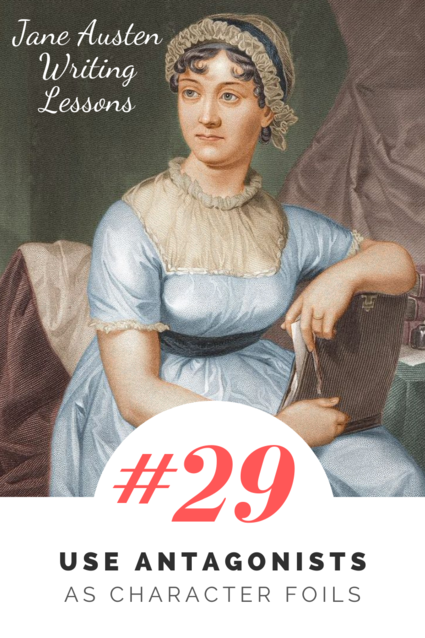
Jane Austen Writing Lessons. #29: Use Antagonists as Character Foils

#29: Use Antagonists as Character Foils

Jane Austen Writing Lessons. #29: Use Antagonists as Character Foils.

There’s a rather brilliant musical adaptation of Emma that I saw performed live in Chicago (in February 2020, right before everything shut down!).

In one of the songs, “The Recital,” Emma plays the pianoforte and sings at a gathering (while also feeling a little jealous of the attention that Mr. Knightley is paying to Jane Fairfax). And then, Jane moves to the pianoforte and begins to play at about the 1 minute 15 second mark—her playing and singing are clearly superior to Emma’s.

“She plays well, does she not?” says Mr. Knightley.

“Only if you enjoy that polished, extremely gifted sort of talent,” replies Emma.

(You can listen to the song on YouTube—stop at about 2 minutes 39 seconds in, because then it transitions to Harriet’s musings.)

What I love about Paul Gordon’s song is that it brilliantly establishes a contrast between Emma and Jane Fairfax, which is made very directly by having them play the very same song. (To me, this works really well for the musical genre.) It’s a shorthand to establish Jane Fairfax as Emma’s foil.

What is a Character Foil?

A character foil is a character who is set up in direct contrast to another character; their opposing attributes or circumstances are featured, with the purpose of revealing things about character and story.

Having a number of different characteristics is not enough for characters to be foils: all characters should be distinctive in some way, and dozens of characters in the story will have contrasting attributes.

In order to be true foils the characters must have something substantial in common, which both invites comparison between the characters and makes their differences more apparent.

Emma and Jane Fairfax are foils to each other. Not only is Jane Fairfax “exactly Emma’s age,” but they are two of the only gentlemen’s daughters in Highbury, and they both have many accomplishments. Yet Jane Fairfax is actually more accomplished; she applies herself with dedication to things while Emma does not. And Emma is in a position of power, wealth, and security, while Jane has none of these things.

A Foil as Antagonist

Not all character foils are antagonists, but many times they are: two people with conflicting characteristics or approaches to life can make natural antagonists. Tension and conflict easily arise between these characters, and it can be a powerful storytelling technique which raises the stakes, highlights the different sorts of choices that could be made (along with resulting consequences), and sheds light on character motivations.

Whether or not a character foil also serves as an antagonist, important contrasts are demonstrated.

A character foil can serve to demonstrate contrast:

  1. To the protagonist
  2. To other characters in the novel
  3. To the reader

In many novels, the foil demonstrates contrast to one or two of these groups, but in Jane Austen’s Emma, contrasts are demonstrated for all three groups.

Contrast demonstrated to the protagonist:

In the opening line of Emma, we learn that Emma is “handsome, clever, and rich,” and throughout her life she has “very little to distress or vex her.”

Yet the existence and presence of Jane Fairfax does vex Emma. When Jane returns to Highbury to stay with her relatives, this is Emma’s internal reaction:

Emma was sorry;—to have to pay civilities to a person she did not like through three long months!—to be always doing more than she wished, and less than she ought! Why she did not like Jane Fairfax might be a difficult question to answer; Mr. Knightley had once told her it was because she saw in her the really accomplished young woman, which she wanted to be thought herself; and though the accusation had been eagerly refuted at the time, there were moments of self-examination in which her conscience could not quite acquit her. But “she could never get acquainted with her: she did not know how it was, but there was such coldness and reserve—such apparent indifference whether she pleased or not—and then, her aunt was such an eternal talker!—and she was made such a fuss with by every body!—and it had been always imagined that they were to be so intimate—because their ages were the same, every body had supposed they must be so fond of each other.” These were her reasons—she had no better.

Emma knows they are the same age, she knows they should have been friends—she is aware of their similarities, and she constantly attempts to emphasize their differences:

She was, besides, which was the worst of all, so cold, so cautious! There was no getting at her real opinion. Wrapt up in a cloak of politeness, she seemed determined to hazard nothing. She was disgustingly, was suspiciously reserved.

Throughout the story, Jane Fairfax also reveals things to Emma about herself: Emma finds herself worried, and perhaps even jealous, when there seems to be a romantic interest between Mr. Knightley and Jane Fairfax.

Contrast demonstrated to other characters in the novel:

The first time in the novel that Jane Fairfax is referenced is actually by Harriet Smith, in conversation with Emma:

“Do you know Miss Bates’s niece? That is, I know you must have seen her a hundred times—but are you acquainted?”

“Oh! yes; we are always forced to be acquainted whenever she comes to Highbury. By the bye, that is almost enough to put one out of conceit with a niece. Heaven forbid! at least, that I should ever bore people half so much about all the Knightleys together, as she does about Jane Fairfax. One is sick of the very name of Jane Fairfax. Every letter from her is read forty times over; her compliments to all friends go round and round again; and if she does but send her aunt the pattern of a stomacher, or knit a pair of garters for her grandmother, one hears of nothing else for a month. I wish Jane Fairfax very well; but she tires me to death.”

Emma’s verbal treatment of Jane Fairfax should act as a warning to Harriet: Emma is not perfect, her vision can be skewed, her intentions not always kind or correct. But despite seeing Jane Fairfax and Emma placed side by side, Harriet does not notice or heed this warning, and it allows Emma to inflict a fair amount of emotional damage on Harriet.

Other characters see a contrast between Emma and Jane Fairfax and chose sides. It is clear, for instance, that Mrs. Elton does not particularly like Emma. She does take a liking to Jane Fairfax and attempts to take her under her wing. Yet Mrs. Elton’s attentions are not always good for Jane Fairfax, something which Emma feels (and even begins to disagree with) as she watches Mrs. Elton attempt to take away Jane’s limited autonomy.

Contrast demonstrated to the reader:

Even before Jane Fairfax is introduced, it is clear that Emma is not always the best person—she can be unlikeable, interfering, and a bit of an antihero. Setting up a foil for Emma further highlights her failings, negative qualities, and weaknesses.

The foil also helps create a beautiful redemption arc for Emma, because it takes a long time, but Emma does begin to change and improve. Despite their differences and her long-proclaimed dislike of Jane Fairfax, Emma realizes and resolves:

“I ought to have been more her friend.—She will never like me now. I have neglected her too long. But I will shew her greater attention than I have done.”

It is not long before Emma is put to the test. She almost uses her wit against Jane Fairfax, as she is wont to do:

She could have made an inquiry or two, as to the expedition and the expense of the Irish mails;—it was at her tongue’s end—but she abstained. She was quite determined not to utter a word that should hurt Jane Fairfax’s feelings; and they followed the other ladies out of the room, arm in arm, with an appearance of good-will highly becoming to the beauty and grace of each.

Later, Jane is feeling unwell and decides to leave a social event at Donwell Abbey early. At first, Emma tries to do what she thinks would be the most kind and solicitous action—to call a carriage. But ultimately, she allows Jane Fairfax to do what Jane wants, which gives her the autonomy and societal power she is often denied. The following passage begins with Jane speaking:

“I am fatigued; but it is not the sort of fatigue—quick walking will refresh me.—Miss Woodhouse, we all know at times what it is to be wearied in spirits. Mine, I confess, are exhausted. The greatest kindness you can shew me, will be to let me have my own way, and only say that I am gone when it is necessary.”

Emma had not another word to oppose. She saw it all; and entering into her feelings, promoted her quitting the house immediately, and watched her safely off with the zeal of a friend. Her parting look was grateful—and her parting words, “Oh! Miss Woodhouse, the comfort of being sometimes alone!”—seemed to burst from an overcharged heart, and to describe somewhat of the continual endurance to be practised by her, even towards some of those who loved her best.

The contrast between the characters and their evolving relationship creates a powerful story for readers. While Emma and Jane Fairfax never have a complete, total reconciliation, the transformation of their relationship is dramatic.

Wrapping up

Not all character foils need to have this sort of reconciliation. And sometimes, a character foil is used for a character other than the main protagonist. In Pride and Prejudice, Mr. Darcy and Mr. Wickham acts as foils to each other, and while a sort of agreement is reached between them at the end of the novel, it is more of a triumph of Darcy and his principles over Wickham.

Using character foils can be a powerful tool, especially with antagonists, which can create marked contrasts for the protagonist, for other characters, and for the reader.

Writing Exercises - Jane Austen Writing Lessons

Exercise 1: Think about one of your favorite character foils from a book or a movie. What do the characters have in common? What is different about these characters? Who notices this contrast, how does this foil effect the plot, and what is the impact of this foil on the reader?

Exercise 2: Take one of your characters who does not have a foil (either from a story you have already written or a character you have brainstormed). Craft a character who could be an effective foil for this character. What would be the advantages of using a foil in your story? What would be the disadvantages?

Exercise 3: Choose a classic fairy tale character, like Belle from Beauty and the Beast. Now create a character foil for this character. The catch: you have to use this random number generator.

Use the random number generator 3 times to choose 3 of the following possible contrasts. Use these three types of contrasts to craft a character foil for the fairy tale character (but also make sure to give the characters enough in common that they are set up as foils).

General categories of possible contrasts:

  1. Background
  2. Education
  3. Personality
  4. Choices
  5. Approach to life
  6. Physical attributes or abilities
  7. Mental attributes or abilities
  8. Economic status
  9. Power/hierarchy
  10. Gender
  11. Passive/active
  12. Strengths/weaknesses
  13. Wants/needs
  14. Sympathetic/unsympathetic

Bonus: do the same exercise, but this time use the generated numbers to choose the things that are similar about the characters.
Don’t Miss a Lesson: Subscribe to Updates and Giveaways from katherinecowley.com

* indicates required


Which newsletter(s) would you like to receive?