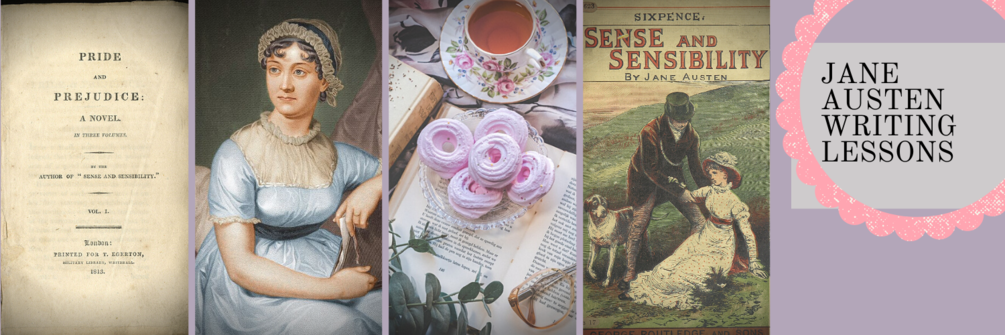
The opening scene of dialogue in Sense and Sensibility belongs not to the main characters, but rather, to their relations. At the beginning of the novel, Mr. Henry Dashwood is dead, and his son, Mr. John Dashwood, has inherited everything; despite Henry’s desires, his second wife and their daughters get nothing from the property. Yet before his death, Henry made his son John promise to take care of his step-mother and three half-sisters.
After this exposition, which is provided by the narrator, the first dialogue of the novel is between John Dashwood and his wife, Fanny Dashwood:
“It was my father’s last request to me,” replied her husband, “that I should assist his widow and daughters.”
“He did not know what he was talking of, I dare say; ten to one but he was light-headed at the time. Had he been in his right senses, he could not have thought of such a thing as begging you to give away half your fortune from your own child.”
“He did not stipulate for any particular sum, my dear Fanny; he only requested me, in general terms, to assist them, and make their situation more comfortable than it was in his power to do. Perhaps it would have been as well if he had left it wholly to myself. He could hardly suppose I should neglect them. But as he required the promise, I could not do less than give it: at least I thought so at the time. The promise, therefore, was given, and must be performed. Something must be done for them whenever they leave Norland and settle in a new home.”
“Well, then, let something be done for them; but that something need not be three thousand pounds.”
From this dialogue, we can already paint a picture of who John and Fanny are, in much more vivid terms than pages of description would provide. John feels familial obligation, and Fanny does not want him to fulfill this obligation to the extent he has planned, which we assume is for selfish reasons.
Good dialogue brings characters to life: it is as if they have stepped from the page and we are watching them, animated before us.
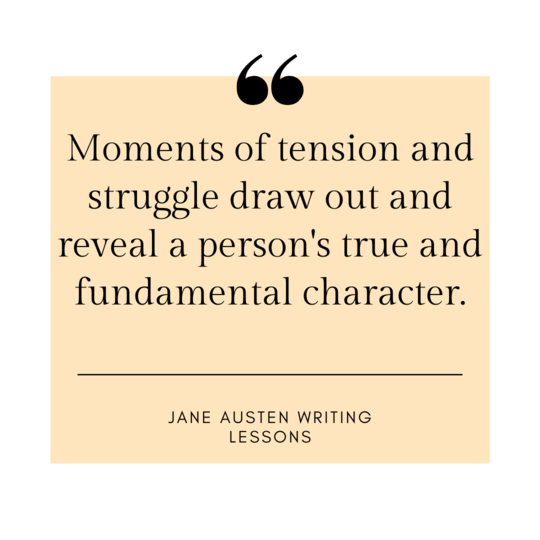
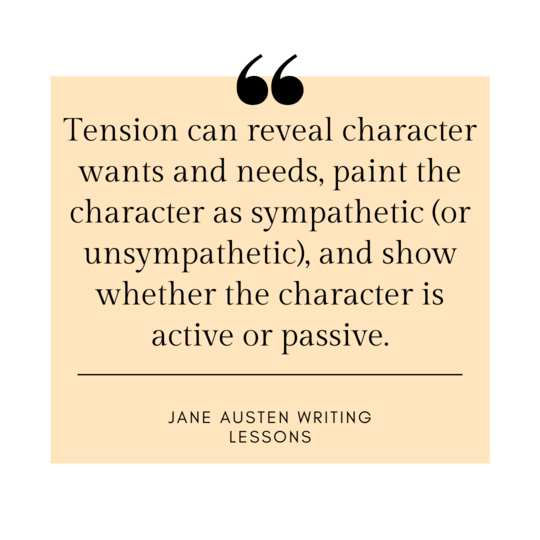
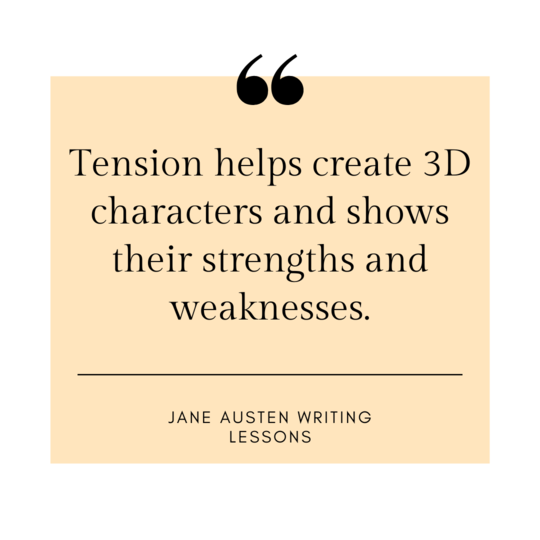
Last week, I talked about using moments of tension to reveal characters to the reader. Effective dialogue is another powerful way to quickly reveal characters to the reader.
While John had planned to give 3000 pounds to his sisters—1000 apiece—he proposes that he cut it in half, giving each of them 500 pounds. And the conversation continues:
“Oh! beyond anything great! What brother on earth would do half so much for his sisters, even if really his sisters! And as it is—only half blood!—But you have such a generous spirit!”
“I would not wish to do any thing mean,” he replied. “One had rather, on such occasions, do too much than too little. No one, at least, can think I have not done enough for them: even themselves, they can hardly expect more.”
“There is no knowing what they may expect,” said the lady, “but we are not to think of their expectations: the question is, what you can afford to do.”
Fanny is skilled at knowing how to maneuver her husband: she praises him for his generosity, and then claims that this is way beyond what anyone would do. She then shifts the conversation to their needs, and ultimately, she will appeal again to the future, hypothetical needs of their young son.
Jane Austen truly has some of the best dialogue of any writer. I could probably write an entire book about how Jane Austen employs dialogue throughout her novels. (Please don’t challenge me to do so—I may not be able to resist the temptation!) In a previous post, I addressed some initial ways that Jane Austen creates dynamic character interactions through dialogue. This post takes it one step further, looking at how dialogue reveals character.
From analyzing Austen’s use of dialogue, I’ve distilled 4 questions that I like to ask myself as I write dialogue for my characters.
4 Key Questions to Ask When Writing Dialogue
1. What is the conversational goal of each of the characters in this conversation?
The writer Kurt Vonnegut famously said, “Every character should want something, even if it is only a glass of water.”
Every character comes into a conversation with a different perspective, a different history and personality, and a different relationship with the subject matter. In turn, this creates a different goal. Even people who are close to each other and know each other well, like family members or close friends, come into a conversation with a different goal. Often, a conversational want will be related, in some way, to a character’s larger, overreaching wants and needs in the story.
In this scene in Sense and Sensibility, John wants to do his duty to his father, and he also wants to feel good about himself—he wants to feel morally justified. Fanny, on the other hand, desperately wants to keep all of the money they have just inherited. However, she also wants her husband to feel good about his decisions and comfortable with moral positioning, and she does not want to damage their relationship or come off as cruel and unfeeling.
2. What is the relationship between the characters?
Readers can judge characters’ relationships with each other through a passage of dialogue. This is because relationships always influence the tone of the dialogue, the flow, the approach, and the outcome.
Relationships will determine how open or closed a character is with their intentions. It will impact what they are comfortable saying. It will demonstrate what is at stake for a character.
Some characters, like Elizabeth Bennet in Pride and Prejudice, have no compunction with asserting themselves and speaking their mind in front of a stranger in a position of power and authority, as Elizabeth does to Lady Catherine de Bourgh, and this fact does much to reveal Elizabeth’s character.
When characters shift their behavior because of their relationships, or behave with deference or authority, respect or disdain, it once again is revelatory.
From just a few lines of dialogue, readers can typically determine much about character relationships and their history with each other.
In this opening passage in Sense and Sensibility, the dynamics of John and Fanny’s marriage are made clear, as are other relationships: the relationship between John and his father; the relationships between John, his stepmother, and his half-sisters; and the relationship (or lack of substantial relationship) Fanny has with any of these other characters.
The dynamics become more complication when it shifts from a dialogue between two characters and a dialogue between a larger number of characters. For instance, in a dialogue between four, five, or six characters, there is a web of relationships: individual relationships between each set of characters, and relationships between each individual character and the group as a whole, particularly is someone is an outsider or less established in the group.
3. How is what each character says interpreted by the other characters?
Listening is a constant act of interpreting: interpreting someone’s words and gestures and expressions for meaning and purpose. This interpretation is influenced by a character’s relationships, current emotional state, background on the subject matter, and personality.
When a character interprets another character’s speech, they react both internally—they could impact their mood, their perspective, etc.—and externally, by what they say and do, both immediately and over time.
Throughout this passage, John listens to his wife intently, and he accepts her praise and flattery and justifications. He interprets anything she says favorably, as if she has said it with the best intent.
Before this scene, in the exposition, the narrator tells us of Mr. John Dashwood:
He was not an ill-disposed young man, unless to be rather cold-hearted, and rather selfish, is to be ill-disposed: but he was, in general, well respected; for he conducted himself with propriety in the discharge of his ordinary duties. Had he married a more amiable woman, he might have been made still more respectable than he was:–he might even have been made amiable himself; for he was very young when he was married, and very fond of his wife. But Mrs. John Dashwood was a strong caricature of himself;–more narrow-minded and selfish.
While the narrator has already explained John’s character, here we see it in action as he interprets Fanny’s words and then acts on them.


 https://www.katherinecowley.com/wp-content/uploads/2025/12/Jane-Austens-250th.png
576
1024
Katherine Cowley
http://www.katherinecowley.com/wp-content/uploads/2024/12/Katherine-Cowley-1.png
Katherine Cowley2025-12-16 11:25:312025-12-17 11:27:05Jane Austen’s 250th Birthday and How Austen Wrote Birthday and Holiday Greetings
https://www.katherinecowley.com/wp-content/uploads/2025/12/Jane-Austens-250th.png
576
1024
Katherine Cowley
http://www.katherinecowley.com/wp-content/uploads/2024/12/Katherine-Cowley-1.png
Katherine Cowley2025-12-16 11:25:312025-12-17 11:27:05Jane Austen’s 250th Birthday and How Austen Wrote Birthday and Holiday Greetings