Jane Austen Writing Lessons

Jane Austen Writing Lessons. With an image of the original cover page of Pride and Prejudice; a color image of Jane Austen; an image of tea and pastries with an open book, and an early cover of Sense and Sensiblity.

One of the best ways to learn to write well is to learn from the examples of great writers. Jane Austen Writing Lessons is a series of blog posts about creative writing principles from plot structure to character development to dialogue. This blog was selected by “The Write Life” as one of the 100 Best Websites for Writers in 2021.

Jane Austen Writing Lessons is now a book!

Jane Austen Writing Lessons has been expanded into a book! The book includes over 70% brand-new material that never appeared on the blog. The book is now available in ebook, paperback, and hardcover from all major retailers.

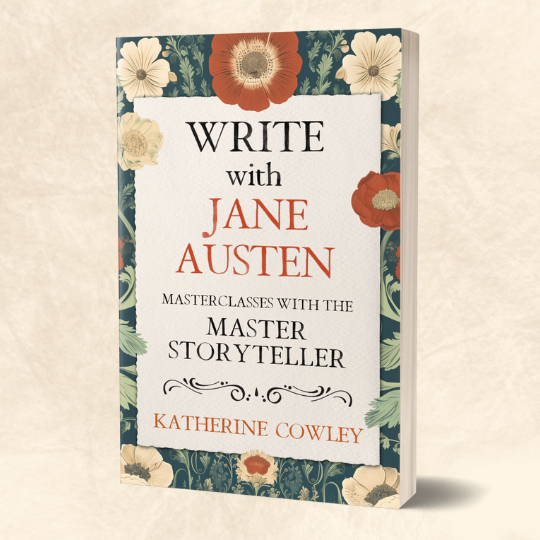
A 3D rendering of the book Write with Jane Austen: Masterclasses with the Master Storyteller

Read more about the book and find links to your favorite retailers.

Examples from Jane Austen

Each lesson looks to Jane Austen’s novels and her other works for examples of excellent writing. Quotes from her six published novels and an analysis of her craft–and how we can apply it to our own writing–is included in each lesson.

Writing Exercises

Writing Exercises - Jane Austen Writing Lessons

Each lesson includes 2-3 writing exercises that will help you practice the creative writing principle and apply it to your own writing.

Most Recent Jane Austen Writing Lessons

Jane Austen celebrating her birthday. Austen wears a birthday hat, holds a birthday present, and sits next to a birthday cake covered with candles.
Jane Austen Writing Lessons. #69: The Jane Austen Approach to Critiquing Writing
An intriguing snippet which has Jane Austen's portrait and a mysterious gray box with the words, "Cover Coming Soon"
Jane Austen Writing Lessons #68: Establishing Relationships and Character Connections in Fiction
Jane Austen Writing Lessons 67. Creating an Emotional Map: Making Interconnected Emotions
Jane Austen Writing Lessons. #66: Evoking Emotions through Objective Correlative (External Objects)
Mary Bennet and Mr. Collins. Why didn't they marry? Would they have made a good match?
Jane Austen Writing Lessons. #65: Different Character Approaches to Dealing with and Expressing Emotions
Jane Austen Writing Lessons. #64: The Size or Degree of Character Emotions

Jane Austen Writing Lessons by Category

Recognition for Jane Austen Writing Lessons

Jane Austen Writing Lessons: one of the

Jane Austen Writing Lessons was selected by The Write Life as one of the “100 Best Websites for Writers in 2021.” They wrote:

“[Jane Austen Writing Lessons] is filled with blog posts about creative writing that use Jane Austen’s novels and other related stories to share what good writing looks and sounds like. Whether you’re interested in plot structure or character development to dialogue, each Jane Austen writing lesson focuses on one principle of writing at a time.”

About the Author

In addition to writing Jane Austen Writing Lessons, Katherine Cowley is the author of the novels The Secret Life of Miss Mary BennetThe True Confessions of a London Spy, and The Lady’s Guide to Death and Deception. She has taught writing classes at Western Michigan University and other universities and community colleges.

Her blog, Jane Austen Writing Lessons, has been expanded into a new book, Write with Jane Austen: Masterclasses with the Master Storyteller.

Jane Austen Writing Lessons. #57: Character Dialogue as Persuasion

#57: Character Dialogue as Persuasion

Jane Austen Writing Lessons. #57: Character Dialogue as Persuasion

Characters speak because they want to create change—and speech is one of the only ways to change other people.

In lesson 55, we discussed when characters use dialogue as manipulation. Manipulation is the unhealthy cousin of a much more useful, overarching principle: persuasion.

Persuasion is when a speaker creates change in an audience—whether an individual or a group—by considering what matters to that audience. Persuasion requires using what matters to the audience to show how a change in thought or behavior would be beneficial.

Over two thousand years ago, Aristotle analyzed different elements of effective persuasion. In a given situation, he wrote that one must find “the available means of persuasion.”

Some characters knowingly draw on the available means of persuasion, consciously considering what would be effective for an audience. Other characters do so unknowingly or intuitively. Some characters are good judges of what would be persuasive for a given audience; other characters are poor judges of their audience.

Regardless of whether a character uses persuasion consciously or unconsciously, effectively or ineffectively, they are drawing upon what Aristotle categorized as the three major appeals we use in persuasion: ethos, pathos, and logos.

Ethos Pathos and Logos in Dialogue (Jane Austen Writing Lessons)

Ethos: appeals to the authority of the speaker, or to others who the listener would find authoritative.

Pathos: appeals to emotion.

Logos: appeals to logic and reason.

In the novel Persuasion, Lady Russell draws upon ethos, pathos, and logos as she attempts to persuade Anne to consider Mr. Elliot as a possible marriage partner. She says:

“I only mean that if Mr. Elliot should some time hence pay his addresses to you, and if you should be disposed to accept him, I think there would be every possibility of your being happy together. A most suitable connection every body must consider it—but I think it might be a very happy one.”

Here, she draws upon pathos—appealing to emotion as she encourages Anne to consider her future happiness. She also draws upon ethos—everyone, including herself, would consider this a “most suitable connection.” It was Lady Russell who had originally encouraged Anne to break off her engagement with Captain Wentworth, and Lady Russell knows that she is an authority figure in Anne’s life, someone whose opinion and blessing matters to Anne.

Yet Anne is not convinced. She replies:

Mr. Elliot is an exceedingly agreeable man, and in many respects I think highly of him,” said Anne; “but we should not suit.”

Lady Russell is not persuasive because she assumes that Anne and Mr. Elliot are well suited, but Anne does not feel the same. In other words, they do not share an implicit assumption.

Implicit Assumptions in Dialogue (Jane Austen Writing Lessons)

Implicit assumptions are the underlying assumptions that undergird an argument and its appeals. These are things which must be accepted as true in order for the argument to work. Often, implicit assumptions tap into the way a character views the world, their philosophy towards life and people, and what matters to them. In order for an argument to be successful, the speaker and the listener must share at least one implicit assumption.

Lady Russell sees that her argument in not working, so she shifts her approach. Instead of making an argument about Mr. Elliot, which would be harder for her to win, she makes an argument which taps into Anne’s priorities for herself. She uses an implicit assumption that both she and Anne share: that Anne wants to be like her mother.

“I own that to be able to regard you as the future mistress of Kellynch, the future Lady Elliot—to look forward and see you occupying your dear mother’s place, succeeding to all her rights, and all her popularity, as well as to all her virtues, would be the highest possible gratification to me.—You are your mother’s self in countenance and disposition; and if I might be allowed to fancy you as she was, in situation, and name, and home, presiding and blessing in the same spot, and only superior to her in being more highly valued! My dearest Anne, it would give me more delight than is often felt at my time of life!”

Here, we have logos—logic and reasoning: Anne can have her lifelong home back if she marries Mr. Elliot. We have pathos—emotion—as memories of Anne’s mother are conjured. We have ethos—appeal to authority—as Lady Russell talks about the joy that this sort of decision would bring her. And because the implicit assumption underneath these appeals is shared, it’s quite an effective argument:

Anne was obliged to turn away, to rise, to walk to a distant table, and, leaning there to pretend employment, try to subdue the feelings this picture excited. For a few moments her imagination and her heart were bewitched. The idea of becoming what her mother had been; of having the precious name of “Lady Elliot” first revived in herself; of being restored to Kellynch, calling it her home again, her home for ever, was a charm which she could not immediately resist. Lady Russell said not another word, willing to leave the matter to its own operation.

Many characters are not nearly as persuasive as Lady Russell—in the next lesson, I’ll discuss how Mr. Collins ineffectively appeals to ethos, pathos, and logos when he proposes to Elizabeth. Yet whether or not these tools of persuasion are used effectively, they are an integral part of the way in which characters speak.

Writing Exercises - Jane Austen Writing Lessons

Exercise 1: Using Ethos, Pathos, and Logos in Your Life

The next time you need to persuade someone of something, big or small, consciously use either ethos, pathos, or logos, or a combination of these appeals. Consider which appeals will be most effective for the situation and the person to whom you are speaking. Afterwards, reflect. Was the appeal effective? Was this a departure from how you would have normally approached the conversation? Would another appeal or approach to the conversation have been more effective?

Exercise 2: Persuasive Scene

Write a short scene between two characters, in which one character is attempting to persuade the other. Make the initial persuasion be ineffective, and then have the character use appeals and an implicit assumption that are more effective.

Exercise 3: Analysis

Analyze scenes of dialogue which you have written in which one character is attempting to persuade another characters or a group of characters. Which appeals does the character use? (Ethos, pathos, logos.) What do the appeals used say about the character attempting to persuade? Does the speaker share an implicit assumption with their audience?

Don’t Miss a Lesson: Subscribe to Updates and Giveaways from katherinecowley.com

* indicates required


Which newsletter(s) would you like to receive?

Jane Austen Writing Lessons. #56: Times and Seasons of Creativity

#56: Times and Seasons of Creativity

Jane Austen Writing Lessons. #56: Times and Seasons of Creativity

Writers and other creatives often feel the pressure to be creating constantly. Praise is extolled upon those who are able to draft quickly, revise quickly, and publish often.

I am naturally a slow writer. My ideas need time to simmer and develop, and I can’t rush the drafting process. At times, the pressure to be a fast writer has made me feel inadequate or insecure, or I’ve felt jealous of those with a faster process.

At other times, life has interfered with my creativity: sicknesses and other challenges can force creative projects into little scraps of low-energy time, or sometimes even cause creative projects to be put on hold.

This, of course, can be discouraging. However, I’m encouraged by looking at Jane Austen’s life and writing.

Let’s consider a few snapshots of Jane Austen’s writing life:

1787-1799: The Early Years

  • 1787-1793: Juvenilia
  • 1793-1795: Lady Susan
  • 1796-1798: Elinor and Marianne; First Impressions
  • 1798-1799: Northanger Abbey

This is a very productive period of writing for Jane Austen. During her teenage years, she wrote many short pieces of various genres and styles, and she shared these pieces with her family. These works are now known as her Juvenilia.

Then she moved on to longer, more developed works—Lady Susan, Elinor and Marianne, First Impressions, and Northanger Abbey.

1800-1809: Years of Struggle

  • Some revisions of Lady Susan and Northanger Abbey
  • 1804: started The Watsons

This period in Jane Austen’s life stands in stark contrast to the prior years. She did some revisions on both Lady Susan and Northanger Abbey, and while both books were sold to publishers, neither were published. She started the book The Watsons, but then abandoned it, leaving it unfinished. She may have done some additional revisions on her other works, and she did continue to write letters, but it was much slower period of writing for Jane Austen.

Why did she write less?

The answer was simple: Life was difficult for Jane Austen during these years.

First, her father uprooted their family to Bath. Jane Austen did not like living in Bath, and her days were filled with social obligations and responsibilities that were difficult to escape.

Then her father died. His death caused Jane Austen to abandon The Watsons—she could not work on it any longer. It also began a period of severe financial insecurity. Jane Austen moved from place to place, often having to rely on others for a place to stay and struggling to have enough for the basic necessities. It is little wonder that she was not able to make much progress on her writing.

1809-1817: The Chawton Years

  • 1809: Moved to Chawton
  • 1811: Sense and Sensibility
  • 1813: Pride and Prejudice
  • 1814: Mansfield Park
  • 1815: Emma
  • 1817: Persuasion; Sanditon (unfinished)

Jane Austen’s brother Edward had been adopted (became the heir) for distant relatives in Chawton. In 1809, he invited Jane and several other family members to live in a cottage on the estate. Suddenly, Jane Austen had security. She had a home. And she had the space and the time to write.

She revised Elinor and Marianne—which she had originally written between 1796 and 1798—and published it as Sense and Sensibility. She rewrote First Impressions as Pride and Prejudice. And then she wrote three new novels: Mansfield Park, Emma, and Persuasion. She began the novel Sanditon, but did not finish it before her death.

Times and Seasons of Writing

We each have times and seasons of writing, and it’s important to treat ourselves with compassion and understanding. We will have times, like the decade in Jane Austen’s life, where it is more difficult to write, where life circumstances create additional challenges for creativity. We might even have years where we cannot actively work on our creative goals.

In another post, I wrote about how even at Chawton, Jane Austen had to actively work to create space for writing in her life. Even in seasons of writing, it takes active work to give time to writing, and writing may still not be easy.

I also like to remember that it’s okay if certain projects take time to reach their final form. Sense and Sensibility and Pride and Prejudice are two of the most important novels in English literature, and two of my favorite novels. And they were not written quickly. They required writing and re-envisioning and rewriting over a 17-year period.

Like Jane, life may at times interfere with our writing. But like Jane, we will have fertile seasons of writing. Like Jane, we can tell our stories and share them with the world.

Writing Exercises - Jane Austen Writing Lessons

Exercise 1: Write the story of your creative journey. What has led you to be the writer you are today? Which times and seasons of your life have been more or less creative? Is there anything from the less creative periods of your life that has helped you with your writing?

Exercise 2: Take a project that you set aside, perhaps years ago. Spend a few minutes considering it. If you were going to rewrite it today, how would you approach it differently?

Don’t Miss a Lesson: Subscribe to Updates and Giveaways from katherinecowley.com

* indicates required


Which newsletter(s) would you like to receive?

Jane Austen Writing Lessons #55: Dialogue as a Weapon (Manipulative Dialogue)

#55: Dialogue as a Weapon (Manipulative Dialogue)

Jane Austen Writing Lessons #55: Dialogue as a Weapon (Manipulative Dialogue)

Many characters use dialogue as a speech act—as an action that can create or induce change. And one of the primary modes of dialogue is persuasion: the act of speaking can often influence emotions and choices.

While many characters will go to great lengths to be persuasive—consider, for example, Mr. Collins’ proposal to Elizabeth in Pride and Prejudice—other characters use dialogue not simply as a means of persuasion, but as a weapon. These characters wield dialogue in manipulative and even abusive ways.

In Mansfield Park, Mrs. Norris consistently uses dialogue as a weapon. She does not do so to everyone—those who she sees as her equals or her superiors are spared. However, she sees Fanny as lesser. Fanny is her poor niece that has been taken in to be raised at Mansfield Park, and to Mrs. Norris, Fanny is undeserving of any respect or consideration.

In the novel, the characters decide to perform a play, and they insist that Fanny participate. Fanny does not want to be in the play, for she sees participating as morally repugnant. She expresses her desire to not participate, and many characters attempt to persuade her. Then Mrs. Norris joins the fray, whispering a rebuke to Fanny, but doing so in a way that everyone else can hear:

Mrs. Norris completed the whole by thus addressing her in a whisper at once angry and audible—“What a piece of work here is about nothing,–I am quite ashamed of you, Fanny, to make such a difficulty of obliging your cousins in a trifle of this sort,–So kind as they are to you!—Take the part with a good grace, and let us hear no more of the matter, I entreat.”

“Do not urge her, madam,” said Edmund. “It is not fair to urge her in this manner. You see she does not like to act. Let her chuse for herself, as well as the rest of us. Her judgment may be quite as safely trusted. Do not urge her any more.”

“I am not going to urge her,”—replied Mrs. Norris sharply, “but I shall think her a very obstinate, ungrateful girl, if she does not do what her aunt and cousins wish her—very ungrateful indeed, considering who and what she is.”

Consider how language is used as a weapon:

  • Norris shames Fanny publicly
  • She trivializes Fanny’s concerns and emotions
  • She is manipulative and speaks of what Fanny owes everyone

In her second passages of dialogue, she also:

  • Casts weighty moral judgment on Fanny’s desires and planned actions
  • Uses a logical fallacy to give Fanny no other possible paths of behavior besides obeying her or publicly going against her
  • Alludes, very directly and unkindly, to Fanny’s inferior position

In response, we read that “Edmund was too angry to speak.” And perhaps he is too angry to speak—but in many ways, he is also used to the weaponized language that Mrs. Norris uses on Fanny. He does not come to her defense.

Instead, someone who is not a member of the family intervenes. Miss Crawford is shocked by Mrs. Norris’ verbal treatment of Fanny, manages to partially remove Fanny from the situation, and spends the rest of the scene trying to be especially kind to Fanny. And despite the fact that Miss Crawford is all in for the play, she attempts to show reservations about it and sympathize with Fanny’s perspective.

As often happens with abusive people in real life, Mrs. Norris does not just do this once to Fanny: this is consistent, and at times it escalates to threats of throwing Fanny out of the house.

In a later chapter, Miss Crawford has invited Fanny to dinner. Mrs. Norris is not pleased, feels that Fanny is undeserving of such favor, and informs Fanny of such.

“The nonsense and folly of people’s stepping out of their rank and trying to appear above themselves, makes me think it right to give you a hint, Fanny, now that you are going into company without any of us; and I do beseech and entreat you not to be putting yourself forward, and talking and giving your opinion as if you were one of your cousins—as if you were dear Mrs. Rushworth or Julia. That will never do, believe me. Remember, wherever you are, you must be the lowest and last; and though Miss Crawford is in a manner at home at the Parsonage, you are not to be taking place of her. And as to coming away at night, you are to stay just as long as Edmund chuses. Leave him to settle that.”

“Yes, ma’am, I should not think of anything else.”

“And if it should rain, which I think exceedingly likely, for I never saw it more threatening for a wet evening in my life, you must manage as well as you can, and not be expecting the carriage to be sent for you. I certainly do not go home to-night, and, therefore, the carriage will not be out on my account; so you must make up your mind to what may happen, and take your things accordingly.”

Her niece thought it perfectly reasonable. She rated her own claims to comfort as low even as Mrs. Norris could.

The terrible, tragic thing is that Fanny has internalized Mrs. Norris’ views. She believes she deserves no comfort. Of course she will not request a carriage, even if it rains.

While Fanny endures her tribulations with sweetness and courage, and while at the points where it matters most to her, she stands up for herself, this weaponized, abusive language has harmed her. As was Mrs. Norris’ intent.

In many ways, Mrs. Norris represents one of the most insidious types of antagonists: someone who is close to the main character and has influence and control, and who uses that power to abuse others in both action and speech.

Mrs. Norris is not a pleasant character to read—and likely wasn’t a pleasant character to write. But the inclusion of her character adds to the themes of the story, adds to our understanding of the oppression inherent in Mansfield Park and its characters.

Many of Austen’s novels includes characters who are manipulative to some degree or another. In Emma, Emma manipulates Harriet into refusing an offer of marriage. In Sense and Sensibility, Lucy Steele extracts a rather-manipulative promise from Eleanor. And in Pride and Prejudice, Mrs. Bennet tries—and fails—to manipulate Elizabeth into marrying Mr. Collins. Most of these characters are less flawed than Mrs. Norris, less thorough in their manipulation (not generally abusive), have at least semi-positive intentions, or have less power than Mrs. Norris does over Fanny. Yet some of the principles are the same. When characters have something they truly want, they are sometimes willing to cross the line between normal persuasive tactics and manipulation.

One of my favorite aspects of Mansfield Park is that by the end of the novel, Fanny is in a new situation—a situation in which she is free from Mrs. Norris’ manipulations and abusiveness. In Emma, Harriet also becomes free of manipulation, and by the end of the book is able to choose what she wants and be confident in herself. While dialogue is sometimes used as a weapon by characters in Austen novels, and while this dialogue may cause great harm, the characters on the receiving end of this harm are consistently able to overcome their struggles.

Writing Exercises - Jane Austen Writing Lessons

Exercise 1: Write a brief scene where a character is trying to persuade someone of something. Whether or not the character succeeds is up to you. Now write a second version of the scene. This time, the character should use some degree of manipulation.

Exercise 2: Make a list of people who are manipulative. They can be mildly, occasionally, or ineffectively manipulative; they can be thoroughly and abusively manipulative; or they can be anywhere in between. These people can be individuals you have encountered in real life, or characters from stories.

Exercise 3: Consider an antagonist in a story you have written, or a story you plan to write. Do they ever use dialogue as a weapon? Would it be useful for them to do so? If not, why?

Don’t Miss a Lesson: Subscribe to Updates and Giveaways from katherinecowley.com

* indicates required


Which newsletter(s) would you like to receive?

Jane Austen Writing Lessons. #54: When to Summarize Dialogue

#54: When to Summarize Dialogue

Jane Austen Writing Lessons. #54: When to Summarize Dialogue

A common writing aphorism is “show don’t tell.” When it comes to dialogue, it is often powerful to show the dialogue in its entirety: to hear what the characters say and how they say it.

Yet while Jane Austen is a master of dialogue, there are countless moments throughout her novels when she chooses to summarize dialogue rather than showing it in scene.

Jane Austen summarizes dialogue when doing so better serves her storytelling purposes.

To consider what purposes summarizing dialogue could serve, let’s analyze a scene from Northanger Abbey.

Summarizing Dialogue in Northanger Abbey

Near the end of Northanger Abbey, Catherine Morland is unceremoniously thrown out of Northanger Abbey by an angry General Tilney. When she arrives home, she tells her family what happened. Soon, they meet up with her friends, the Allens, and they too must hear the story.

What is interesting in this passage is that Jane Austen does not show us the full scene. Instead, she intermixes telling (in this case through summary) with showing.

In the first paragraph of the scene, Austen summarizes the entire interaction, giving a bird’s eye view of what occurred, with narrator interpretation. Then we are brought to near the beginning of the scene in order to hear Catherine’s mother, Mrs. Morland, tells the story, giving her dialogue line by line.

[Catherine] was received by the Allens with all the kindness which her unlooked-for appearance, acting on a steady affection, would naturally call forth; and great was their surprise, and warm their displeasure, on hearing how she had been treated—though Mrs. Morland’s account of it was no inflated representation, no studied appeal to their passions. “Catherine took us quite by surprise yesterday evening,” said she. “She travelled all the way post by herself, and knew nothing of coming till Saturday night; for General Tilney, from some odd fancy or other, all of a sudden grew tired of having her there, and almost turned her out of the house. Very unfriendly, certainly; and he must be a very odd man; but we are so glad to have her amongst us again! And it is a great comfort to find that she is not a poor helpless creature, but can shift very well for herself.”

The summary at the start of the paragraph frames the conversation—it tells us what happened, and what to look for in the responses. It also offers insights into their characters, particularly in light of how they react in response to what is a plain, unstudied account of the events. Then we see, in scene, the exact four sentences of dialogue that Mrs. Morland used to tell the story.

This paragraph is followed by another paragraph of mostly summary. When there are direct quotes, they are statements that the characters say multiple times, and their inclusion is used as an example of the type of response that Mr. and Mrs. Allen make:

Mr. Allen expressed himself on the occasion with the reasonable resentment of a sensible friend; and Mrs. Allen thought his expressions quite good enough to be immediately made use of again by herself. His wonder, his conjectures, and his explanations became in succession hers, with the addition of this single remark—“I really have not patience with the general”—to fill up every accidental pause. And, “I really have not patience with the general,” was uttered twice after Mr. Allen left the room, without any relaxation of anger, or any material digression of thought.

The conversation then turns to Mrs. Allen’s recollections of Bath. This conversation is shown in scene, with each line of dialogue included by Austen. Mrs. Allen explains that she had her gown with Mechlin lace mended, and then she elaborates on their experiences in Bath and the Assembly rooms. To each statement, Catherine gives only short responses, because this conversation is bringing to mind her love interest, Mr. Henry Tilney, which also reminds her that Henry’s father, the General, has just thrown her out.

In the next two paragraphs we have dialogue from Mrs. Tilney on Bath, followed by a sentence of dialogue summary, followed by more dialogue from Mrs. Tilney:

“It was very agreeable, was not it? Mr. Tilney drank tea with us, and I always thought him a great addition, he is so very agreeable. I have a notion you danced with him, but am not quite sure. I remember I had my favourite gown on.”

Catherine could not answer; and, after a short trial of other subjects, Mrs. Allen again returned to—“I really have not patience with the general! Such an agreeable, worthy man as he seemed to be!”

The summary phrase is of note: Catherine could not answer and after a short trial of other subjects. The use of summary here emphasizes that Catherine is struggling to hold this conversation, because everything connects back to the Tilneys. Mrs. Allen tries introducing other subjects—and the exact subjects they try speaking about are not included, because they aren’t actually relevant to the story. But summarizing the fact that she tries various conversation topics shows how very difficult this is for Catherine—the Tilneys are what dominates her mind, and it is difficult for her to speak of them, but also difficult for her to speak of anything else.

There are a number of reasons to summarize dialogue rather than to show it in scene.

The Most Common Reasons Jane Austen Summarizes Dialogue

The most common reasons Austen summarizes dialogue:

  1. To show the passage of time.
  2. To condense unimportant dialogue.
  3. To focus the reader on the most important dialogue.
  4. To give interpretation of the dialogue, and provide commentary on the scene.
  5. To draw us into the lens and perspective of the narrator OR to draw us into the perspective of the character.

Whenever I am writing a scene where the dialogue is not quite working, one of the questions I ask myself is: Would part of this dialogue be more useful if it was conveyed through summary? Summarizing dialogue is another useful tool that can be used to powerful effect.

Writing Exercises - Jane Austen Writing Lessons

Exercise 1: Write a short scene that consists largely of dialogue between two characters. However, there’s a catch. For one of the characters you can include the dialogue, but for the second character, you can only summarize their dialogue. Try to give a feel for the second character’s dialogue and its effect even though you cannot include the dialogue itself.

Exercise 2: In film, dialogue is rarely summarized: because of the conventions of the medium, it is almost always shown in scene. Find a dialogue-heavy scene in a film and rewrite this scene in prose. Include a significant portion of the lines of dialogue exactly as they were stated in the film, but then summarize other sections of the dialogue. What effects does this summary create? How is summarizing some of the dialogue useful?

Exercise 3: Take a draft that you have written and analyze the dialogue. Are there any full scenes of dialogue you could eliminate and replace with a summary? Are there scenes of dialogue where it would be advantageous to replace a small or large part of the dialogue with summary? Find at least one spot in your draft where dialogue summary would be useful and revise.

Don’t Miss a Lesson: Subscribe to Updates and Giveaways from katherinecowley.com

* indicates required


Which newsletter(s) would you like to receive?

Jane Austen Writing Lessons. #53: Creating Space for Writing

#53: Creating Space for Writing

Jane Austen Writing Lessons. #53: Creating Space for Writing

One of the most common questions I am asked about my writing is, “When do you write?” I’m also asked, “How do you get writing done with children?” or “How do you prioritize writing when there are other important responsibilities?”

Part of writing is understanding your process, and what it takes for you to be able to write. This is something that Jane Austen seems to have thought a lot about. On September 8, 1816, she wrote a letter to her sister Cassandra which included the following paragraph:

I enjoyed Edward’s company very much, as I said before, and yet I was not sorry when Friday came. It had been a busy week, and I wanted a few days’ quiet and exemption from the thought and contrivancy which any sort of company gives. I often wonder how you can find time for what you do, in addition to the care of the house; and how good Mrs. West could have written such books and collected so many hard words, with all her family cares, is still more a matter of astonishment. Composition seems to me impossible with a head full of joints of mutton and doses of rhubarb.

Company and a busy week made writing more difficult for Jane Austen. She needed time for herself, time for quiet, and time without too many obligations. Especially in her years living in Chawton, Jane’s family did much to lift some of her responsibilities in order to give her the time and the mental space for writing.

Jane also prioritized a physical space. She had her own little table, just for her. And when I attended a guided virtual tour of her Chawton house a few weeks ago, the guide explained that several of the windows by the road were boarded up, so she wouldn’t have all the passerbys on the road looking in on her and distracting her.

In the letter, Jane is astonished by Mrs. West, who balances books and family cares: “Composition seems to me impossible with a head full of joints of mutton and doses of rhubarb.”

Most of us have things we need to balance, whether it’s family obligations, a full or part time job, school, or endless other responsibilities. These things are part of our lives. They’re not going to go away. But are we letting our heads be full of joints of mutton and doses of rhubarb? Or are we finding some time that is just ours, where we can let everything else go and give space for creativity?

When my children were pre-school age, I used nap time and movie time just for writing. It didn’t matter if there was a pile of dishes in the sink or a mess on the floor, appointments to schedule, or seemingly-urgent needs. This was my time, no matter what, and I wouldn’t let it be filled with mutton or rhubarb or anything else.

At other times, I’ve done #5amwritersclub so I could write before my mind filled with any other obligations. I’ve worked in coffeeshops. I’ve prioritized attending writing group.

We all have times, like Jane Austen, where we have obligations that prevent us from writing. But it’s important to make space for writing, whether it’s an hour a day, one evening a month, or a weekend retreat twice a year.

I have a variation on the standard writing exercises today—these are more personal reflections, about your personal writing spaces. But first, a few personal writing notes. I wrote an essay on revising for tone for Women Writers, Women[’s] Books. And yesterday, my second novel was released, The True Confessions of a London SpyIt’s exciting to have a new book to share with readers and friends.

Writing Exercises - Jane Austen Writing Lessons

Exercise 1: Spend a few minutes reflecting on the spaces you have for writing in your life. What gives you mental, physical, and creative space for writing. Do you prioritize giving yourself this space? What is something you could change to help create better spaces for writing in your life?

Exercise 2: Speak to the people in your life about your writing. How do you support the people in your life in their goals? How do they support you in your creative endeavors? Would any adjustments help you better support each other.

Exercise 3: Make a list of the priorities in your life, the things that matter to you, the things that pay the bills, the things that are essential. The goal is not to feel guilty that you have other responsibilities that are not writing. The key is to consider what things truly matter to you most, to give yourself credit for those things and to find meaning in those things. Sometimes non-priority things can be eliminated or shifted to give more space for your key priorities.

Don’t Miss a Lesson: Subscribe to Updates and Giveaways from katherinecowley.com

* indicates required


Which newsletter(s) would you like to receive?