Jane Austen Writing Lessons

Jane Austen Writing Lessons. With an image of the original cover page of Pride and Prejudice; a color image of Jane Austen; an image of tea and pastries with an open book, and an early cover of Sense and Sensiblity.

One of the best ways to learn to write well is to learn from the examples of great writers. Jane Austen Writing Lessons is a series of blog posts about creative writing principles from plot structure to character development to dialogue. This blog was selected by “The Write Life” as one of the 100 Best Websites for Writers in 2021.

Jane Austen Writing Lessons is now a book!

Jane Austen Writing Lessons has been expanded into a book! The book includes over 70% brand-new material that never appeared on the blog. The book is now available in ebook, paperback, and hardcover from all major retailers.

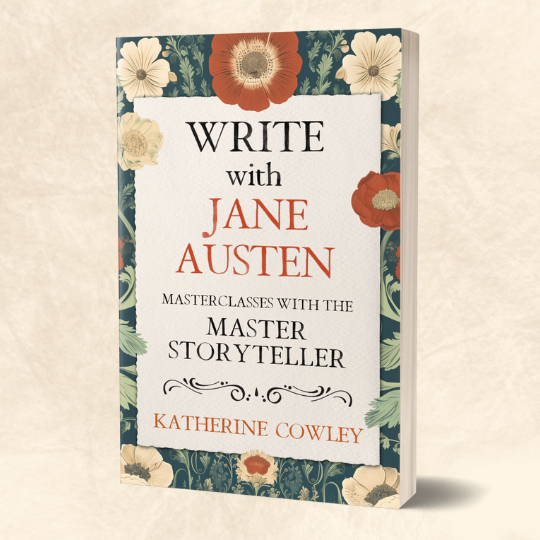
A 3D rendering of the book Write with Jane Austen: Masterclasses with the Master Storyteller

Read more about the book and find links to your favorite retailers.

Examples from Jane Austen

Each lesson looks to Jane Austen’s novels and her other works for examples of excellent writing. Quotes from her six published novels and an analysis of her craft–and how we can apply it to our own writing–is included in each lesson.

Writing Exercises

Writing Exercises - Jane Austen Writing Lessons

Each lesson includes 2-3 writing exercises that will help you practice the creative writing principle and apply it to your own writing.

Most Recent Jane Austen Writing Lessons

Jane Austen celebrating her birthday. Austen wears a birthday hat, holds a birthday present, and sits next to a birthday cake covered with candles.
Jane Austen Writing Lessons. #69: The Jane Austen Approach to Critiquing Writing
An intriguing snippet which has Jane Austen's portrait and a mysterious gray box with the words, "Cover Coming Soon"
Jane Austen Writing Lessons #68: Establishing Relationships and Character Connections in Fiction
Jane Austen Writing Lessons 67. Creating an Emotional Map: Making Interconnected Emotions
Jane Austen Writing Lessons. #66: Evoking Emotions through Objective Correlative (External Objects)
Mary Bennet and Mr. Collins. Why didn't they marry? Would they have made a good match?
Jane Austen Writing Lessons. #65: Different Character Approaches to Dealing with and Expressing Emotions
Jane Austen Writing Lessons. #64: The Size or Degree of Character Emotions

Jane Austen Writing Lessons by Category

Recognition for Jane Austen Writing Lessons

Jane Austen Writing Lessons: one of the

Jane Austen Writing Lessons was selected by The Write Life as one of the “100 Best Websites for Writers in 2021.” They wrote:

“[Jane Austen Writing Lessons] is filled with blog posts about creative writing that use Jane Austen’s novels and other related stories to share what good writing looks and sounds like. Whether you’re interested in plot structure or character development to dialogue, each Jane Austen writing lesson focuses on one principle of writing at a time.”

About the Author

In addition to writing Jane Austen Writing Lessons, Katherine Cowley is the author of the novels The Secret Life of Miss Mary BennetThe True Confessions of a London Spy, and The Lady’s Guide to Death and Deception. She has taught writing classes at Western Michigan University and other universities and community colleges.

Her blog, Jane Austen Writing Lessons, has been expanded into a new book, Write with Jane Austen: Masterclasses with the Master Storyteller.

Jane Austen Writing Lessons. #47: Have Characters Justify Their Behavior

#47: Have Characters Justify Their Behavior

Jane Austen Writing Lessons. #47: Have Characters Justify Their Behavior

Characters constantly justify their behaviors and their perspectives—especially their negative behaviors and perspectives. It is the only way for people to live with themselves: they must feel like their actions and viewpoints are justifiable. If they can’t justify their behaviors, then they will feel guilt, shame, or sorrow. These negative emotions can either lead them to change and grow and try to do differently (as Emma ultimately does in Austen’s novel), or the character may choose to suppress their guilt and other negative emotions and find new justifications for their behavior.

Lady Susan, from Austen’s novella Lady Susan, is an excellent example of a character who justifies her negative behaviors and perspectives.

Near the start of the story, she writes a letter to her friend Mrs. Johnson:

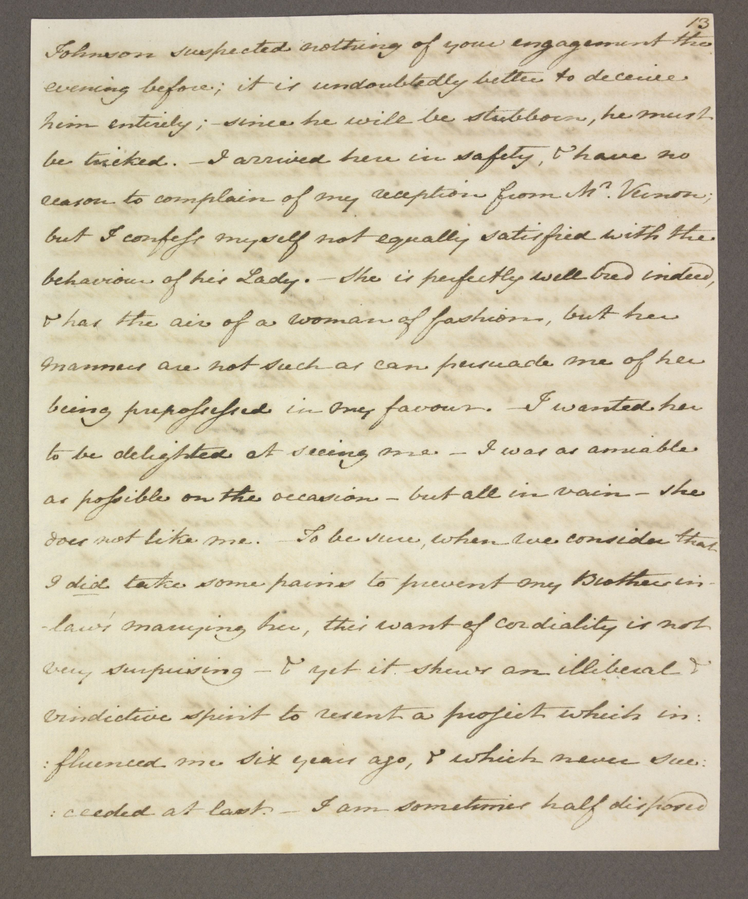
“I received your note my dear Alicia, just before I left Town, and rejoice to be assured that Mr. Johnson suspected nothing of your engagement the evening before; it is undoubtedly better to deceive him entirely;–since he will be stubborn, he must be tricked.”

Here’s part of the passage in Jane Austen’s handwritten manuscript–it appears in the first few lines.

Page 13 of Jane Austen’s original manuscript of Lady Susan. The entire manuscript is in the public domain and can be found on Wikimedia Commons.

Lady Susan uses strong words to describe her own behavior, words that generally have negative connotations: deceive, trick. Yet she feels no guilt.

Characters justify themselves when they feel they have good reasons, and that their behaviors and perspectives are necessary for the situation.

In this case, she feels a need to spend time with her friend Mrs. Johnson, despite Mr. Johnson discouraging their relationship. The only way that she can see Mrs. Johnson is through deceit, which, in her opinion, is necessary because of his stubbornness.

Later in the letter, Lady Susan writes about her experience staying with her deceased husband’s brother, Mr. Vernon, and his wife, Mrs. Vernon:

“I wanted her to be delighted at seeing me—I was as amiable as possible on the occasion—but all in vain—she does not like me.—To be sure, when we consider that I did take some pains to prevent my Brother-in-law’s marrying her, this want of cordiality is not very surprising—and yet it shews an illiberal and vindictive spirit to resent a project which influenced me six years ago, and which never succeeded at last.”

Lady Susan is displeased with Mrs. Vernon’s treatment of her, and she does glimpse the truth, that her own behavior has been at fault.

Even the most despicable characters will generally recognize that they are at least partially at fault in a situation or that they contributed to it in some way.

Yet Lady Susan does not use this recognition in a way that allows for future growth. She does not apologize to Mrs. Vernon, and she does not change her behavior. Instead, she points a finger at Mrs. Vernon.

Characters justify themselves by either placing the blame for their behavior elsewhere, or by pointing to someone else’s behavior as being worse or less justified than their own behavior.

Lady Susan soon sets her eyes on Mrs. Vernon’s unmarried brother, Mr. Reginald De Courcy. Mrs. Vernon writes to her mother, Lady de Courcy:

Lady Susan’s intentions are of course those of absolute coquetry, or a desire of universal admiration.

Coquetry is flirtation, often a sexual flirtation, and was seen very negatively in the time period. In Mrs. Vernon’s letter, she details Lady Susan’s artifice. Yet Lady Susan represents herself in this situation very differently as she writes to Mrs. Johnson:

“I am much obliged to you my dear Friend, for your advice respecting Mr. De Courcy, which I know was given with the fullest conviction of its expediency, tho’ I am not quite determined on following it.—I cannot easily resolve on anything so serious as Marriage, especially as I am not at present in want of money….

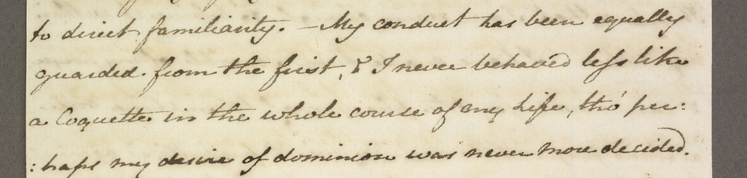
“It has been delightful to me to watch his advances towards intimacy, especially to observe his altered manner…My conduct has been equally guarded from the first, and I never behaved less like a Coquette in the whole course of my Life, tho’ perhaps my desire of dominion was never more decided.”

Original Jane Austen Manuscript of Lady Susan: My conduct has been equally guarded from the first, and I never behaved less like a Coquette in the whole course of my Life, tho’ perhaps my desire of dominion was never more decided.

An excerpt from page 32 of the original manuscript of Lady Susan. Available in the public domain through Wikimedia Commons.

Characters are apt to interpret and represent the same events in a way that paints themselves most favorably. While Mrs. Vernon see coquetry, Lady Susan insists that “I have never behaved less like a Coquette in the whole course of my Life.”

As we look at Austen’s works, we see many other characters justifying themselves—in Pride and Prejudice, Elizabeth justifies her condemnation of Mr. Darcy and her occasional mistreatment of him. In Emma, Emma justifies her belief of knowing better than anyone else, and she justifies her treatment and judgment of Jane Fairfax and Miss Bates.

In all of these cases, we see that the characters must justify their negative perspectives and outward behavior both to themselves and to select characters around them.

Lady Susan never changes—she digs into her position, and does worse and worse things throughout the novella.

Emma and Elizabeth both are forced to see gaps in their justification; their encounter evidence which challenges their viewpoints; they can see the negative impact of some of their actions. Rather than leaning into their justifications, as Lady Susan does, they both make changes in their lives. Note: Emma at first does resist change, and does resist recognizing her error, even after seeing negative consequences for her behavior; it is only at the end of the book that she makes a change. Elizabeth’s perspective on Mr. Darcy begins to change after the midpoint of the novel, upon reading his letter.

Writing Exercises - Jane Austen Writing Lessons

Exercise 1: Make a list of ten negative behaviors or actions (these could be anything—yelling at someone, cutting someone off on the road, not paying a bus fare, etc). Now write down a justification a character could have for each behavior. Make sure to use each type of justification at least once (necessary/have a good reason for it, placing blame elsewhere, someone else’s behavior is worse, interpreting the event more favorably for themselves).

Exercise 2: Choose a book not written my Jane Austen. Find a moment when a character justifies their behavior to themselves, and another moment when they justify their behavior to someone else. Do they use the same justifications or different? How does the other person respond, and how does the character react to that response?

Exercise 3: Option 1: for a story you have planned, find a scene or a moment where your character has an objectionable perspective or behaves in a negative or harmful way. Brainstorm ways they might justify themselves, and, if you’re ready, write the scene.

Option 2: Most characters have an objectionable perspective or perform a harmful action at some point. For a story you have drafted, does your character have any objectionable perspectives or harmful actions? Does the character justify themself? If not, add a justification. If they already have a justification, try to improve their justification.

Don’t Miss a Lesson: Subscribe to Updates and Giveaways from katherinecowley.com

* indicates required


Which newsletter(s) would you like to receive?

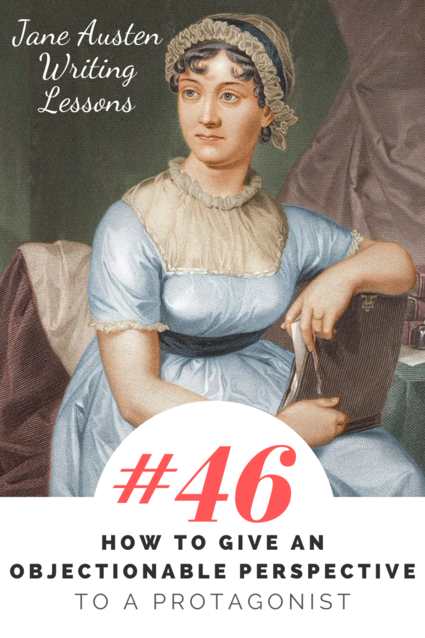
Jane Austen Writing Lessons. #46: How to Give an Objectionable Perspective to a Protagonist

#46: How to Give an Objectionable Perspective to a Protagonist

Jane Austen Writing Lessons. #46: How to Give an Objectionable Perspective to a Protagonist

Often, objectionable opinions—ones the author strongly disagrees with—are assigned to antagonists: if the perspective belongs to an antagonist, it is easy to represent it without condoning it.

Yet our protagonists should not be perfect people—they need flaws and weaknesses, and sometimes even objectionable perspectives that actively cause harm to others.

An example of this is Emma, the title character and protagonist of Jane Austen’s novel Emma. She is the protagonist, and while at times the narrator makes commentary on her, the narrative voice generally leans into her perspective.

Emma is clever, handsome, and rich. She has a dominant, influential position in her society. She also holds objectionable viewpoints on who has value; she believes her perspective is always superior to that of anyone else; she is judgmental, classist, and self-centered.

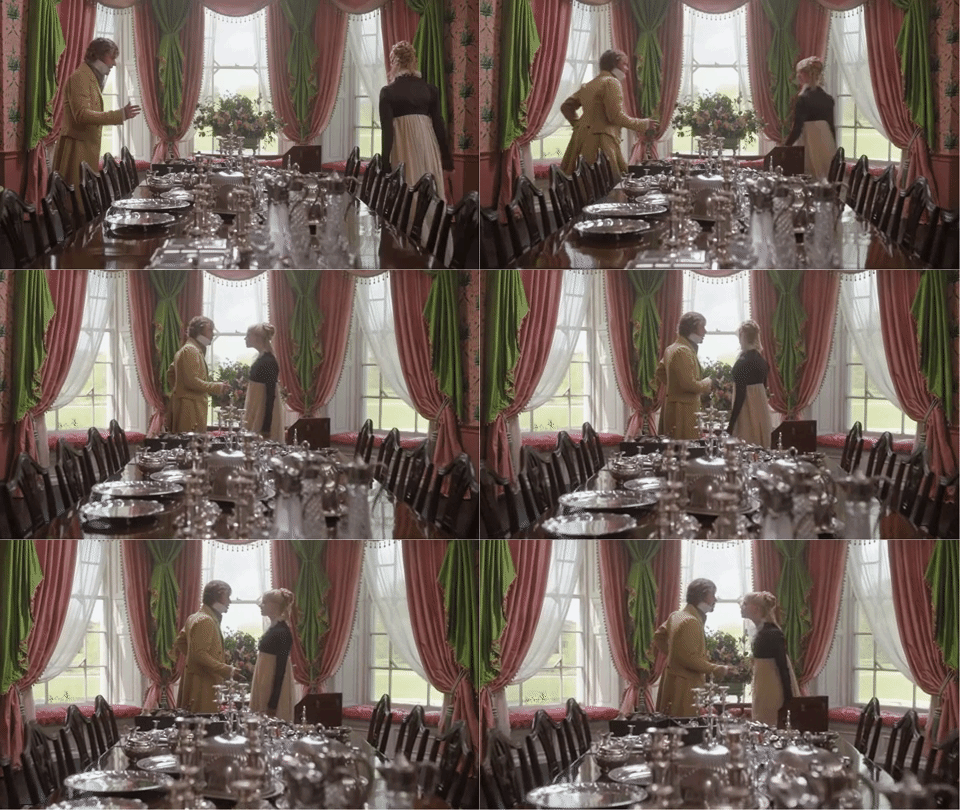
Emma opening the carriage window (from Emma 2020)

So how do you give an objectionable perspective to a protagonist?

1. Understand your character’s views and the reasons for their views and behaviors

In last week’s lesson, we discussed the importance of understanding your character’s views, even—and especially—when you disagree with them. This is also essential when a protagonist holds objectionable perspectives, and when these objectionable perspectives lead to negative behaviors.

After giving a little background on Emma’s character and situation, the narrator helps us understand the reasons for Emma’s perspectives:

The real evils, indeed, of Emma’s situation were the power of having rather too much her own way, and a disposition to think a little too well of herself; these were the disadvantages which threatened alloy to her many enjoyments. The danger, however, was at present so unperceived, that they did not by any means rank as misfortunes with her.

This does not necessarily absolve Emma of her approach, but it does help us understand her.

2. Craft an unreliable narrator

An unreliable narrator is one who cannot give us a full perspective—or chooses not to. When using a close third person point of view (as much of Emma does), or when writing in first person, readers are given the story through a character’s lens. No character can see the big picture—every character is limited by their experiences, their knowledge, and their interactions with other. If the character has an objectionable perspective, this can make them even more unreliable: everything they see or experience will be filtered through that perspective and their understanding of the world.

This happens constantly in the novel Emma. Emma has disliked (and been jealous of) Jane Fairfax since childhood. When Jane Fairfax returns to Highbury, Emma is forced to renew their acquaintance. In the following passage, we can see her making judgments on Jane—both positive and negative. We can also see her coming to conclusions about Jane being in love with Mr. Dixon, who happens to be the husband of Jane’s best friend. The evidence provided throughout the novel supports that conclusion—because it is filtered through Emma’s perspective. Yet Emma is completely wrong in this judgment, and this interpretation of events is used by Emma to cause harm to Jane later. Here’s a passage describing part of Emma and Jane’s first visit after Jane’s return:

In short, [Emma] sat, during the first visit, looking at Jane Fairfax with twofold complacency; the sense of pleasure and the sense of rendering justice, and was determining that she would dislike her no longer. When she took in her history, indeed, her situation, as well as her beauty; when she considered what all this elegance was destined to, what she was going to sink from, how she was going to live, it seemed impossible to feel any thing but compassion and respect; especially, if to every well-known particular entitling her to interest, were added the highly probable circumstance of an attachment to Mr. Dixon, which she had so naturally started to herself. In that case, nothing could be more pitiable or more honourable than the sacrifices she had resolved on. Emma was very willing now to acquit her of having seduced Mr. Dixon’s actions from his wife, or of any thing mischievous which her imagination had suggested at first. If it were love, it might be simple, single, successless love on her side alone. She might have been unconsciously sucking in the sad poison, while a sharer of his conversation with her friend….

An unreliable narrator is powerful because it invites us to embrace the perspectives—we cannot help doing it, at least to an extent—and yet we gradually realize, as we read, that the narrator is unreliable, which can lead us question the validity of their perspectives.

3. Incorporate a voice that disagrees

If a character has an objectionable perspective, there should always be another character that disagrees with them. Sometimes this disagreeing character takes on the perspective of the author; at other times, this disagreeing character provides other viewpoints which may not represent the author’s perspective, yet still oppose that of the main character.

No matter what time period, no matter what group of people, in real life there has always been someone who has disagreed with objectionable perspectives, even when those perspectives seem almost universal.

In the novel Emma, because Emma is in a place of power and privilege in her community, almost no one will voice any opposition to her. This includes people that could or should oppose some of her viewpoints or behaviors, people like Emma’s father, or her former governess, who did not voice disagreement or objection even when acting as a governess.

Yet despite Emma’s power, there is still a character willing to criticize Emma and point out the flaws in her perspective: Mr. Knightley.

After Emma convinces Harriet to turn down Mr. Martin’s proposal, Emma has a discussion with Mr. Knightley.

Mr. Knightley confides in Emma that Harriet may soon be receiving an offer of marriage, and Emma explains that the offer has already happened, and that Harriet declined via a letter.

Mr. Knightley is shocked:

“You saw her answer!—you wrote her answer too. Emma, this is your doing. You persuaded her to refuse him.”

“And if I did, (which, however, I am far from allowing) I should not feel that I had done wrong. Mr. Martin is a very respectable young man, but I cannot admit him to be Harriet’s equal; and am rather surprized indeed that he should have ventured to address her. By your account, he does seem to have had some scruples. It is a pity that they were ever got over.”

“Not Harriet’s equal!” exclaimed Mr. Knightley loudly and warmly; and with calmer asperity, added, a few moments afterwards, “No, he is not her equal indeed, for he is as much her superior in sense as in situation. Emma, your infatuation about that girl blinds you.”

Mr. Knightley then continues with another 298 words of criticism. Emma presents counterarguments and Mr. Knightley returns in kind.

Emma is not convinced by Mr. Knightley’s arguments—she does not really listen to them, and it does not change her perspective or behavior. Yet despite that, it is a key part of Mr. Knightley’s character to oppose her, and it is essential for Emma to know that her perspective is not universally shared and that others may see it as flawed.

Having an alternative perspective invites the reader to see the flaws in the objectionable perspective. It also sets up the main character for either growth or tragedy.

Emma and Mr. Knightley arguing in Emma 2020

Emma and Mr. Knightley arguing in the 2020 film Emma.

4. Create an opportunity for growth or tragedy

Giving a character an objectionable perspective for growth or change—if the character realizes the problems with their perspective, they have the possibility for a powerful character arc as they transform and become someone better.

If they choose not to transform, then it opens the door for tragedy, in which the readers and the character experience the consequences of not changing.

Throughout the novel, Emma hurts many characters including Mr. Martin, Mr. Elton, Jane Fairfax, Harriet Smith, and Miss Bates. It is when she insults and hurts Mrs. Bates at Box Hill that she begins to feel guilt for her behavior (and Mr. Knightley criticizes Emma’s behavior, not allowing her to brush it off).

The next chapter begins:

The wretchedness of a scheme to Box Hill was in Emma’s thoughts all the evening. How it might be considered by the rest of the party, she could not tell. They, in their different homes, and their different ways, might be looking back on it with pleasure; but in her view it was a morning more completely misspent, more totally bare of rational satisfaction at the time, and more to be abhorred in recollection, than any she had ever passed.

At this point, Emma could continue to act as she has—assuming her perspective is superior and justifying her actions. Yet instead, she goes to visit Miss Bates, and for once she is truly interested in Miss Bates’ conversation and appreciative of Miss Bates’ virtues.

There is still regression for Emma—still opportunities when her harmful perspectives come into play and she risks a tragic ending—but ultimately she begins to transform and heal some of the damage she has done.

Endowing Emma with objectionable perspectives gave her great opportunities throughout the novel. By the end, she’s still a bit classist, still overconfident at times, but some of her core problematic perspectives have shifted.

Note: There are characters who do not grow, and yet do not suffer tragedy, such as Jane Austen’s title character in Lady Susan.

Conclusion

Giving a protagonist an objectionable perspective can be a powerful tool, and you can give them this perspective without condoning it.

In the next lesson I’ll discuss how characters justify their behavior, especially when it’s negative behavior.

Writing Exercises - Jane Austen Writing Lessons

Exercise 1: Write a scene from the perspective of an unreliable narrator, where their viewpoint taints or colors their interpretation of the world around them. Give one or two clues to the reader that this perspective may be unreliable.

Exercise 2: Make a list of characters or protagonists you like (from any storytelling medium) and their viewpoints or perspectives that you disagree with. Consider why you like these characters despite disagreeing with them.

Don’t Miss a Lesson: Subscribe to Updates and Giveaways from katherinecowley.com

* indicates required


Which newsletter(s) would you like to receive?

How to Write Perspectives You Don’t Agree With in Fiction (And How to Write Objectionable Perspectives)

#45: How to Write Perspectives You Don’t Agree With in Fiction (And How to Write Objectionable Perspectives)

How to Write Perspectives You Don’t Agree With in Fiction (And How to Write Objectionable Perspectives)

One of the powers of writing fiction is that you are able to write characters who are not like you—they can have different backgrounds, different skills, different desires, different circumstances.

But sometimes, for the purposes of plot or character or theme, you need to write fictional perspectives that you don’t agree with.

Sometimes these might be perspectives that take a different philosophy on life—in Sense and Sensibility, Mrs. Jennings attempts to pry into Elinor’s life to discover who Elinor favors, despite the subject making Elinor uncomfortable:

When Mrs. Jennings attacked [Elinor’s sister Margaret] one evening at the park, to give the name of the young man who was Elinor’s particular favourite, which had been long a matter of great curiosity to her, Margaret answered by looking at her sister, and saying, “I must not tell, may I, Elinor?”

This of course made every body laugh; and Elinor tried to laugh too. But the effort was painful. She was convinced that Margaret had fixed on a person whose name she could not bear with composure to become a standing joke with Mrs. Jennings.

Mrs. Jennings pushes and pushes until she discovers from Margaret that the name begins with F, and it makes Elinor extremely uncomfortable.

Yet there are also perspectives that Austen represents in her novels that are much more objectionable. As you write your own stories, you may need to write a character who you not only disagree with, but whose views (and resulting actions) you find reprehensible.

How do you write perspectives you don’t agree with in fiction? And how do you write objectionable perspectives?

Understand your character’s views and the reasons for their views and behaviors

Understand your character’s views and the reasons for their views and behaviors

In order to write a character, you must understand them. In Sense and Sensibility, Lucy Steele manipulates the protagonist, Elinor, by sharing secrets and extracting promises from her. Lucy causes Elinor much pain.

Yet she is an effective character, because Austen understand her views:

Lucy Steele is a woman grasping for a respectable place in life. The man she loved and made promises to when younger seems to be in love with someone else. If we were in her place, wouldn’t many of us want to try to do something?

When characters have objectionable perspectives on life, they often have reasons for it, things in their past and their present that have influences their views and behavior.

Their motives for these views and their behavior might be inwardly focused, like selfishness, a desire for power, or a disregard for societal mores. Their motives might be outwardly focused, such as spite, revenge, or jealousy. Their motives for these objectionable perspectives might more positive—they might think they are benefiting others by their behavior. And sometimes a character might have an objectionable viewpoint because they believe the ends justify the means or they lack the understanding and knowledge to see the negative implications of their negative viewpoints.

At the beginning of the year I wrote a post about giving antagonists redemptive qualities. In that post I discussed John Willoughby as a character in Sense and Sensibility. He makes choices that cause active harm to the protagonists, yet his motives are clear, and while some of his motives and perspectives are harmful, others are positive. In a poignant and powerful passages that is often cut from film adaptations, John Willoughby is given an entire scene in which to express his viewpoints, his regrets, and his justifications. He knows the harm he has caused, yet refuses to give up some of his objectionable perspectives. But because we see his story, we feel for him, and Elinor feels for him.

Don’t Make an Objectionable Perspective Universal

When you write a character with an objectionable perspective, don’t make that perspective universal, especially within groups or categories to which a character belongs.

As I discussed in the previous post, groups of characters should not be written as monoliths—within any group there is a range of perspectives and opinions. While a character may have a particular objectionable perspective, not everyone within their societal class, religion, race, nationality, or any other sort of group will have that perspective. It can be harmful to people within those groups if you represent an objectionable perspective as universal.

For example, some of the most objectionable perspectives on life in Sense and Sensibility are held by Fanny Dashwood and her mother, Mrs. Ferrars. Fanny is selfish and more than willing to deprive Mrs. Dashwood and her daughters of any support. Mrs. Ferrars is very classist, as she is also controlling, vindictive, and cruel. Yet one of their other family members, Edward Ferrars, is shown in a completely different light. While his choices sometimes cause Elinor pain, he does not want to cause her pain and he spends the story trying to be good and honorable to everyone.

(Note: sometimes in Austen novels, you have only one character from a group, for example, Mr. Collins is the only clergyman character in Pride and Prejudice. Yet his views are not universalized as representative of all clergymen.)

Assign the Objectionable Perspective to an Antagonist

Assign the Objectionable Perspective to an Antagonist

When representing an objectionable perspective, the goal as a writer is likely not to condone that viewpoint. This is the reason why, in many novels, the truly objectionable perspectives are given to antagonists.

Because an antagonist interferes with the main character, it is often made clear that their behavior and the viewpoints that lead to this behavior are not advocated by the narrator or the writer.

Let’s consider, once again, the selfish perspective of Fanny Dashwood:

Mrs. John Dashwood did not at all approve of what her husband intended to do for his sisters. To take three thousand pounds from the fortune of their dear little boy would be impoverishing him to the most dreadful degree. She begged him to think again on the subject. How could he answer it to himself to rob his child, and his only child too, of so large a sum? And what possible claim could the Miss Dashwoods, who were related to him only by half blood, which she considered as no relationship at all, have on his generosity to so large an amount. It was very well known that no affection was ever supposed to exist between the children of any man by different marriages; and why was he to ruin himself, and their poor little Harry, by giving away all his money to his half sisters?

Through use of free indirect speech and a summary of Fanny’s arguments, we are given Fanny’s perspective, and it is an objectionable one.

Yet Austen’s narrator does not moralize or directly condemn. Austen does not take a heavy, didactic approach, which would lessen the beauty and effectiveness of her novels. Rather, she allows Fanny to show her perspective, and throughout the novel she explores the impact of this perspectives on the main characters as they are, in essence, cast out of their home.

Next Lesson: How to Give an Objectionable Perspective to a Protagonist

Next Lesson: How to Give an Objectionable Perspective to a Protagonist

While it’s easier to write an objectionable perspective in an antagonist, it can be extremely effective to write an objectionable perspective in a protagonist. That will be the subject of the next lesson.

Writing Exercises - Jane Austen Writing Lessons

Exercise 1: Think of a modern perspective that you find objectionable. This could be something political, something social, or something you’ve read about in the news. Read several blog posts or articles from people who have this perspective. Then write a scene in which a character holds this perspective. Try to write them in a way that is fair to their motives and the reasons for their behavior.

Exercise 2: Who is your favorite villain or antagonist? Write a paragraph about the objectionable viewpoint or viewpoints that they hold, and how these are represented in the text.

Exercise 3: Analyze a draft that you have written. Do you have any characters with objectionable perspective? What is working well about the representation of this character and this perspective? How could this representation be improved? If you don’t have any objectionable perspectives, would it be useful to add one?

Don’t Miss a Lesson: Subscribe to Updates and Giveaways from katherinecowley.com

* indicates required


Which newsletter(s) would you like to receive?

Jane Austen Writing Lessons. #44: Avoid Writing Groups of Characters as Monoliths

#44: Avoid Writing Groups of Characters as Monoliths

In real life and in fiction, people are part of groups.

Some groups are chosen—for example, in Pride and Prejudice, people have chosen friendship groups, such as Mr. Darcy’s friendship with Mr. Bingley and Colonel Fitzwilliam, or Elizabeth Bennet’s friendship with Jane Bennet and Charlotte Lucas. Other people choose to join a group such an occupation—for example, Mr. Collins becoming a clergyman.

Other groups are formed more naturally or organically, like five Bennet sisters, who did not choose to be sisters, and yet, because of their birth into the same family, share many commonalities.

Many groups are constructs by society or other people. For example, the gentry is a societal construct that impacts many of Jane Austen’s characters.

There are many other types of groups, defined by religion, race, physical characteristics, nationality, personal interests…the possibilities are endless.

In order for people to be part of a group they must share things in common, and often they share many things in common. While these commonalities are essential, the risk in writing groups of people is representing them as monoliths.

Don't write your groups of characters as monoliths. (From Jane Austen Writing Lessons.)

(Image of the Utah monolith by Patrick A. Mackie, CC license)

A monolith is a large stone, often made a single material.

When you write a group of people as a monolith, you treat them as uniform and homogenous. They have the same perspectives, the same attributes, the same belief systems.

Yet this is not an accurate representation. The five Bennet sisters are each very different. Not every clergyman in Austen’s novels is like Mr. Collins. The gentry in Pride and Prejudice have very different lifestyles and resources: Sir William Lucas is titled, but comes from an occupational background; Mr. Bennet owns land but cannot pass anything to his daughters; Georgiana Darcy is set to inherit a large fortune; Anne de Bourgh also will inherit, but struggles with health problems.

Not everyone with the same religion, race, class, or nationality is of one mind on any issue.

If you write a group of people as a monolith, it is easy to fall into stereotypes, and some of these stereotypes can be damaging and harmful. If you are writing a group that you are not part of or are not familiar with, you increase your risk of writing a group as a monolith or using harmful stereotypes. When you’re not part of a group, you must take the effort to become fluent in the range of people and perspectives within a group.

Writing a group as a monolith also misses out on so many fictional possibilities.

The goal is to give individuals within a group a range of perspectives and attributes.

When you do so, it:

  • Allows for greater tension
  • Produces genuine obstacles
  • Fosters more possibilities for character growth, and
  • Creates higher stakes and risks in relationships.

Let’s look at how Jane Austen introduces a single group of people in Pride and Prejudice: Mr. Bingley’s party at the Netherfield Assembly.

Mr. Bingley

Mr. Bingley was good-looking and gentlemanlike; he had a pleasant countenance, and easy, unaffected manners.

Mr. Bingley’s sisters (Miss Caroline Bingley and Mrs. Louisa Hurst)

His sisters were fine women, with an air of decided fashion.

Mr. Hurst

His brother-in-law, Mr. Hurst, merely looked the gentleman;

Mr. Darcy

but his friend Mr. Darcy soon drew the attention of the room by his fine, tall person, handsome features, noble mien, and the report which was in general circulation within five minutes after his entrance, of his having ten thousand a year….he was looked at with great admiration for about half the evening, till his manners gave a disgust which turned the tide of his popularity; for he was discovered to be proud, to be above his company, and above being pleased; and not all his large estate in Derbyshire could then save him from having a most forbidding, disagreeable countenance, and being unworthy to be compared with his friend.

What unifies this group is clear: they are all with Mr. Bingley, and they each have a level of fortune and prestige. Yet even at this initial introduction of these characters, all of the other characters are doing their best to figure out the group’s distinguishing features.

Jane Austen’s narrator makes contrasts between members of the Bingley party time and time again. Many of these contrasts are about the differences between Mr. Bingley and Mr. Darcy, but key contrasts are made between other combinations of characters, such as Mr. Darcy and Mr. Hurst:

Mr. Darcy said very little, and Mr. Hurst nothing at all. The former was divided between admiration of the brilliancy which exercise had given to her complexion, and doubt as to the occasion’s justifying her coming so far alone. The latter was thinking only of his breakfast.

Creating contrasts between characters who are very similar

The two characters in the group who are the most similar are Mrs. Hurst and Miss Bingley. In some cases, such as the 2005 film adaptation of Pride and Prejudice, their characters are even combined into one character, because of their similarities.

Yes, one is married and one is single, but they are both prideful, judgmental, conniving, kind to Jane, and unkind to Elizabeth.

But even in their similar attributes, Jane Austen gives them marked differences:

  • Caroline Bingley’s attention is constantly on Mr. Darcy. Her every word is calculated to endear herself to him.
  • Louisa Hurst pays Darcy attention, but is just as likely to pay attention to others, watch cardplaying, or play with her bracelets.
  • It is always Miss Bingley who begins the criticism of Elizabeth or her family. It is a topic that she takes great personal interest in, largely because she wants to distinguish between herself and Elizabeth and feel superior to her.
  • Louisa Hurst is more of a follower. She likes to be part of the conversation, so once Miss Bingley has begun a critique, then she joins in and they feed off of each other. Yet she seems that she is involved more for the sport of it and for the approval of her sister.

Here’s a brief excerpt from the novel where we see this distinction:

When dinner was over, [Elizabeth] returned directly to Jane, and Miss Bingley began abusing her as soon as she was out of the room. Her manners were pronounced to be very bad indeed, a mixture of pride and impertinence; she had no conversation, no style, no taste, no beauty. Mrs. Hurst thought the same, and added,

“She has nothing, in short, to recommend her, but being an excellent walker. I shall never forget her appearance this morning. She really looked almost wild.”

“She did, indeed, Louisa. I could hardly keep my countenance. Very nonsensical to come at all! Why must she be scampering about the country, because her sister had a cold? Her hair so untidy, so blowsy!”

When Jane Austen writes groups of characters, they are never monoliths. Each group contains a range of perspectives and attributes, which is part of what makes her character groupings interesting and memorable.
Writing Exercises - Jane Austen Writing Lessons

Exercise 1: Write a few paragraphs about your own membership in a group:

What is a group that you are a part of? What attributes unify the members of the groups? What makes group members different? Even in attributes that group members share, what differences are there?

Exercise 2: Take a book or a movie that you have read or watched recently and make a list of all the different groups of people in the story. Do the groups change over time? How do the groups interact? Are there people who are not fully part of the groups, or who are trying to enter or interact with a particular group?

Exercise 3: Write a scene with two characters who are very similar (like Louisa Hurst and Caroline Bingley). Make sure to give them several key distinctions which differentiate them throughout the scene and create a more real dynamic.

Don’t Miss a Lesson: Subscribe to Updates and Giveaways from katherinecowley.com

* indicates required


Which newsletter(s) would you like to receive?

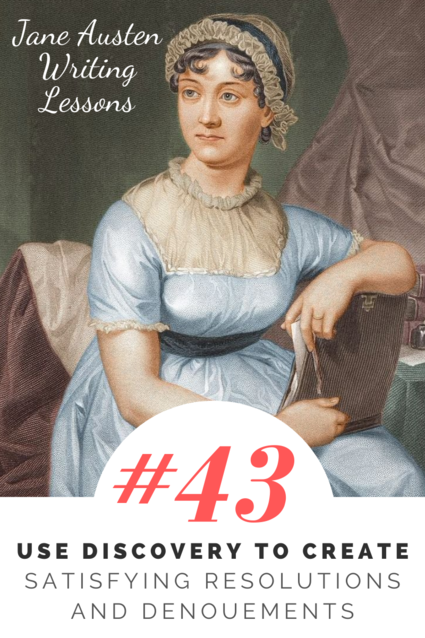
Jane Austen Writing Lessons. #43: Use Discovery to Create Satisfying Resolutions and Denouements

#43: Use Discovery to Create Satisfying Resolutions and Denouements

Jane Austen Writing Lessons. #43: Use Discovery to Create Satisfying Resolutions and Denouements

If an airplane pilot crashes the plane while landing, it doesn’t matter how good the rest of the ride was. The same goes for novels—if you don’t land the ending, the book will not be satisfying.

Jane Austen is a novelist who always “lands the ending.” One of the main ways she does this is by incorporating discoveries into the resolution of the story: in particular, she uses discoveries to answer the big questions that have been raised throughout the story.

In lesson 40, we talked about some of the big questions raised in the novel Persuasion, including:

  • What will Anne’s future look like?
  • Can Anne and Wentworth reconcile?

Most of the other big questions in the book have been explored and answered by the time we hit the last two chapters of the novel, but not these two questions. Characters and readers have yet to discover the resolution.

The second to last chapter of Persuasion acts as the final “unravelling,” the final section of the climax sequence where the most important questions must be answer, the most important discoveries made. In this chapter, Anne and Captain Harville discuss love and the inconstancies of men and women—who suffers the most from loss of love? Whose feelings are the most tender, the most constant? Captain Wentworth overhears their conversation, and as a result of Anne’s words, writes her a letter which begins:

I can listen no longer in silence. I must speak to you by such means as are within my reach. You pierce my soul. I am half agony, half hope. Tell me not that I am too late, that such precious feelings are gone for ever. I offer myself to you again with a heart even more your own, than when you almost broke it eight years and a half ago. Dare not say that man forgets sooner than a woman, that his love has an earlier death. I have loved none but you.
Upon reading the letter, Anne cannot sit still—she goes out into Bath, and when she sees Captain Wentworth, she joins him on a walk. And here, here we discover the answers we’ve been seeking. Anne and Captain Wentworth do reconcile, they express their love to each other, and they become engaged.

In a novel, when questions are raised for the characters, readers want answers by the end of the story. Some of these discoveries occur, and should occur, throughout the book, but some should be saved for the end.

Answering a key question or key questions near the end of the novel provides a satisfying resolution for both the characters and the reader.

In Persuasion the key discoveries are made in the second to last chapter. But there are still more discoveries saved for the denouement.

Discoveries in the Denouement

The denouement serves to show what happens as a result of the final resolution. It is a chance for characters to make any final smaller discoveries, to show any relationship changes, and to wrap up any lingering subplots which have not been resolved.

In the novel Persuasion, the final chapter serves as the denouement. It begins with the following paragraph, which reassures us that the key questions will truly be resolved in the way in which we as readers hope:

Who can be in doubt of what followed? When any two young people take it into their heads to marry, they are pretty sure by perseverance to carry their point, be they ever so poor, or ever so imprudent, or ever so little likely to be necessary to each other’s ultimate comfort. This may be bad morality to conclude with, but I believe it to be truth; and if such parties succeed, how should a Captain Wentworth and an Anne Elliot, with the advantage of maturity of mind, consciousness of right, and one independent fortune between them, fail of bearing down every opposition?

There are a number of other minor discoveries in the final chapter as part of the denouement:

  • We discover Sir Walter’s view on his daughter’s engagement. He approves (he decides that Captain Wentworth has a nice balance of physical attractiveness and fortune, which are two of the only things that matter to him).
  • We discover that Anne’s sister Mary is happy for her, and (mostly) not jealous.
  • We discover how Anne’s other suitor, Mr. Elliot reacts:

The news of his cousin Anne’s engagement burst on Mr. Elliot most unexpectedly. It deranged his best plan of domestic happiness, his best hope of keeping Sir Walter single by the watchfulness which a son-in-law’s rights would have given.

  • We discover that Mrs. Clay has become Mr. Elliot’s mistress (and thus, Anne’s father Sir Walter is safe from Mrs. Clay’s scheming).
  • We discover that Lady Russell and Captain Wentworth are able to reconcile with each other. This is an important discover, as Lady Russell was the person who convinced Anne to break off her original engagement to Wentworth eight years before.
  • We discover the resolution to the subplot of Anne’s friend Mrs. Smith being in poverty: Captain Wentworth is able to use his connections to secure Mrs. Smith’s fortunes, her health improves, and she maintains a good friendship with Anne.

Austen, of course, never leaves her endings completely tidy—there’s never a sense of complete assured happiness. In the final paragraph, we read:

Anne was tenderness itself, and she had the full worth of it in Captain Wentworth’s affection. His profession was all that could ever make her friends wish that tenderness less; the dread of a future war all that could dim her sunshine. She gloried in being a sailor’s wife, but she must pay the tax of quick alarm…

Austen makes no pretense that Anne and Wentworth’s lives will be perfect. But it is a wonderful resolution because it answers the core, larger questions of the book. It’s a wonderful resolution because this discovery is made in a beautiful way. And it’s a wonderful resolution because the denouement is able to provide the reader with discoveries for lingering questions and subplots.

A Recap

We’ve spent the past seven lessons talking about discovery. To recap, we covered:

Discovery is a powerful tool that can be used in any sort of fiction to drive the character forward and invoke the reader’s interest. Ultimately, the process of discovery assists the character on their external journey, as they interact with the world and find their place in it. Discovery is also fundamental to a character’s internal journey: it gives them reason to change, and sometimes the greatest discoveries come from reflection about themselves, as characters recognize who they really are.

Writing Exercises - Jane Austen Writing Lessons

Exercise 1: Write a new denouement

Take a short story or a novel that you have written and write a new denouement. Keep the main resolution the same, but write a different denouement, which resolves subplots, relationships, and other small discoveries in a new way.

Exercise 2: Write just the ending of a story

The author Victoria Schwab (also published as V.E. Schwab) writes her climax and denouement first, before writing anything else. In episode 15.42 of Writing Excuses she explained, “I don’t do anything until I’ve planned the ending. The ending…and that climax through the last page determines the entire story I’m telling….Rather than write toward the end, and think ‘What kind of resolution do I need in order to fulfill the promises I’ve made early on?’, I write backwards, from the end, and make those promises from the ending that I know I want to achieve.”

Take a story idea that you haven’t used and write the ending. To reemphasize—you are just writing the ending of the story, not the beginning or the middle. Consider what sorts of discoveries would you like your characters to make at the end of the story, and what emotions you would like to evoke in your reader. Also, ask yourself the same question that Victoria Schwab asks herself: “Who are my characters the moment we leave them?”

Once you’ve written the ending, consider what storytelling it will take to reach this ending, and how to get your characters to this point.

Exercise 3: Best and Worst Endings

Think of two stories, one which had a satisfying and rewarding ending, and another which had an ending that didn’t quite work for you. Now go back and analyze the endings—what specifically made the endings effective and ineffective for you as a reader?

Don’t Miss a Lesson: Subscribe to Updates and Giveaways from katherinecowley.com

* indicates required


Which newsletter(s) would you like to receive?