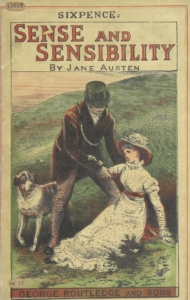
In Sense and Sensibility, Mr. Dashwood’s death changes everything for Mrs. Dashwood and her daughters, Elinor, Marianne, and Margaret. Yet for a time, they stay in stasis, continuing to live on the estate that has been their home. Yet it is no longer really their home: Mrs. Dashwood’s stepson, Mr. John Dashwood, and his wife, Fanny Dashwood, are the new owners. Fanny in particular makes the elder Mrs. Dashwood and her daughters unwelcome, especially once she notices that her brother, Edward Ferrars, is interested in Elinor. She rudely confronts Mrs. Dashwood on the subject, and Mrs. Dashwood decides that they will withdraw from the estate:
To quit the neighborhood of Norland was no longer an evil; it was an object of desire; it was a blessing, in comparison of the misery of continuing her daughter-in-law’s guest: and to remove for ever from that beloved place would be less painful than to inhabit or visit it while such a woman was its mistress.
As they leave, Marianne wails a lament:
“Dear, dear Norland! when shall I cease to regret you!—when learn to feel a home elsewhere!—Oh! happy house, could you know what I suffer in now viewing you from this spot, from whence perhaps I may view you no more!….you will remain the same; unconscious of the pleasure or the regret you occasion, and insensible of any change in those who walk under your shade!—But who will remain to enjoy you?”
This forced eviction takes the Dashwoods on a physical journey—to a new county, where they live in a cottage and meet a whole set of new people. In addition to a physical journey, it’s also a journey to try to find home and to see if they can survive losing almost everything that they find dear. This journey starts both Marianne and Elinor on internal journeys; Marianne is full of sensibility and unrestrained emotion, but must learn how to let more than her emotions govern her; Elinor has a bit too much sense, and keeps too much inside her, not allowing herself to want and hope for the things she really desires.
While some inciting incidents lead to physical journeys, like in Sense and Sensibility, a physical journey is not required. For instance, in Emma the inciting incident is the marriage of Emma’s governess. Emma’s internal and external journeys are captivating, but they do not require her to leave her home (the furthest she goes is Box Hill, which is only seven miles away).
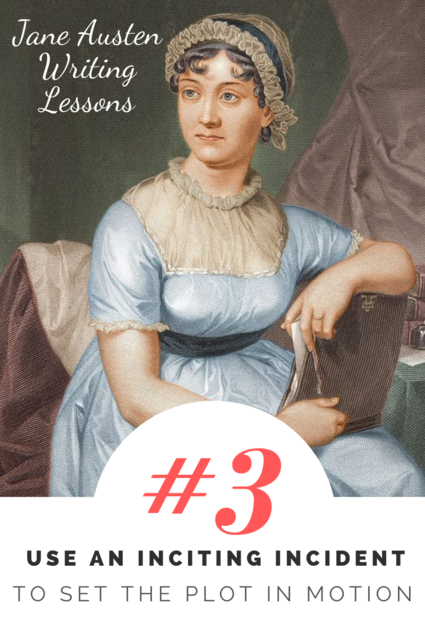
Change is at the heart of interesting plots, and the possibility for change is why we root for characters. A good inciting incident sets the plot in motion and paves the way for the rest of the story.


 https://www.katherinecowley.com/wp-content/uploads/2025/12/Jane-Austens-250th.png
576
1024
Katherine Cowley
http://www.katherinecowley.com/wp-content/uploads/2024/12/Katherine-Cowley-1.png
Katherine Cowley2025-12-16 11:25:312025-12-17 11:27:05Jane Austen’s 250th Birthday and How Austen Wrote Birthday and Holiday Greetings
https://www.katherinecowley.com/wp-content/uploads/2025/12/Jane-Austens-250th.png
576
1024
Katherine Cowley
http://www.katherinecowley.com/wp-content/uploads/2024/12/Katherine-Cowley-1.png
Katherine Cowley2025-12-16 11:25:312025-12-17 11:27:05Jane Austen’s 250th Birthday and How Austen Wrote Birthday and Holiday Greetings